Introduction
Fintech, crypto, and banking companies are running out of runway on compliance. FinCEN levied a $3.4 billion penalty against Binance in 2023, TD Bank faced enforcement action in late 2024, and DORA became applicable across EU financial entities in January 2025.
The market responding to that pressure is substantial: the global enterprise GRC market was valued at $72.42 billion in 2025 and is projected to reach $203.65 billion by 2033, growing at 13.7% annually.
Vanta has built a strong reputation automating SOC 2, ISO 27001, and HIPAA compliance for SaaS companies. But for fintech, crypto, and banking firms navigating BSA/AML obligations, FCA requirements, FinCEN reporting, or DORA, compliance software alone isn't enough.
Below: 10 Vanta alternatives evaluated on what each does well, where each falls short, and the criteria that matter most when your regulatory environment goes beyond a standard security certification.
Key Takeaways
- Vanta suits US-based SaaS companies but has limited depth for financial services-specific regulations
- Top alternatives include Drata, Secureframe, Sprinto, AuditBoard, Hyperproof, and six others covered below
- Key selection criteria: framework coverage, pricing flexibility, automation depth, and geography
- Compliance software handles workflows and documentation — it cannot replace a BSA Officer, MLRO, or CCO
- Match your tool to your regulatory profile, not your budget or brand preference
What Is Vanta & Why Are Companies Looking for Alternatives?
Vanta automates compliance workflows for frameworks like SOC 2, ISO 27001, HIPAA, GDPR, and PCI DSS — claiming to handle up to 90% of evidence collection and monitoring automatically. It was built primarily for US-based SaaS companies seeking security certifications to satisfy enterprise customers and investors.
Vanta's Pricing Reality
Vanta does not publish pricing. According to Vendr's 2026 data, expect:
- $20,000–$40,000/year for a single framework (50–200 employees)
- $35,000–$70,000/year for 2–3 frameworks
- $5,000–$15,000/year for the vendor risk management add-on
- Typical contract terms of 1–3 years
For early-stage companies, that's a steep commitment before the product has been fully validated against your specific regulatory environment.
Why Companies Look Elsewhere
Most companies cite the same three frustrations:
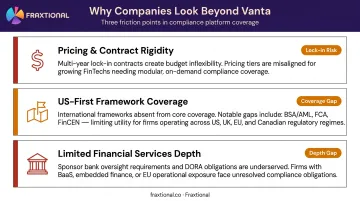
- Pricing and contract rigidity — multi-year lock-ins and steep per-framework costs are startup-unfriendly
- US-first framework coverage — Vanta's official framework library covers SOC 2, ISO 27001, HIPAA, GDPR, PCI DSS, FedRAMP, CMMC, NIST CSF, TISAX, and HDS, but does not list native BSA/AML, FCA, or FinCEN-specific workflows
- Limited financial services depth — for companies with sponsor bank relationships, FinCEN registration requirements, or DORA obligations, Vanta's tooling addresses the evidence layer but not the regulatory accountability layer
These gaps point to a broader distinction every financial services company should understand: compliance software manages documentation, monitoring, and workflow automation. Regulatory interpretation, examiner management, SAR escalation, and sponsor bank relationships require qualified human leadership — a BSA Officer, MLRO, or CCO. That's the gap no software vendor on this list fills.
Top 10 Vanta Competitors & Alternatives in 2026
Each alternative below was evaluated on:
- Compliance framework coverage and depth
- Automation capability and evidence collection
- Pricing flexibility and transparency
- Suitability for financial services and regulated industries
- User reviews from G2 and Capterra
1. Drata
Drata is one of Vanta's most direct competitors. It's an automated trust management platform built for continuous security monitoring and evidence collection across 30+ pre-built frameworks, serving companies from startup through enterprise with a strong integration ecosystem.
Standout features:
- Continuous real-time control monitoring (not just scheduled checks)
- Built-in Trust Center for sharing compliance posture with customers
- AI-powered questionnaire assistance
- Live in-app support model
Limitations: Some auditors report that Drata-generated reports require additional formatting before submission. Pricing is not publicly listed, and users cite cost as a barrier.
| Attribute | Details |
|---|---|
| Best For | Startups to enterprise needing SOC 2, ISO 27001, or multi-framework automation |
| Key Frameworks | SOC 2, ISO 27001, HIPAA, GDPR, PCI DSS, DORA, FedRAMP, and more |
| G2 Rating | 4.7/5 (1,178 reviews) |
| Pricing | Not publicly listed; Vendr reports $18,000–$38,000/year (single framework) |
2. Secureframe
Secureframe positions itself around speed-to-compliance, with pre-built templates and automated evidence collection from cloud tools, HR systems, and security providers.
Standout features:
- Clear step-by-step compliance checklists
- Strong integrations with cloud providers
- Focused onboarding experience for first-time certifications
Limitations: Users report platform bugs, slow customer support responses, and limited flexibility in questionnaire formatting. Pricing is higher than Vanta according to some user reviews.
| Attribute | Details |
|---|---|
| Best For | Startups and mid-sized companies needing fast SOC 2 or ISO 27001 certification |
| Key Frameworks | SOC 2, ISO 27001, HIPAA, PCI DSS, GDPR, CCPA, FedRAMP, NIST, CMMC |
| G2 Rating | 4.7/5 (797 reviews) |
| Pricing | Not publicly listed; reported higher than Vanta |
3. Sprinto
Sprinto targets cloud-native SaaS companies and tech startups with pre-approved compliance programs designed for non-technical leaders. It covers 200+ frameworks and emphasizes fast time-to-compliance.
Standout features:
- Plug-and-play integration approach with Jira, Slack, and cloud providers
- Strong customer support reviews
- Average implementation time around 2 months, with ROI reported at 8 months
Limitations: Users flag software stability issues, unresponsive control forms, and limited report customization. Pricing practices have drawn criticism in some reviews.
| Attribute | Details |
|---|---|
| Best For | SaaS startups needing quick SOC 2 or ISO 27001 certification |
| Key Frameworks | SOC 2, ISO 27001, GDPR, HIPAA, and 200+ others |
| G2 Rating | 4.8/5 (1,638 reviews) |
| Pricing | Not publicly listed; some users describe pricing as aggressive |
4. AuditBoard (now Optro)
AuditBoard — now rebranded as Optro — is a full-suite enterprise GRC platform used by over 50% of Fortune 500 companies, per Optro's own reporting. It covers audit management, risk assessment, compliance tracking, ESG reporting, and third-party risk — making it a full GRC suite rather than a security certification tool.
Standout features:
- End-to-end audit management workflows
- ESG program management integration
- Real-time risk dashboards
- Strong track record with large regulated enterprises
Limitations: Steep learning curve, no automated security certification pathway comparable to Vanta, and high pricing that typically excludes smaller firms.
| Attribute | Details |
|---|---|
| Best For | Large enterprises in regulated industries needing full GRC capabilities |
| Key Frameworks | SOC 2, ISO 27001, NIST, HIPAA, PCI DSS, and custom frameworks |
| G2 Rating | Not publicly listed |
| Pricing | Not publicly listed; positioned as a premium enterprise solution |
5. Hyperproof
Hyperproof is built for sustained compliance operations — not just initial certification. It suits companies managing complex multi-framework programs with large, cross-functional security teams.
Standout features:
- Strong cross-functional collaboration tools
- Customizable risk scoring
- Centralized evidence management
- FedRAMP Moderate authorized environment (Hyperproof Gov)
Limitations: Users flag limited custom reporting options, complex setup processes, and pricing available only on request.
| Attribute | Details |
|---|---|
| Best For | Enterprises managing multiple frameworks with large compliance teams |
| Key Frameworks | SOC 2, ISO 27001, HIPAA, GDPR, NIST, PCI DSS, and custom frameworks |
| G2 Rating | Not publicly listed |
| Pricing | Not publicly listed; available upon request |
6. Scrut Automation
Scrut takes a risk-first approach to compliance, with continuous 24/7 cloud security posture monitoring across AWS, Azure, and Google Cloud environments and 60+ out-of-the-box frameworks.
Standout features:
- 75+ integrations with cloud, security, and HRIS tools
- Continuous monitoring (not scheduled like some competitors)
- Pre-built policy templates
- Strong customer success team
Limitations: A newer platform with some features still in development; users report occasional slow-load and performance issues.
| Attribute | Details |
|---|---|
| Best For | Cloud-native companies in regulated industries needing continuous risk visibility |
| Key Frameworks | SOC 2, ISO 27001, HIPAA, GDPR, PCI DSS, SOC 1 |
| G2 Rating | Not publicly listed |
| Pricing | Not publicly listed; available upon request |
7. Thoropass
Thoropass (formerly Laika) combines automation with direct access to in-house compliance experts. It's particularly well-suited to companies tackling their first major certification, where guided expert support matters as much as the tooling itself.
Standout features:
- Dedicated compliance expert access throughout certification
- Hands-on audit support for SOC 2, ISO 27001, HIPAA, GDPR, and PCI DSS
- Centralized compliance status dashboards
- 4.7/5 average across 200+ G2 reviews
Limitations: Fewer supported frameworks than some competitors, and some users report unintuitive navigation.
| Attribute | Details |
|---|---|
| Best For | Companies new to compliance needing both automation and expert guidance |
| Key Frameworks | SOC 2, ISO 27001, HIPAA, GDPR, PCI DSS |
| G2 Rating | 4.7/5 (200+ reviews) |
| Pricing | Not publicly listed; available upon request |
8. OneTrust
OneTrust covers privacy, security, data governance, and AI governance across an extensive global regulatory library. It's most relevant for organizations managing complex cross-border data privacy obligations.
Standout features:
- Extensive global framework library including GDPR, CCPA, DORA, ISO 27001, SOC 2, NIST, and APRA CPS 230
- Pre-built questionnaire automation
- Strong EMEA market presence
- Pricing packages available on their website (more transparent than most)
Limitations: Reviews consistently flag poor customer service, a complex interface, and costs that are prohibitive for SMEs.
| Attribute | Details |
|---|---|
| Best For | Enterprises with complex cross-border data privacy and regulatory obligations |
| Key Frameworks | GDPR, CCPA, ISO 27001, DORA, SOC 2, NIST, and many global privacy frameworks |
| G2 Rating | Not publicly listed |
| Pricing | Flexible packages available via website |
9. Scytale
Scytale is built for startups and SMBs, offering AI-powered compliance automation with 80+ frameworks, expert guidance, and a lightweight approach designed for teams without dedicated compliance staff.
Standout features:
- User access review facilitation
- Integrations with Okta and other identity tools
- Clear audit progress tracking
- AI-driven continuous compliance monitoring
Limitations: Lacks some advanced features found in larger platforms, and users note a learning curve for more complex configurations.
| Attribute | Details |
|---|---|
| Best For | Startups and small businesses preparing for their first SOC 2 or ISO 27001 audit |
| Key Frameworks | SOC 2, ISO 27001, HIPAA, GDPR, PCI DSS, and 80+ others |
| G2 Rating | Not publicly listed |
| Pricing | Not publicly listed; available upon request |
10. Strike Graph
Strike Graph takes a modular approach, letting organizations build customizable compliance frameworks rather than following a fixed template. Its AI-native platform links controls, risks, and evidence across frameworks — useful for organizations that need to expand from SOC 2 into ISO 27001 or other certifications over time.
Standout features:
- Highly customizable framework builder
- AI-powered evidence collection and validation
- Real-time compliance dashboards
- Flexibility for multi-framework management
Limitations: Limited integration with external auditors, meaning teams often manage audit communications manually.
| Attribute | Details |
|---|---|
| Best For | Organizations with unique or complex compliance requirements needing tailored frameworks |
| Key Frameworks | SOC 2, ISO 27001, HIPAA, GDPR, PCI DSS, and custom frameworks |
| G2 Rating | Not publicly listed |
| Pricing | Not publicly listed; available upon request |
How We Chose These Vanta Alternatives
The Evaluation Criteria
Alternatives were assessed across five dimensions:
- Framework breadth — particularly relevance to financial services, fintech, and crypto requirements (BSA/AML, FCA, DORA, FinCEN)
- Automation depth — does the tool cover evidence collection only, or full control testing and risk workflows?
- User-validated performance — strengths and weaknesses drawn from G2 and Capterra reviews
- Pricing and contract flexibility — critical for startups and growing fintechs that cannot afford multi-year lock-ins
- Scalability — coverage from seed stage through Series B and beyond
A common mistake companies make: choosing a tool based on brand recognition without verifying whether it actually supports the frameworks their regulators, auditors, or sponsor banks require.
Geography Matters More Than Most Buyers Realize
Framework relevance is highly geography-dependent:
- US fintech and crypto — BSA/AML, FinCEN registration, NYDFS, SOC 2 for customer trust
- UK companies — FCA regulations, Cyber Essentials, ISO 27001
- EU companies — DORA (applicable since January 2025), GDPR, ISO 27001
- Canada — FINTRAC, PIPEDA, OSFI guidelines
Most platforms on this list lead with SOC 2 and ISO 27001. That covers security certifications — but it doesn't address BSA program documentation, SAR escalation workflows, ICT third-party registers under DORA, or the evidence banks expect during sponsor bank due diligence.
That gap matters most for regulated fintech and crypto companies, where framework coverage directly affects what auditors and sponsor banks will accept.
The Software vs. Human Judgment Line
Most buyers skip this question entirely: what does the software actually handle, and what still requires a qualified compliance officer?
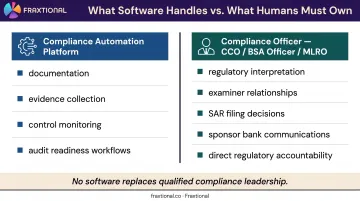
Compliance automation platforms handle documentation, evidence collection, control monitoring, and audit readiness workflows. What they don't cover:
- Regulatory interpretation and examiner relationships
- SAR filing decisions and escalation judgment calls
- Sponsor bank communications and onboarding requirements
- Direct regulatory accountability — which no software can absorb
These are human-led functions, and for fintech and banking companies, they carry real consequences.
Companies like BayFirst, Trans Pecos Bank, and a range of fintech and crypto clients have worked with Fraxtional precisely because compliance tooling alone doesn't satisfy sponsor bank onboarding requirements or regulatory examinations. The software layer handles documentation; the human leadership layer handles accountability. Buying decisions that ignore that distinction tend to surface the gap at the worst possible time.
Conclusion
No single Vanta alternative works for every organization. The right choice depends on your regulatory profile, company size, geographic footprint, and the specific frameworks your customers, regulators, and investors require. Picking based on brand reputation or G2 ratings alone can cost you — especially if your operating environment involves financial services-specific obligations that most security compliance platforms don't natively cover.
Before committing, get itemized quotes that break down per-framework costs, add-on pricing, audit support terms, and contract flexibility. Scrutinize whether the tool's framework library actually maps to your regulatory obligations — not just the frameworks it markets most prominently.
For fintech, crypto, and banking companies operating in the US, UK, Canada, or EU, compliance software is one part of the equation. The other part is someone accountable for regulatory interpretation, examiner management, and sponsor bank relationships — roles a CCO, BSA Officer, MLRO, or CAMLO fills.
Fraxtional provides fractional compliance leadership that works alongside any compliance tool. Financial services companies get director-level oversight on demand, without committing to a full-time executive hire.
Frequently Asked Questions
Frequently Asked Questions
What is the main difference between Vanta and its competitors?
All these platforms automate compliance workflows and evidence collection, but they differ in framework coverage, pricing models, automation depth, and industry focus. Vanta skews toward SaaS security certifications; alternatives vary by regulated industry fit, enterprise GRC depth, and cross-border privacy coverage.
Is Vanta suitable for fintech or crypto companies?
Vanta covers SOC 2, ISO 27001, and GDPR, but its framework library doesn't include native BSA/AML, FinCEN, FCA, or DORA-specific workflows. Fintech, crypto, and banking companies will need to supplement it with specialist compliance expertise for financial services obligations.
How much does Vanta cost compared to its alternatives?
Vendr reports Vanta at $20,000–$40,000/year for a single framework and $35,000–$70,000/year for 2–3 frameworks at 50–200 employees. Drata runs comparably at $18,000–$38,000/year for a single framework. Most alternatives on this list don't publish pricing; OneTrust is among the more transparent options with package tiers available on its website.
Do compliance automation tools replace the need for a compliance officer?
No. These platforms automate evidence collection, control monitoring, and documentation workflows — they don't make regulatory decisions, manage examiner relationships, or own BSA program accountability. For financial services companies, a qualified compliance officer (CCO, BSA Officer, MLRO, or CAMLO) remains essential, especially during regulatory examinations or sponsor bank reviews. Fractional compliance leadership is one way to fill that gap without the cost of a full-time hire.
What compliance frameworks should fintech companies prioritize when evaluating these tools?
Start with SOC 2 (investor and customer trust) and ISO 27001 (security management), then add GDPR or CCPA based on your data handling obligations. Geography determines what comes next: DORA for EU entities, FCA frameworks for UK-regulated firms, and BSA/AML workflows for US companies with FinCEN obligations.
What should I look for in a Vanta alternative for a startup?
Prioritize transparent or startup-friendly pricing, fast time-to-compliance, and flexible contract terms — avoid multi-year lock-ins until you've validated that the tool fits your environment. Strong customer support and coverage of the specific frameworks your investors, customers, or regulators actually require matter more than feature count.