
Introduction
Leadership gaps hit faster than most organizations expect. In 2025, 234 CEOs departed globally across major indices—a 16% increase year-over-year and 21% above the eight-year average. Yet only 21% of organizations maintain a formal succession plan, leaving most companies exposed when senior leaders exit unexpectedly.
A vacant executive seat doesn't just slow operations—it creates decision-making paralysis. Teams stall on strategic decisions, investors grow uneasy, and regulators take notice. For fintech and crypto companies, a missing Chief Compliance Officer or BSA Officer can jeopardize bank partnerships and licensing approvals within weeks.
Interim executives solve this crisis by stepping into senior roles immediately—making decisions, owning outcomes, and maintaining momentum while boards conduct deliberate permanent searches. For compliance-heavy functions, the fractional model takes this further: rather than a fixed-term placement, fractional leaders provide ongoing embedded expertise without the cost or commitment of a full-time hire.
This article covers when interim and fractional executives make sense, what to look for when engaging one, and how organizations in fintech, banking, and crypto are using this model to stay operationally sound through leadership transitions.
Key Takeaways
- Interim executives maintain business continuity during transitions, deployed within days to fill C-suite vacancies
- The engagement carries real decision-making authority and operational accountability — not an advisory role
- Common triggers: sudden departures, M&A integration, compliance gaps, and specialized strategic initiatives
- Fractional leadership covers ongoing part-time needs — senior expertise on demand, without a full-time salary
What Is an Interim Executive?
An interim executive is an experienced professional brought in temporarily to fill a senior leadership vacancy. They do the job—managing teams, making decisions, and executing strategy—rather than advising on how someone else should do it. Interim leaders carry full operational accountability for a defined period, typically three to twelve months.
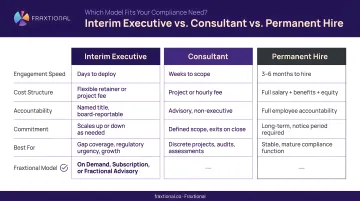
Interim vs. Consultant vs. Permanent Executive
Each leadership model serves a different need:
Interim executives hold full decision-making authority and operational accountability during a fixed engagement. They integrate with teams, manage direct reports, and own outcomes—without the ramp-up time or internal politics of a permanent hire.
Consultants provide recommendations and strategic guidance without execution responsibility. They analyze, advise, and present options—but don't run the function day-to-day.
Permanent executives carry long-term ownership of results, building teams and culture over years. They navigate internal relationships and organizational dynamics that short-term leaders bypass.
Interim leaders execute with authority but without the career incentives or political constraints that shape permanent executive behavior. That combination makes them especially effective when a company needs momentum, not a transition plan.
The most commonly filled interim roles include CEO, CFO, COO, Chief Compliance Officer, Chief Risk Officer, and BSA Officer. Regulated industries—fintech, crypto, and banking in particular—see the highest demand, where a compliance leadership vacancy can mean direct regulatory exposure rather than just an open org chart box.
When Do Companies Need an Interim Executive?
Sudden Leadership Departures
Unplanned executive exits create immediate continuity risk. Executive roles take 90 to 120 days to fill permanently, with CEO searches averaging 149 days. Extended C-suite vacancies directly impact team morale, project momentum, and investor confidence.
Organizations can't afford to leave senior seats empty during a thorough search. Interim executives keep decision-making on track, removing the pressure to hire quickly and settle for a poor fit.
M&A and Organizational Restructuring
Mergers and acquisitions create unique leadership demands. During integration periods, companies need experienced leaders to:
- Align teams across merged entities
- Maintain operational continuity during restructuring
- Manage conflicting processes and cultures
- Navigate reporting structure transitions
An interim executive holds the integration together while permanent roles are being redefined—preventing the operational drift that causes deals to underdeliver on their original rationale.
Strategic Initiatives and New Function Buildouts
Companies launching new functions—compliance programs, digital transformation initiatives, or market expansions—often lack the internal expertise to build them from scratch. An interim executive with specific experience can:
- Establish the function's infrastructure and processes
- Hire and train permanent teams
- Define success metrics and governance models
- Transition ownership to a permanent hire once the foundation is solid
This is a proactive use of interim leadership, not a crisis response. The goal is to build something new with the right expertise from day one, then hand it off cleanly.
Compliance and Regulatory Leadership Gaps
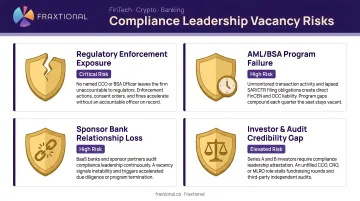
For fintech, crypto, and banking companies, a compliance officer vacancy isn't just an HR gap—it's immediate regulatory exposure. The Federal Reserve's 2024 enforcement action against Evolve Bank & Trust required the board to ensure individuals with compliance responsibility possess "appropriate subject matter expertise, stature, and resources."
Sponsor banks, regulators, and investors expect roles like Chief Compliance Officer, BSA Officer, CAMLO, and MLRO to remain actively filled. Even short vacancies can:
- Jeopardize sponsor bank partnerships under review
- Delay licensing approvals
- Raise red flags during investor due diligence
- Violate regulatory requirements for designated compliance officers
An OCC Cease and Desist order against Bank of America required: "If the BSA Officer position is vacated, the Board shall promptly appoint a new, qualified BSA Officer." For regulated companies, interim compliance leadership isn't optional—it's a regulatory and operational necessity.
Crisis and Turnaround Scenarios
When companies face financial distress, reputational damage, or operational failure, the speed of response matters as much as the quality of it. Interim executives with turnaround experience can move immediately, without the ramp-up time a new permanent hire requires. They:
- Make difficult decisions without legacy relationships constraining them
- Communicate transparently with stakeholders
- Implement recovery plans without political friction
- Chart paths forward while boards conduct permanent searches
Turnaround situations demand immediate action, not six-month onboarding processes.
Key Benefits of Bringing in an Interim Executive
Rapid Deployment
Unlike permanent executive searches taking months, 87% of interim professionals land assignments within 8 weeks. Top interim executives can step in within 10 to 15 days when urgency demands it.
This speed advantage is the primary reason organizations turn to interim leadership—continuity cannot wait while boards debate permanent hire profiles and conduct extensive search processes.
Immediate Impact with Minimal Onboarding
Interim executives are seasoned professionals who have navigated similar transitions before. They assess quickly, align with key stakeholders early, and begin executing without the typical adjustment period. Their advantages include:
- Recognize patterns quickly from prior comparable engagements
- Stay results-focused throughout, driven by defined-term accountability
- Operate without a learning curve on role fundamentals
- Manage stakeholders across functions from day one
Fresh Perspective and Objectivity
Interim leaders enter without legacy biases, internal politics, or pre-existing relationships. This outsider position makes them better placed to:
- Diagnose structural problems others overlook
- Make difficult decisions internal teams resist
- Challenge assumptions without career consequences
- Propose changes that protect organizational health over personal relationships
During crises or organizational dysfunction, this objectivity is often the deciding factor between action and stalemate.
Cost Efficiency vs. Rushed Permanent Hires
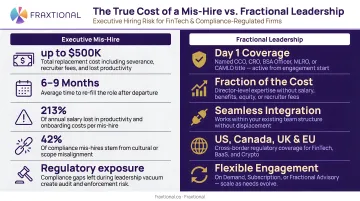
46% of newly hired employees fail within 18 months, and executive mis-hires prove even costlier. Research shows 27% to 46% of executive transitions are regarded as failures or disappointments two years later.
The cost of replacing a manager within 6 to 12 months of hire is 2.3 times their annual salary. Factors include:
- Severance and separation costs
- Lost productivity during vacancy and ramp-up
- Team disruption and morale impact
- Re-recruitment expenses
An interim leader provides high-caliber leadership on a defined engagement, giving organizations time to make deliberate, well-aligned permanent hires rather than rushing decisions under pressure.
Organizational Stability and Stakeholder Confidence
Beyond the cost case, visible leadership shapes how the organization is perceived externally. Employees, investors, and regulators all respond to capable leadership in place — an interim executive signals professional transition management rather than organizational drift.
For regulated companies, this confidence factor carries particular weight. Compliance vacancies raise immediate concerns with sponsor banks conducting due diligence and regulators evaluating governance. An experienced interim compliance officer demonstrates continuity of control and oversight, reducing regulatory risk during transitions.
Interim vs. Fractional Leadership: What's the Difference?
The core distinction is engagement structure:
- Interim leadership is typically full-time for a defined period (3–12 months), filling a specific vacancy or managing a time-bound initiative
- Fractional leadership is part-time and ongoing, providing embedded senior expertise across multiple months or years
When Fractional Makes More Sense
Fractional models suit organizations that need consistent director-level expertise without full-time executive cost or commitment. Three scenarios come up most often:
- Growth-stage companies (seed through Series B) that need compliance, risk, or operations leadership but can't justify a full C-suite salary
- Specialized technical functions — compliance, risk, and regulatory roles in fintech, crypto, and banking require deep expertise that few organizations need on a 40+ hour weekly basis
- Ongoing operational involvement where the engagement extends beyond transition management — fractional leaders become embedded members of the leadership structure at reduced time commitment
Fraxtional's Fractional Compliance Leadership Model
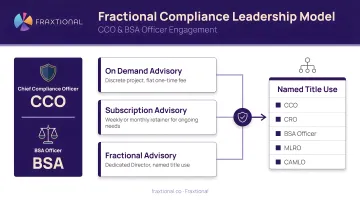
Fraxtional's model applies this directly: fractional compliance leadership for fintech, crypto, and banking companies, with roles including CCO, CRO, BSA Officer, CAMLO, and MLRO on flexible engagement terms.
The model solves a real challenge. Fintech and crypto companies need credible compliance leadership to satisfy sponsor banks, regulators, and investors — but a full-time Chief Compliance Officer costs $275,000–$400,000 annually, which often exceeds early-stage budgets and operational needs. Key features of the engagement model include:
- Director-led oversight on every client engagement
- Flexible terms ranging from short-term advisory to long-term fractional arrangements
- Daily access to compliance expertise across BSA/AML, UDAAP, Reg E, and cross-border operations
Fraxtional's T100 Finance Award recognition as a Leader in Compliance carries practical weight: sponsor banks and investors routinely evaluate compliance governance during partnership approvals and due diligence, and credentialed leadership directly affects those outcomes.
The Overlap Between Interim and Fractional
In practice, interim and fractional models can overlap. What begins as an interim engagement to cover a compliance vacancy may evolve into an ongoing fractional arrangement once the immediate crisis passes. The right provider serves both needs—covering acute continuity requirements while building long-term compliance infrastructure.
How to Select and Integrate an Interim Executive Successfully
Define Success Criteria Before Searching
Organizations should clearly articulate before beginning the search:
- Scope of the assignment – What decisions does the interim leader own? What's outside their authority?
- Specific deliverables – What outcomes define success? What must be completed before transition?
- Timeline and duration – How long will the engagement last? What milestones trigger review?
- Cultural and technical requirements – What leadership style fits the organization? What domain expertise is non-negotiable?
Vague mandates produce slow starts and misaligned outcomes. The clearer the brief, the faster an interim leader can move.
Evaluate for Fit Beyond Credentials
Technical skills and industry experience matter, but interim executives succeed through:
- Adaptability – Thriving in ambiguous, fast-changing environments
- Communication skills – Building trust and alignment quickly across stakeholder groups
- Emotional intelligence – Reading organizational dynamics and navigating resistance
- Authority-building capability – Earning respect and influence rapidly in new settings
In short-term engagements, there's no runway for a slow start — situational judgment is what separates a productive interim from an expensive placeholder.
Support Integration from Day One
Successful integration requires deliberate organizational support:
- Immediate access to key stakeholders – Schedule introductions with the leadership team, board members, major customers, and regulatory contacts within the first week
- Clear communication of role and authority – Announce the interim leader's scope and decision-making authority to the organization; ambiguity creates friction and slows execution
- Data, systems, and context access – Provide logins, documentation, and background briefings immediately; every day spent waiting for access delays impact
- Regular feedback loops – Establish weekly check-ins to surface misalignments early; interim engagements move fast and there's little room to course-correct late
Frequently Asked Questions
What is an interim leadership position?
An interim leadership position is a temporary senior role filled by an experienced external professional to maintain business continuity during a vacancy, transition, or crisis. It differs from a permanent hire in duration and scope, typically lasting 3-12 months with defined deliverables rather than long-term strategic ownership.
Do interim CEOs get paid more?
Interim executives are typically compensated at a premium day rate or monthly rate compared to the equivalent annualized salary of a permanent hire. This reflects the specialized skills involved, speed of deployment, and absence of long-term benefits. The tradeoff: no severance, equity, or ongoing employment commitment.
How long does an interim executive typically stay in a role?
Most interim assignments range from three to twelve months, depending on transition complexity or initiative scope. Average interim assignment length is 9.6 months, though 42% now last longer than six months and 16% extend beyond a year. Some engagements convert to permanent hires when the fit proves strong.
What is the difference between an interim and a fractional executive?
An interim executive works full-time for a defined short-term period to fill a specific vacancy or manage a time-bound initiative. A fractional executive works part-time on an ongoing basis—often serving multiple organizations—making it the right fit for companies that need consistent senior expertise in specialized functions like compliance or risk without a full-time hire.
When should a fintech or crypto company consider fractional compliance leadership?
Fractional compliance leadership is valuable for seed-to-Series B fintech or crypto companies that need CCO, BSA Officer, or MLRO expertise to meet regulatory requirements, sponsor bank expectations, or investor due diligence. It's the practical alternative when a full-time senior compliance hire—typically $275,000–$400,000 annually—isn't yet justified.