
Many fintech founders, startup boards, and PE-backed company leaders face this scenario more often than they'd like. The conventional choices seem limiting: spend 4-6 months recruiting a permanent executive or promote someone internally who may lack the experience. But there's a third path—interim and fractional executives who deliver expert, time-bound leadership without the cost or commitment of a full-time hire.
This post explains what interim executives are, how they differ from fractional models, the core benefits they offer, and when each arrangement makes the most sense for regulated industries like fintech, crypto, and banking.
Key Takeaways
- Interim executives are experienced C-suite professionals who step into leadership roles on a temporary, full-time basis
- Fractional executives provide ongoing, part-time leadership—not just a bridge to a permanent hire
- Both models deliver senior expertise without full-time headcount costs
- In fintech, crypto, and banking, specialized compliance executives (CCO, CRO, MLRO) help firms meet regulatory obligations without a full-time hire
- The right model depends on your timeline: interim for defined transitions, fractional for sustained compliance leadership
What Is an Interim Executive?
An interim executive is a seasoned, senior-level leader brought in temporarily to fill a C-suite or director-level vacancy, typically for a few months to around two years. Unlike consultants who advise from the sidelines, interim executives step directly into the role with full decision-making authority.
Industry sources frame interim executives as "change agents"—not placeholders. These are action-oriented professionals with proven track records who arrive ready to assess, decide, and execute from day one. InterimExecs (2025) states, "Interim executives are change agents. They help companies solve complex business challenges and have a track record of achieving strong results."
Typical roles interim executives fill include:
- CEO, CFO, COO, CTO, CMO
- Chief Compliance Officer (CCO)
- Chief Risk Officer (CRO)
- BSA Officer
- Money Laundering Reporting Officer (MLRO)
Any senior function where a vacancy creates operational or strategic risk becomes a candidate for interim leadership.
The Profile of a Career Interim Executive
Career interim executives are often overqualified relative to the role they fill. A leader who previously headed a $1 billion business may step in as an interim at a $500 million firm — so there's no learning curve, just execution from day one.
These professionals are typically financially secure and motivated by solving defined problems rather than climbing corporate ladders. They prioritize variety, autonomy, and immediate impact over the long-term commitment of a permanent appointment.
Key distinction: Interim executives differ from board members who temporarily carry an "interim" title. Career interim executives are operationally hands-on and accountable for results, not just governance.
Interim vs. Fractional Executives: Key Differences
Fractional executives provide ongoing, part-time executive leadership—usually on a recurring basis—rather than filling a role full-time temporarily. They're embedded in the organization but at a fraction of full-time capacity.
Core Structural Differences
| Dimension | Interim Executive | Fractional Executive |
|---|---|---|
| Time Commitment | Full-time, defined temporary term | Part-time, recurring cadence |
| Primary Goal | Stabilize and lead through a gap | Build capability without full-time seat |
| Authority | Holds the seat with clear decision rights | Embedded with defined decision rights |
| Exit Criteria | Handover to permanent leader | Graduation to full-time hire or stable team ownership |
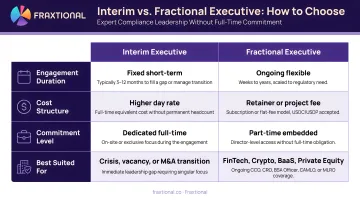
Interim = temporary and full-time (bridge role). Fractional = ongoing and part-time (embedded expertise model).
When Fractional Makes More Sense Than Interim
Early-stage startups and Series A/B companies often don't have the budget or workload to justify a full-time C-suite hire but still need consistent executive-level oversight. Fractional leadership is a natural fit—especially in functions like compliance, finance, or risk.
In regulated industries—fintech, crypto, banking, money transmission—fractional compliance leadership has become a recognized model for meeting regulatory obligations without building a full-time team. Roles such as a fractional CCO, BSA Officer, or MLRO give companies named officers who can be designated in regulatory filings and audits, while still operating part-time across multiple clients.
Fraxtional's director-led model is built around exactly this structure, offering named compliance officers with direct regulatory accountability at a fraction of the cost of a full-time hire.
The Core Benefits of Interim Executive Leadership
Fresh, Objective Perspective
Unlike internal promotions, interim and fractional executives come without organizational baggage, internal politics, or attachment to legacy decisions. They identify and address issues that internal staff may overlook or resist—precisely because they're not invested in defending past choices.
Speed to Impact
Traditional executive searches for C-suite roles average 90 to 120 days, with CEO searches extending up to 149 days. Interim executives can be deployed in a matter of days or weeks, according to industry sources.
- Traditional search: 3–5 months before your new executive starts
- Interim deployment: Days to weeks before they're on-site and operational
Cost Efficiency
Engaging an interim or fractional executive avoids the salary, equity, benefits, and severance costs associated with permanent C-suite hires.
Cost comparison for a Chief Compliance Officer:
| Cost Component | Full-Time CCO | Fractional CCO |
|---|---|---|
| Base Compensation | $229,069 average (US, 2026) | $8,000–$22,000/month retainer |
| True Employer Cost | $270,000–$320,000+ (includes benefits, taxes) | Flat retainer; no benefits or payroll taxes |
| Executive Search Fees | 25–33% of first-year cash compensation ($60,000 to $175,000+) | Zero placement fees |
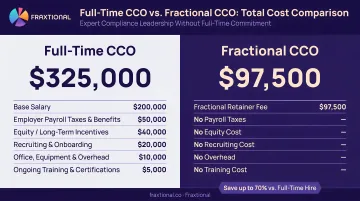
For growth-stage companies, the table above shows why the fractional model is compelling—particularly when the role doesn't require a full-time presence.
Clarity on the Permanent Hire
That cost efficiency also changes how you hire permanently. With an interim in place, there's no pressure to rush a decision.
Interim leaders help organizations understand what the full-time role actually requires: which skills matter most, what leadership style fits the culture, what priorities will drive results. By removing the desperation from the search process, they give the board room to wait for the right candidate.
They also conduct an objective audit of the function—often refining the job description based on what the organization actually needs, not what was assumed at the outset.
Urgency as a Catalyst
The time-bound nature of interim and fractional engagements creates productive pressure. Interim executives focus on measurable outcomes within a defined period, which drives accountability and momentum that most permanent hires take months to build.
When Does a Company Need an Interim Executive?
Unplanned Leadership Departures
Resignation, termination, or sudden incapacity of a key executive creates an immediate vacuum. Global CEO turnover hit a record high in 2025 with 234 departures—a 16% increase from 2024. In the US, 40% of S&P 1500 CEOs departed within their first five years.
Leaving the seat empty during a lengthy search exposes fintech and regulated firms to real risk — missed regulatory deadlines, stalled audits, and sponsor bank concerns. An interim executive keeps operations on track while the permanent search runs its course.
Rapid Growth or Transformation
Companies scaling quickly often need experienced executive support for a defined phase — before headcount and budget justify a permanent hire. A fintech moving from seed to Series A, or a crypto firm entering a regulated market, may need a CCO or CRO in place for 6–12 months to satisfy investor and regulatory expectations.
Compliance and Regulatory Pressure
Fintech, banking, and crypto organizations often face regulatory deadlines that require credentialed compliance leadership immediately. FinCEN regulations do not prescribe employment status for compliance officers, focusing instead on competence, authority, and access. The UK's FCA accepts part-time MLROs on the same basis — what matters is proportionate commitment, not employment status.
Regulatory mandates cannot wait:
- BSA/AML program requirements for money transmitters
- Licensing conditions for state or federal approvals
- Sponsor bank expectations for compliance officer designation
- Audit findings requiring immediate remediation
Fraxtional's fractional CCO and BSA Officer services are built specifically for these moments — deployable quickly, scoped to the engagement, and priced at a fraction of a full-time executive hire.
What to Look for When Hiring an Interim Executive
Proven Track Record Over Credentials
The most effective interim executives bring experience from companies larger or more complex than your own. Look for demonstrated outcomes — not just titles — across multiple organizations. Pattern recognition built across different industries and crises is what separates a strong interim from a capable full-time hire.
Emotional Intelligence and Adaptability
Interims often walk into turbulent or ambiguous situations. The ability to build trust quickly, read stakeholder dynamics, and communicate clearly under pressure is as important as technical expertise.
Korn Ferry (2022) identifies the critical attributes:
- Builds trust fast — calms emotions and restores team morale from the first week
- Stays apolitical, takes no credit, and avoids internal power dynamics entirely
- Prioritizes immediate impact over slow orientation; the clock starts on day one
Specialization That Matches the Problem
A generalist CEO interim is very different from a fractional Chief Compliance Officer with fintech regulatory experience. The more specialized the function (such as BSA/AML, UDAAP, or MLRO for UK operations), the more critical it is to match domain expertise to the specific regulatory challenge at hand.
For compliance roles, verify:
- Professional indemnity insurance (£1M–£5M+ for UK roles; equivalent minimums apply for US and EU engagements)
- Background checks and regulatory screening (especially for Senior Manager roles)
- Authority and independence from revenue-generating business lines
- Sufficient knowledge to make decisions and implement advice
Frequently Asked Questions
What does an interim executive do?
An interim executive temporarily fills a senior leadership role, taking on full executive responsibilities—from strategic decision-making to team leadership—while the organization completes a permanent search or navigates a specific transition period.
What is the difference between an interim CEO and a permanent CEO?
Both hold the same authority within the organization, but an interim CEO operates on a fixed-term basis with a defined mandate—typically without equity stakes or long-term commitments—which often allows them to make difficult, objective decisions free from political constraints.
What is the difference between a fractional and an interim executive?
An interim executive is typically full-time and temporary (filling a vacant seat), while a fractional executive provides ongoing, part-time leadership—serving multiple organizations simultaneously and offering consistent expertise without a full-time headcount commitment.
How long does an interim executive typically serve?
Most interim placements run 4 to 12 months, with some roles extending to two years depending on organizational complexity and the pace of the permanent search.
Can an interim executive transition into a permanent role?
While interim engagements are designed to be temporary, organizations sometimes convert successful interim leaders into permanent hires once the fit has been demonstrated. It happens—but it's not the expected outcome going in.