
Fractional executive services are frequently discussed in terms of cost savings alone, but their real value materializes in day-to-day compliance outcomes, regulatory credibility, and leadership continuity. When structured properly, fractional compliance executives deliver the same regulatory authority and oversight as full-time hires—at a fraction of the cost and commitment—while eliminating the multi-year ramp-up time and catastrophic hiring risk that plagues traditional C-suite recruitment.
This article explains why fractional executive services deliver measurable business benefits in practice—not just in theory—and when they matter most for companies operating in high-compliance environments.
Key Takeaways
- Fractional executive services provide part-time, senior-level leadership at significantly lower cost than full-time hires
- For regulated industries, fractional compliance executives (CCO, BSA Officer, CAMLO, MLRO, CRO) satisfy bank partner and regulator expectations without full-time overhead
- Primary business benefits: cost efficiency (50-70% savings), immediate access to specialized expertise, and engagement flexibility that scales with growth
- Without fractional leadership, startups default to reactive firefighting: regulatory fines, collapsed bank partnerships, and investor scrutiny follow
- Results depend on clear goals, consistent engagement, and a willingness to act on expert recommendations
What Are Fractional Executive Services?
Fractional executive services provide experienced C-suite professionals who assume leadership and decision-making authority on a part-time or retainer basis, embedded directly into the company rather than operating as external consultants. Unlike advisors who offer recommendations from the outside, fractional executives take operational ownership of outcomes — building compliance programs, managing regulatory relationships, overseeing audits, and guiding strategy — while working fewer hours than a full-time hire.
That embedded model makes fractional roles well-suited for early-stage and scaling companies that need director-level expertise in compliance, risk, finance, or operations without the budget for a full-time hire. A Series A fintech preparing for a sponsor bank partnership, for example, might engage a fractional Chief Compliance Officer to design the AML program, write policies, and lead regulatory discussions — work that demands C-suite authority but doesn't yet justify a permanent headcount.
Structured as an embedded, ongoing function, fractional executives are a deliberate leadership decision — one focused on achieving specific outcomes:
- Securing regulatory approval and license acquisition
- Maintaining operational continuity through compliance transitions
- Building investor readiness and satisfying pre-deal diligence
- Establishing credibility with sponsor banks and regulators
This accountability is what distinguishes fractional executives from short-term project consultants.
Key Business Benefits of Fractional Executive Services
The advantages below are grounded in operational and financial outcomes that regulated-industry companies actively track—cost reduction, regulatory risk mitigation, decision speed, and growth readiness—not abstract leadership theory.
Benefit 1: Significant Cost Savings Without Sacrificing Leadership Quality
Fractional executives deliver the same strategic decision-making and accountability as full-time leaders, but companies pay only for the hours and scope they actually need—eliminating salary burden, benefits packages, equity grants, and recruiting costs.
How This Works in Practice:
A company on a monthly retainer model gains consistent access to a senior compliance officer or risk leader without committing to a six-figure annual salary, payroll taxes, or executive benefits. Instead of allocating $25,000+ per month for a full-time Chief Risk Officer, a fractional engagement might cost $3,000 to $15,000 per month depending on scope—freeing capital for product development, technology infrastructure, or market expansion.
Why This Is an Advantage:
Full-time Chief Compliance Officer compensation averages $299,000 to $419,000 annually, with tech sector CCOs reaching up to $770,000 in total compensation. Fractional retainers, by comparison, typically range from $3,000 to $15,000 per month—representing 50-70% cost savings compared to equivalent full-time roles.
The financial risk of a failed executive hire compounds these savings. Research from Korn Ferry indicates that replacing a manager within 6 to 12 months costs 2.3 times their annual salary, while the cumulative cost can reach 10 to 15 times the executive's salary when factoring in severance, lost productivity, and cultural impact.
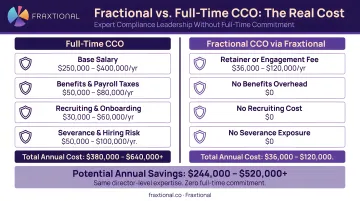
A fractional model eliminates that exposure. If an engagement isn't delivering results, companies can restructure or end the arrangement without severance obligations or legal complexity.
Every dollar not spent on full-time executive overhead becomes available for licensing applications, geographic expansion, or product development—capital allocation decisions that directly impact growth trajectory.
KPIs Impacted:
- Leadership cost as a percentage of operating budget
- Executive overhead per headcount
- Burn rate reduction
- Time-to-productive leadership (days from engagement start to active decision-making)
When This Advantage Matters Most:
Seed through Series B companies where budget constraints are most acute; companies preparing for sponsor bank partnerships or investor due diligence where compliance credibility is required but a full-time hire isn't yet justified.
Benefit 2: Immediate Access to Deep, Specialized Expertise
Fractional executives bring years of domain-specific experience from multiple organizations and regulatory environments—meaning they arrive already fluent in the challenges, regulations, and operational realities of your industry.
How This Works in Practice:
Rather than spending months onboarding a new hire, a fractional compliance leader (CCO, BSA Officer, CAMLO, or MLRO) can assess a company's regulatory posture, identify gaps, and begin addressing them within the first weeks of engagement.
They arrive with hands-on experience across BSA/AML, UDAAP, Regulation E, sanctions screening, and cross-border compliance. There is no ramp-up period that delays critical work.
Why This Is an Advantage:
It typically takes a full year for employees to reach their full potential for performance. Fractional leaders eliminate this lag entirely, executing critical tasks from day one. A crypto firm facing an upcoming regulatory exam, for example, can engage a fractional BSA Officer who has already navigated dozens of similar exams—avoiding the costly trial-and-error process that comes with a less experienced hire.
External perspective matters. A fractional executive serving multiple companies simultaneously develops pattern recognition that single-company hires rarely possess. They've directly observed:
- How regulators respond to specific control frameworks
- How sponsor banks evaluate partner readiness
- What investor due diligence actually scrutinizes during pre-deal reviews
The talent shortage compounds this advantage. 50% of anti-financial crime professionals cite a lack of skilled resources as a high or very high risk, while crypto compliance hiring surged 340% in 2025. Fractional models provide immediate access to expertise that would otherwise require months of recruiting in an exceptionally competitive market.
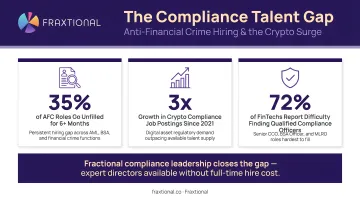
Fraxtional's director-led model gives every client direct oversight from experienced directors with specialized knowledge across fintech, banking, crypto, and high-risk models—the depth of expertise that sponsor banks and investors scrutinize during pre-deal reviews.
KPIs Impacted:
- Time to compliance readiness
- Number of regulatory gaps identified and remediated
- Audit outcomes and findings per cycle
- Sponsor bank approval rate
- Exam findings per supervisory cycle
When This Advantage Matters Most:
Companies applying for licenses or establishing sponsor bank relationships; firms facing regulatory examination or investor pre-deal reviews; crypto and embedded finance companies where specialized BSA/AML and MLRO expertise is scarce internally.
Benefit 3: Flexibility That Scales With Business Needs
Fractional engagement models allow companies to calibrate leadership intensity to their current stage, operational demands, and budget—scaling support up during high-stakes periods and adjusting back during stable phases.
How This Works in Practice:
A company might engage a fractional CCO for 10 hours per week during steady-state operations, then increase engagement to near full-time during an exam cycle, pre-deal regulatory review, or license application—without the overhead and contractual obligations of a permanent executive. This elasticity matches the cyclical nature of compliance workloads more efficiently than fixed full-time headcount.
Why This Is an Advantage:
Compliance needs are often project-driven rather than constant. The FFIEC BSA/AML Examination Manual notes that examinations occur during each supervisory cycle, typically every 12 to 18 months. During those windows, companies require intensive senior oversight—but between exams, the workload stabilizes. A fractional model allows organizations to pay for the leadership they need when they need it, rather than maintaining full-time capacity for intermittent demand.
Flexibility also reduces organizational risk. When business conditions change—downturns, pivots, acquisitions—a fractional engagement can be restructured without severance, legal complexity, or disruption to team morale. This agility is particularly valuable for startups navigating uncertain growth trajectories.
Regulatory credibility is maintained regardless of employment status. FinCEN's proposed AML/CFT Program rules require a designated, qualified compliance officer with decision-making authority, but do not mandate full-time W-2 employment. Sponsor banks and investors increasingly accept fractional compliance leaders as valid—particularly when backed by a recognized firm with a proven track record.
KPIs Impacted:
- Leadership utilization rate
- Engagement cost per regulatory milestone achieved
- Time to scale compliance function up or down
- Leadership continuity during transitions
When This Advantage Matters Most:
Fast-growing startups navigating multiple simultaneous regulatory requirements across jurisdictions; companies operating across the US, Canada, UK, or EU where compliance obligations vary significantly and a global fractional team is more efficient than multiple full-time hires.
What Happens When Fractional Leadership Is Missing or Ignored
Companies that delay investing in experienced compliance or risk leadership—assuming they'll "figure it out" or hire full-time later—frequently face consequences far more costly than the engagement they avoided.
Regulatory Exposure Accumulates Silently
Without a senior compliance officer, gaps in BSA/AML programs, inadequate UDAAP controls, or unaddressed cyber risk go undetected until an exam, audit, or partner review surfaces them. By that point, remediation is expensive and reputational damage may already be done.
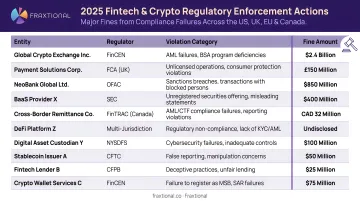
Recent enforcement actions illustrate the financial toll:
- Monzo faced a £21 million fine in 2025 for rapid growth that outpaced compliance capacity
- Paxful received a $3.5 million penalty for operating without an AML program and failing to designate a qualified BSA Officer
- Block (Cash App) paid $80 million to state regulators for insufficient money laundering controls
- Coinbase Europe was fined €21.4 million for faulty transaction monitoring and inadequate internal controls
Sponsor Bank and Investor Relationships Stall
Banks are under strict mandates to oversee their fintech partners. A 2024 joint statement by the OCC, FDIC, and FRB makes clear that banks must rigorously manage third-party AML/CFT compliance. Fintechs cannot rely on their sponsor bank to carry that burden — they must demonstrate their own credible controls. Companies without senior compliance leadership face rejected applications or delayed partnership closings.
The same scrutiny applies during fundraising. Investors treat compliance gaps as material risks, and due diligence requires clean paperwork across AML, KYC, privacy, and licensing. Gaps in any of these areas slow down — or kill — funding rounds.
Reactive Firefighting Replaces Strategic Planning
Without ongoing compliance oversight, leadership teams spend disproportionate time responding to urgent regulatory issues rather than executing growth strategy. That reactive cycle steadily erodes both momentum and margins.
How to Get the Most Value from Fractional Executive Services
The companies that extract the most value from fractional leadership treat it as an embedded, ongoing function—not a one-time project. The goal is consistent leadership presence, not periodic check-ins.
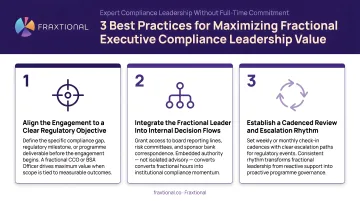
Three practices separate firms that see real results from those that don't:
Set specific, measurable objectives upfront. Define what success looks like before engagement begins — a clean audit, a bank partnership secured, a compliance program built, or a licensing application filed. Vague briefs produce vague results; specificity creates accountability.
Integrate the fractional leader into live decisions. Compliance and risk executives can only provide effective oversight when they have visibility as decisions happen. Weekly syncs, access to key stakeholders, and inclusion in product or partnership discussions all matter. A fractional CCO who learns about a new product launch after go-live cannot manage the associated compliance risks.
Implement recommendations, don't just collect them. The value of fractional leadership is realized when insights drive action, not when they accumulate in reports. Firms that empower their fractional executives to lead change — rather than simply advise — consistently see better regulatory and operational outcomes, from cleaner exams to faster sponsor bank approvals.
Conclusion
For fintech, crypto, banking, and embedded finance companies, fractional executive services solve a fundamental challenge: the need for experienced, credible compliance and risk leadership at a cost and commitment level that matches the realities of early and growth-stage organizations.
The advantages of fractional leadership compound over time. A company that engages fractional compliance leadership early builds the regulatory infrastructure, institutional knowledge, and stakeholder credibility that makes scaling, licensing, and fundraising easier.
Treating it as an ongoing practice — not a one-time fix — is what separates companies that stay ahead of regulation from those perpetually catching up.
Three moments expose whether compliance leadership was built or deferred:
- Sponsor bank diligence — banks want evidence of an embedded compliance function, not a rushed hire
- Investor pre-deal reviews — fractional executives provide the audit trail and credibility investors expect
- Regulatory exams — prepared companies engage; those that delayed scramble to explain gaps
Companies that embed fractional executives early arrive at each of these moments ready. The ones that wait spend capital and time on reactive fixes that a fractional engagement would have prevented.
Frequently Asked Questions
What are the benefits of a fractional employee?
Fractional employees provide senior-level expertise at a fraction of full-time hire costs, with the flexibility to scale engagement up or down as business needs change. In regulated industries, they also eliminate the 6-12 month learning curve typical of traditional executive hires.
What does a fractional executive do?
A fractional executive takes on active leadership and decision-making authority inside your company — not advisory work from the outside. They own outcomes directly, handling responsibilities like compliance program management, regulatory relationships, and audit oversight on a part-time or retainer basis.
How much do fractional executives get paid?
Compensation varies by role, expertise, and engagement scope, typically structured as a monthly retainer rather than hourly billing. Fractional BSA/AML officers and CCOs generally range from $3,000 to $15,000 per month, significantly lower than the equivalent full-time executive's salary plus benefits and equity, which averages $299,000 to $770,000 annually.
Is a fractional executive the same as a consultant?
No. Consultants advise from the outside without operational accountability; fractional executives are embedded in the organization and own outcomes directly. They function as a part-time C-suite leader — with real authority, not just recommendations.