

Too often, startups approach fractional engagements with generic consulting templates that fail to address the decision-making authority, regulatory accountability, and integration depth required for compliance leadership. The result? Contracts that leave scope undefined, authority ambiguous, and classification risk unaddressed—creating regulatory gaps that invite supervisory findings, back taxes, and personal liability for company officers.
This guide covers the critical differences between fractional and consulting agreements, the essential contract clauses that protect both parties, the classification risks that can expose companies to penalties exceeding $10,000 per violation, the compensation models that align with regulatory expectations, and the confidentiality and intellectual property protections that regulated industries demand.
TLDR: Key Takeaways
- Fractional executive agreements require explicit scope, decision-making authority, and duration language that standard consulting contracts lack
- Misclassifying a fractional executive as an independent contractor can trigger back taxes, benefits liability, and penalties up to $10,000 per violation
- Retainer models fit team-leading roles; hourly billing suits advisory-only engagements
- Confidentiality, IP ownership, and conflict-of-interest clauses are non-negotiable for compliance roles handling sensitive regulatory data
- Companies operating across the US, Canada, UK, or EU must address multi-jurisdictional obligations in the agreement
What Makes a Fractional Executive Agreement Different From a Consulting Contract
The fundamental distinction is integration versus delivery. A consultant delivers a discrete project with defined deliverables and a clear exit point—think building a compliance manual or completing a risk assessment. A fractional executive embeds in the leadership team, attends strategy meetings, drives ongoing initiatives, and exercises decision-making authority over critical functions. This operational depth changes what the contract must address.
For compliance-specific fractional roles, the stakes rise considerably. BSA Officers, CAMLOs, and MLROs don't just advise — they interact with regulators, sign compliance certifications, and represent the company in supervisory reviews. FinCEN explicitly requires that BSA compliance officers have "appropriate authority, independence, and access to resources" and must regularly report to the board.
The UK's Financial Conduct Authority (FCA) holds the same standard. It expects Money Laundering Reporting Officers (SMF17) to be senior leaders with independence from client-facing operations, explicitly warning that applicants spending only "a few hours a week" on the role tend to be unsuccessful.
Enforcement actions confirm the regulatory risk. TD Bank's 2024 FinCEN consent order cited a "siloed governance structure" where the BSA Officer lacked direct authority over AML Technology and Operations, a structural deficiency that contributed to willful BSA failures.
The Bittrex case makes the point from another angle: FinCEN penalized the firm partly because it designated its CEO as the AML compliance officer, an arrangement FinCEN deemed "not commensurate with Bittrex's risk profile."
Standard consulting agreements fail here because they lack the clauses needed for fractional executive work:
- Defined authority levels (what decisions can the executive make independently?)
- Escalation paths (when must board or CEO approval be obtained?)
- Leadership integration expectations (meeting attendance, reporting cadence, team access)
- Reporting structures (who does the executive report to, and how often?)
When companies use the wrong template, they create regulatory exposure. Regulators don't care what the contract says — they care whether the compliance function has real authority, independence, and continuity. A generic consulting agreement that treats a BSA Officer as a project-based advisor invites supervisory findings and enforcement risk.
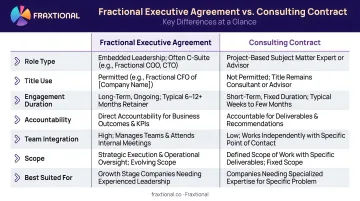
Fraxtional's director-led model is structured around this reality. Each engagement is scoped to the specific compliance role and regulatory environment — meaning contract terms reflect actual BSA Officer, CAMLO, or MLRO responsibilities rather than generic contractor language bolted on after the fact.
Essential Contract Clauses for Fractional Executive Engagements
Scope of Work and Decision-Making Authority
The agreement must precisely define what decisions the fractional executive can make independently versus what requires board or CEO sign-off. For compliance roles, this includes:
- Policy approval authority - Can the CCO approve and implement new AML policies without board review, or only recommend them?
- Regulatory filing authority - Can the BSA Officer sign Suspicious Activity Reports (SARs) and Currency Transaction Reports (CTRs) directly, or must legal counsel co-sign?
- Examiner engagement authority - Can the MLRO respond to regulatory inquiries independently, or must the CEO be present for all examiner meetings?
- Budget and resource authority - Can the CRO authorize compliance software purchases up to a certain threshold, or must all spending be pre-approved?
Ambiguity here creates operational paralysis and regulatory risk. If a regulator asks who has final authority over AML transaction monitoring thresholds and the answer is unclear, the firm has a governance problem.
Engagement Duration and Renewal Terms
Typical engagement lengths for fractional compliance executives run 6–18 months initially, with built-in review points at 90 days and 6 months. The agreement should specify:
- Initial term - Fixed period (e.g., 12 months) with clear start and end dates
- Renewal mechanism - Automatic renewal unless either party provides 60 days' notice, or affirmative opt-in renewal requiring mutual written consent
- Review milestones - Scheduled check-ins to assess scope, workload, and performance
- Off-ramp provisions - Clear exit terms if the company hires a full-time executive or if the fractional arrangement no longer fits
These off-ramp provisions matter as much as the engagement terms themselves — because how the relationship ends shapes what regulators see.
Termination Provisions
When an off-ramp clause gets triggered — whether by a full-time hire, a performance issue, or a regulatory event — the termination provisions determine whether the transition is clean or chaotic. Key elements include:
Notice periods - 30–60 days' written notice for voluntary termination, allowing time for knowledge transfer and regulator notification
Immediate termination triggers:
- Material breach of confidentiality obligations
- Regulatory finding of personal misconduct by the executive
- Failure to cooperate with regulatory examination
- Conviction of financial crimes or regulatory violations
Transition obligations:
- Document all open compliance matters and risk issues
- Transfer case files, risk memos, and audit trails
- Brief successor or internal team on pending regulatory matters
- Remain available for 30 days post-termination for transition questions
The FFIEC BSA/AML Examination Manual explicitly states that failing to correct a previously reported problem—such as failure to appoint a qualified BSA officer—ordinarily results in a mandatory cease and desist order. Abrupt departures without transition plans create supervisory gaps that regulators penalize.
Governing Law and Jurisdiction
For companies operating across multiple states or countries, the agreement must specify which jurisdiction's law governs disputes. This choice has real consequences:
US multi-state operations - Specify which state's law applies (often Delaware or the company's headquarters state) to avoid conflicts between employment laws
US-UK-EU operations - Define whether US federal law, UK law, or EU member state law governs, and whether disputes are resolved through arbitration or litigation
Tax and classification impact - Jurisdiction choice affects independent contractor classification tests, which vary significantly (California's ABC test is far stricter than federal standards)
Data protection constraints - The European Data Protection Board (EDPB) requires that cross-border data transfers comply with GDPR Chapter V, meaning if a fractional executive operates outside the EU/UK, supplementary measures (e.g., standard contractual clauses) are required
Arbitration is frequently chosen for cross-border executive disputes due to enforceability of awards under the New York Convention. However, US courts may delegate arbitrability questions to arbitrators if the clause is drafted broadly — a problem that can be avoided with precise drafting.
Contracts must explicitly separate the governing law of the contract from the law of the arbitration seat. Conflating the two creates exactly the kind of jurisdictional ambiguity the UK Supreme Court confronted in Kabab-Ji (2021).
Employee vs. Independent Contractor: Understanding Classification Risks
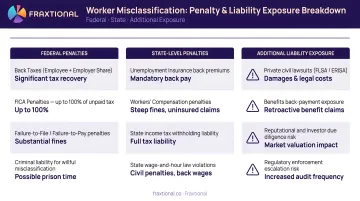
This is the highest-stakes legal question in a fractional engagement. The government determines classification, not the contract — and getting it wrong exposes companies to severe penalties.
The Cost of Misclassification
Federal penalties:
- Willful failure to collect or pay over tax (IRC § 7202) is a felony carrying fines up to $10,000 and up to 5 years imprisonment
- Failure to file correct information returns (IRC § 6721) carries $250 per return, up to $3,000,000 annually
- FLSA civil money penalties for willful or repeated violations reach $2,515 per violation as of January 2025
- FLSA criminal fines for willful violations reach $10,000
State penalties:
Additional exposure:
- Back taxes (employer share of Social Security, Medicare, unemployment)
- Unpaid benefits (health insurance, retirement contributions)
- Personal liability for company officers who signed tax returns
Factors Pointing Toward Employee Status
The IRS applies a common law test focusing on three categories:
- Behavioral Control - Does the company instruct how, when, and where work is performed? Does the company provide training?
- Financial Control - Does the company reimburse expenses? Does the worker invest in their own tools and equipment? Can the worker profit or lose based on their decisions?
- Type of Relationship - Are benefits provided? Is the relationship permanent or indefinite? Does the service form a core part of the company's regular business?
Warning signs for fractional compliance executives:
- Works exclusively for one company even if part-time
- Retained indefinitely without a defined end date
- Maintains regular office hours or required meeting attendance
- Paid on salary or hourly basis rather than flat-fee invoice
- Uses company-provided laptop, email, compliance software
- Functions as fully integrated leadership team member with no distinction from employees
Factors Supporting Independent Contractor Status
Elements that reduce classification risk:
- Serves multiple companies simultaneously
- Sets own hours and work location
- Operates through registered business entity with its own EIN
- Submits invoices rather than timesheets
- Covers own expenses (travel, software subscriptions, professional development)
- Role defined by high-level expertise and strategic guidance rather than day-to-day operational management
- Has meaningful control over how work is performed
Those contractor-status factors provide a useful checklist, but fractional compliance roles rarely fit neatly into either column.
The Blurry Line for Fractional Compliance Executives
The challenge: compliance executives are often deeply integrated — attending board meetings, co-managing compliance teams, engaging regulators directly — which can look like employment regardless of what the contract says.
Current federal standard: On May 1, 2025, the DOL issued Field Assistance Bulletin 2025-1, pausing enforcement of the Biden-era 2024 Independent Contractor Rule and directing investigators to use the traditional "economic realities" test outlined in Fact Sheet #13, focusing on the worker's dependence on the business.
State-specific traps:
- California (AB 5/AB 2257) - Uses the ABC test: workers are presumed employees unless free from control, working outside the company's usual business, and independently established in that trade. A business-to-business exemption under Labor Code § 2776 exists but requires 12 specific criteria to be met.
- New York - The NY DOL uses a "right to control" test, emphasizing that even professionals with freedom may be employees if the employer controls important aspects like client contact or billing.
- UK (IR35) - Medium and large clients must determine employment status when a fractional executive operates through a Personal Service Company (PSC). If deemed employed, the fee-payer must withhold Income Tax and National Insurance.
Recommendation: Companies in regulated industries should have an employment attorney review the engagement setup before finalizing any arrangement. The integrated nature of compliance roles creates inherent classification risk that requires professional assessment.
1099 vs. W-2 Implications
Most fractional executives prefer 1099 for tax efficiency and flexibility. To minimize co-employment risk:
- Ensure the executive operates through a registered business entity (LLC, S-Corp) with its own EIN
- Require formal invoicing rather than timesheets
- Avoid providing benefits (health insurance, retirement, paid leave)
- Structure payment as flat monthly retainer or project fee, not hourly wages
- Document that the executive serves multiple clients simultaneously
- Avoid requiring attendance at regular employee meetings or events
Fee and Compensation Structures: Which Model Fits Your Engagement
The Three Primary Fee Models
Hourly Rate
- Best for: Advisory roles with no direct reports, defined consulting engagements
- Advantages: Provides budget ceiling, flexibility to scale hours up or down, pay only for time used
- Disadvantages: Can create perverse incentives (more hours = more revenue), harder to predict total cost
- A fractional CCO advising on policy development for 10 hours per month
Flat Monthly Retainer
- Best for: Ongoing embedded leadership where the executive leads a team or function
- Advantages: Predictable cost, aligns incentives with outcomes rather than hours, simplifies budgeting
- Disadvantages: May overpay during slow months, requires clear scope to avoid scope creep
- A fractional BSA Officer leading AML operations with three direct reports
Project-Based Flat Fee
- Best for: Defined deliverables with clear completion criteria
- Advantages: Fixed cost, clear scope, easy to budget and approve
- Disadvantages: Difficult to scope accurately, change orders can erode savings, not suitable for ongoing roles
- Building a compliance program from scratch or preparing for a regulatory audit
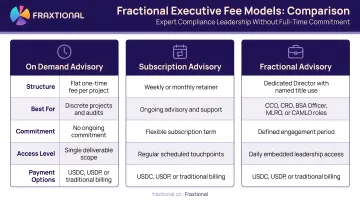
Hybrid Models
Retainer-plus-performance bonuses tied to measurable outcomes are now standard in many compliance engagements:
- Successful regulatory examination with no findings
- Bank partnership secured within 90 days
- Clean audit with no material weaknesses
- Regulatory license approval without deficiencies
When drafting these clauses, define metrics precisely in the agreement — and tie them to outcomes within the executive's control (audit findings) rather than external timelines (regulator processing time).
Market Rate Benchmarks
Full-time compliance executive compensation (baseline for comparison):
- Chief Compliance Officer average base salary: $403,000
- CCO average total cash compensation: $740,707
- Technology sector CCOs: $770,000 total compensation
- Heads of AML/MLROs: $160,000–$220,000+ base salary
Fractional executive pricing:
- General fractional C-suite executives: $8,000–$22,000 per month for 2–3 days per week
- Fractional CFOs: $8,000–$18,000/month
- Fractional CTOs and CMOs: $10,000–$22,000/month
Fractional compliance executive rates (CCO, BSA Officer, CAMLO, MLRO) typically fall within the $12,000–$18,000/month range for experienced directors, driven by the regulatory expertise premium and personal liability exposure.
Cost comparison: A fractional engagement at $15,000/month ($180,000/year) represents a 75% cash saving compared to the $740,000+ total compensation required for a full-time CCO—making director-level expertise accessible to seed-stage and Series A companies.
Confidentiality, IP Ownership, and Conflict of Interest Protections
Confidentiality Clauses for Regulated Industries
Fractional compliance executives handle exceptionally sensitive material—BSA/AML findings, regulatory correspondence, audit results, internal investigation reports, and customer transaction data. Standard NDA language is insufficient.
The agreement must define:
- What counts as confidential information (include regulatory exam reports, suspicious activity data, board materials)
- Duration of confidentiality obligations post-engagement (typically 3–5 years minimum, indefinite for trade secrets)
- Permitted disclosures (legally compelled disclosures to regulators, responses to subpoenas)
- Return or destruction of confidential materials upon termination
- Restrictions on use of confidential information for competitive purposes
Compliance-specific additions:
- Prohibition on disclosing SAR/STR filings (federal law already prohibits this, but reinforce contractually)
- Limits on sharing regulatory examination findings with other clients
- Data security requirements (encryption, secure file transfer, device security)
Intellectual Property Ownership
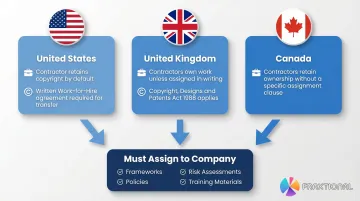
Default ownership rules vary by jurisdiction:
United States: Under 17 U.S.C. § 201, employers automatically own copyrights for works created by employees within scope of employment. For independent contractors, the contractor retains ownership unless the work falls into specific statutory categories AND there is an express written agreement stating it is a "work made for hire."
United Kingdom: Under the Copyright, Designs and Patents Act 1988, employers own copyright for works made by employees in the course of employment. Independent contractors own their work unless assigned in writing.
Canada: The Copyright Act dictates that employers own works created by employees under a "contract of service." Independent contractors retain ownership unless a specific assignment clause is included.
What must be assigned to the company:
- Compliance frameworks and program documentation
- Policies, procedures, and internal controls
- Risk assessments and audit findings
- Training materials and employee guides
- Regulatory filings and correspondence templates
- Due diligence questionnaires and vendor assessments
What the executive may retain:
- General methodologies and expertise transferable across clients
- Pre-existing templates and tools brought into the engagement
- Knowledge and experience gained during the engagement
The line gets blurry in practice. When disputes arise, courts look at whether the work was created specifically for the client or adapted from pre-existing tools — so your contract should require the executive to flag any pre-existing materials used, and document them as licensed-in rather than assigned.
Conflict of Interest and Non-Compete Language
Because fractional executives serve multiple clients simultaneously, the agreement must define which competitor relationships are prohibited, how conflicts must be disclosed, and what the resolution process is.
Prohibited relationships:
- Direct regulatory competitors in the same product category (e.g., can't serve two competing crypto wallet providers simultaneously)
- Companies under adverse supervisory action or consent order
- Companies engaged in litigation with the client
Required disclosures:
- All current and prospective client relationships that could create conflicts
- Any business interests in companies that compete with the client
- Family relationships with employees or executives of competitors
Resolution process:
- Executive must disclose potential conflict within 5 business days of learning about it
- Company has 10 business days to object or approve
- If objection is reasonable, executive must decline the conflicting engagement or resign from one client
The resolution process matters more than the prohibition list — courts care whether you gave the executive a clear, fair path to resolve conflicts before they escalate.
Non-compete enforceability note: The FTC's 2024 rule banning non-competes nationwide was struck down on September 5, 2025, meaning the federal ban is not in effect. State laws continue to govern:
- California - Generally unenforceable except in narrow circumstances
- UK - Proposed limiting post-termination non-competes to 3 months
- Canada (Ontario) - Broadly banned for employees under the Working for Workers Act (2021), though exceptions exist for executives
Non-compete clauses must be reasonable in scope (geography, duration, restricted activities) to be enforceable. Courts are more likely to enforce non-solicitation clauses (prohibiting poaching employees or customers) than outright non-competes.
Regulatory Cooperation Obligations
Include a post-engagement cooperation clause — most generic fractional agreements omit this entirely. The executive must remain available to cooperate with any regulatory examination, internal investigation, or supervisory inquiry that touches their tenure, regardless of when it surfaces.
Critical for:
- BSA Officers who signed SARs during their tenure
- CAMLOs who made AML program certifications
- MLROs who represented the firm to regulators
- CCOs who attested to compliance in board reports
Under the FCA's Conduct Rules (COCON), Senior Managers must "be open and cooperative with the FCA, the PRA and other regulators"—an obligation that extends beyond employment. Fractional agreements must spell this out explicitly.
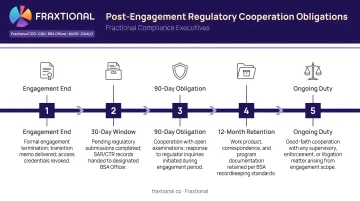
Cooperation obligations should include:
- Availability for interviews with regulators or auditors
- Production of documents and communications from the engagement period
- Truthful testimony in investigations or enforcement proceedings
- Reasonable notice (5–10 business days) and compensation for time (hourly rate or daily fee)
Frequently Asked Questions
What is the difference between a fractional executive agreement and a standard consulting contract?
Fractional agreements are designed for ongoing, embedded leadership roles—they cover decision-making authority, team integration, reporting structures, and indefinite duration. Consulting contracts are scoped to discrete projects with defined deliverables and clear exit points, lacking the governance and operational depth that fractional roles require.
Can a fractional executive work for competing companies at the same time?
Yes, but the agreement must define which conflicts are prohibited (direct competitors, companies under regulatory action) and require proactive disclosure of new engagements. The executive must obtain written consent before accepting any work that could create a conflict.
How should a fractional executive be paid — hourly, retainer, or project-based?
The right model depends on scope: retainers work best for ongoing team leadership; hourly suits advisory roles with variable workload; project fees fit defined deliverables like building a compliance program. Hybrid retainer-plus-bonus structures tied to regulatory outcomes are increasingly common for senior roles.
What are the legal risks of misclassifying a fractional executive as an independent contractor?
Misclassification can result in back taxes (employer share of Social Security, Medicare, unemployment), unpaid benefits, federal penalties up to $10,000 per violation for willful tax evasion, FLSA civil penalties of $2,515 per violation, and personal liability for company officers. The government's classification test—not the contract language—determines the outcome.
Who owns intellectual property created by a fractional executive?
In the US, contractors retain copyright by default unless a written agreement assigns it to the company. The agreement should explicitly transfer company-specific work product (policies, frameworks, reports) to the company while letting the executive retain general methodologies and expertise.
Do fractional compliance executives (CCO, BSA Officer, CAMLO) require different contract language than other fractional roles?
Yes. Generic fractional templates don't address the regulatory obligations these roles carry. Agreements must include clauses covering examiner access, SAR confidentiality, post-termination cooperation with investigations, and regulatory notification requirements.