
Introduction
Fintech, crypto, and banking companies increasingly know they need compliance leadership — but pricing rarely comes with a clear playbook. The result: dangerous underinvestment in regulatory controls, sticker shock at the first fractional CCO or BSA Officer quote, or premium rates paid to generalist consultants who lack regulated-industry depth. Global regulatory fines increased by 417% in H1 2025 compared to the same period in 2024, driven primarily by a crackdown on the digital assets sector.
Fractional compliance executive pricing varies widely based on role type, regulatory scope, jurisdiction, engagement structure, and seniority required. Misunderstanding any one of these factors leads to poor budgeting or the wrong engagement altogether.
Companies approaching sponsor bank relationships or licensing milestones often discover too late that they've underscoped their compliance needs, sometimes resulting in failed audits, delayed partnerships, or regulatory penalties that dwarf the cost of proper leadership.
Getting the budget right starts with understanding what drives the cost. This guide breaks down pricing tiers by compliance role, the factors that move costs up or down, how fee structures are typically built, and how to size a realistic compliance budget for your stage.
Key Takeaways
- Fractional compliance executives (CCO, BSA Officer, CAMLO, MLRO, CRO) typically cost $5,000–$20,000+ per month depending on role, scope, and jurisdiction
- The biggest pricing drivers are role seniority, regulatory complexity, number of jurisdictions covered, and engagement intensity
- Early-stage fintechs and crypto startups typically need lighter retainer arrangements
- Companies approaching bank partnerships or licensing milestones require deeper, higher-cost engagements
- Fractional compliance leadership costs significantly less than a full-time hire — and far less than the fines, failed audits, or lost sponsor bank relationships that follow non-compliance
How Much Does a Fractional Compliance Executive Cost?
There is no single price for fractional compliance leadership — costs vary significantly based on role, regulatory environment, company stage, and engagement model. Companies that assume a single market rate often end up underscoping their needs.
When cost is misunderstood, several things go wrong:
- Startups underbudget and engage an advisor without true ownership accountability
- Scaling companies overpay for generalist consultants who lack regulated-industry depth
- Companies delay compliance leadership entirely — until a regulatory event forces the issue, multiplying cost, urgency, and risk
Pricing by Engagement Tier
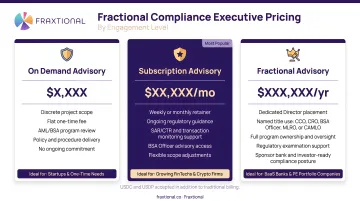
The three tiers below reflect current market ranges for fractional compliance leadership. Use the table as a quick reference, then review the tier breakdowns for scope details.
| Tier | Monthly Range | Best For |
|---|---|---|
| Entry-Level Advisory | $3,000–$6,000 | Pre-revenue, baseline compliance |
| Mid-Range Operational | $7,000–$12,000 | Seed–Series A, named accountability |
| Senior / High-Complexity | $13,000–$20,000+ | Series B+, multi-jurisdiction, crypto |
What's Included — and What's Not
Typically included across all tiers:
- Direct leadership hours from senior compliance professionals
- Regulatory correspondence support
- Policy ownership and development
- Committee and board participation
- Strategic program oversight
Not included (billed separately or by third parties):
- KYC/AML platform and transaction monitoring tool costs
- Licensing fees and application costs
- External legal counsel fees
- External audit and examination fees
- Technology platform subscriptions
Key Factors That Drive Fractional Compliance Executive Pricing
Within any tier, several variables determine where a specific engagement lands. Understanding them helps companies scope engagements correctly rather than defaulting to the cheapest option.
Role Type and Regulatory Designation
Different compliance roles carry different pricing weight. A fractional BSA Officer accountable to regulators and sponsor banks commands different pricing than a fractional CCO providing strategic oversight. A CAMLO or MLRO operating under FCA or FINTRAC obligations carries additional accountability that is reflected in cost.
Regulatory designation matters. In the UK, interim MLRO day rates range from £1,000–£1,600, compared to £600–£1,000 for compliance directors without named accountability. The premium reflects the personal regulatory liability and reputational risk these roles assume.
Fraxtional's "Fractional Advisory" service provides executives who assume full named accountability as CCO, CRO, BSA Officer, MLRO, or CAMLO — meaning they can be named in regulatory filings, audits, and contracts. That distinction matters at audit time: regulators and sponsor banks look for a named, accountable individual — not a consultant listed as "advisor."
Regulatory Complexity and Industry Vertical
High-risk business models — crypto exchanges, money transmitters, embedded finance platforms, BaaS providers — require compliance executives with specialized experience in those models, commanding a premium over generalist compliance leadership.
Regulators have sharpened their focus on these models. The Financial Action Task Force's 2024 and 2025 targeted updates flag virtual assets and VASPs as significant illicit finance risks, noting that "most on-chain illicit activity now involves stablecoins." The European Banking Authority extended its ML/TF risk guidelines to Crypto-Asset Service Providers in 2024, citing the speed of transfers and identity-obscuring features as key risk factors.
That regulatory scrutiny drives compensation upward. Full-time market rates illustrate the specialist premium:
| Role | Region | Compensation Range |
|---|---|---|
| Crypto Compliance Officer | US | $160,000 median total pay ($92K–$161K base + $29K–$53K additional) |
| Head of Financial Crime / MLRO (CIB) | UK | £150,000–£300,000 |
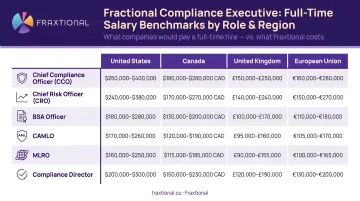
Sources: Glassdoor, Barclays Simpson 2025 Guide. Fractional rates are a fraction of these figures, but the specialist premium still applies relative to generalist compliance engagements.
Jurisdictional Scope
Multi-jurisdiction engagements (for example, a fintech operating in the US, UK, and EU simultaneously) are priced higher than single-market engagements due to the need for cross-border regulatory fluency across BSA/AML, FCA rules, GDPR, PSD2, and local licensing regimes.
The UK Financial Conduct Authority requires specific Senior Management Functions (SMFs) to be approved before starting their roles, notably SMF16 (Compliance Oversight) and SMF17 (Money Laundering Reporting Officer). FinCEN's proposed AML/CFT program requirements emphasize the need for financial institutions to have persons responsible for the AML/CFT program based in the United States.
Scope structure sets the floor on cost. Seniority sets the ceiling — and justifies it. A compliance executive with a proven track record in securing sponsor bank partnerships, navigating regulatory examinations, or building programs trusted by investors will price higher — and that premium is worth it, particularly for companies at inflection points like fundraising or licensing.
Fraxtional has documented cases where their compliance leadership helped clients secure sponsor bank relationships in under 60 days, pass regulatory reviews faster than expected, and avoid delays in onboarding by resolving policy deficiencies within days. This track record commands a premium over generalist consultants without these outcomes.
Common Fee Structures for Fractional Compliance Executives
Fractional compliance executives use several different fee structures, and the right one depends on the nature of the engagement — ongoing operational leadership requires a different structure than a one-time gap assessment or project.
Monthly Retainer (Most Common)
The retainer model — a fixed monthly fee tied to a defined scope of hours and responsibilities — is the most common structure for fractional compliance leadership with operational accountability. It provides cost predictability for the company and keeps the executive accountable to continuous program performance, not just billable hours.
Typical retainer terms include:
- Minimum 3–6 month commitment period
- Defined deliverables and service levels
- Hours-per-week allocation (e.g., 10–20 hours)
- Escalation procedures for regulatory events
- Response time commitments for routine vs. urgent matters
Hourly and Project-Based Arrangements
Hourly or project-based pricing works well for discrete, time-limited engagements:
- Gap assessments and compliance audits
- Policy and procedure drafting
- Pre-deal compliance reviews for investors
- Short-term advisory engagements where direct reporting accountability is not required
Fractional CFO hourly rates range from $150–$450, with compliance professionals in comparable senior tiers charging similar rates. UK interim compliance roles translate to approximately £86–£171 per hour based on day rates of £600–£1,200.
For ongoing compliance programs, this model creates exposure — it doesn't reflect the continuous ownership that operational roles demand. Reserve it for projects with defined scope and a clear finish line. When the work bleeds into program management, a retainer structure is the more appropriate fit.
Performance or Milestone-Based Additions
Some senior fractional compliance executives, particularly those engaged around licensing milestones, sponsor bank approval, or regulatory exam preparation, may structure a portion of their fee around successful outcomes.
It makes sense when all of the following conditions are met:
- There's a clear, measurable outcome (license approved, exam passed, bank partnership secured)
- The executive has meaningful control over the outcome
- Both parties agree on success criteria upfront
- Base compensation still covers the executive's time and expertise
This model carries risks: Regulatory outcomes depend on many factors beyond the executive's control. A failed licensing application may reflect the business model, not the quality of compliance work. Clear success definitions and realistic expectations are essential.
Fractional vs. Full-Time Compliance Executive: The True Cost
Comparing fractional and full-time compliance executive costs requires looking at total employer cost — not just base salary. Most companies significantly underestimate the full-time figure.
Full-Time CCO Base Salary Benchmarks:
- US Public Company: $532,454 median total pay (2024)
- US Private Company: $316,000 median total pay (2024)
- US All Industries: $234,301 average base salary (2026)
- UK Fintech & Payments: £150,000–£250,000 base for SMF16 Head of Compliance
- UK Corporate Banking: £150,000–£300,000 base for Head of Financial Crime / MLRO
Employer On-Costs:
For management and professional occupations in March 2025, total benefits accounted for 31.3% of total compensation. This means a $250,000 base salary carries approximately $78,250 in employer costs for benefits and payroll taxes.
Executive Search Fees:
Retained executive search firms typically charge between 25% and 35% of the placed executive's total first-year compensation (base salary plus target bonus). For a $300,000 total compensation package, search fees add $75,000–$105,000 to the true first-year cost.
Total First-Year Cost Example (US Private Company CCO):
- Base salary: $250,000
- Benefits and payroll taxes (31.3%): $78,250
- Executive search fee (30%): $75,000
- Total first-year cost: $403,250
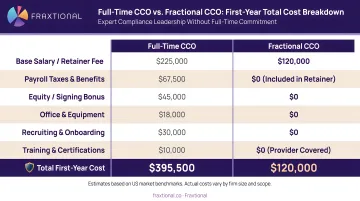
Fractional Alternative at $12,000/month:
- Annual cost: $144,000
- First-year savings: $259,250
Those numbers make the financial case clearly. The deeper argument is fit: a seed-stage fintech doesn't need 40 hours per week of CCO time. It needs expert compliance leadership matched to its actual regulatory obligations and growth stage — and fractional engagement delivers exactly that.
Speed Advantage:
Engaging a fractional compliance provider takes days, not months — and in compliance, timing around a regulatory review or bank partnership application is rarely flexible.
Fraxtional's director-led model enables companies like PayForGo, Swap Global, and others to deploy qualified compliance executives within days or weeks, compared to the typical 6–12 month full-time recruitment timeline.
How to Budget for Fractional Compliance Leadership at Your Stage
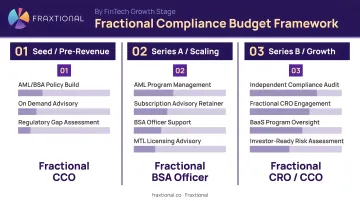
Budget based on company stage and regulatory trigger points:
Pre-Revenue / Seed (Compliance Baseline):
- Budget range: $3,000–$6,000/month
- Scope: Policy framework development, bank application readiness, initial risk assessments
- Duration: 3–6 months to establish foundation
- Trigger points: Approaching first sponsor bank conversation, preparing for seed fundraise
Series A (BSA/AML Program Build):
- Budget range: $7,000–$12,000/month
- Scope: BSA/AML program build, sponsor bank onboarding, first regulatory exam prep, named BSA Officer designation
- Duration: 6–12 months to operationalize program
- Trigger points: Securing sponsor bank partnership, launching regulated product, first regulatory examination
Series B+ / Crypto / Cross-Border (Multi-Jurisdiction Programs):
- Budget range: $13,000–$20,000+/month
- Scope: Multi-jurisdiction programs, CAMLO/MLRO designation, investor due diligence readiness, cross-border regulatory coordination
- Duration: 12+ months ongoing operational leadership
- Trigger points: Expanding to new jurisdictions, applying for MTL or crypto licenses, preparing for major regulatory review
The Three Most Common Budgeting Mistakes
Under-scoping the retainer. Compliance is an ongoing operational function. A 3-month engagement to write policies doesn't address who manages the BSA/AML program, responds to regulatory inquiries, or maintains sponsor bank relationships once those policies exist.
Choosing on price without evaluating domain fit. Generalist consultants lack the specific experience required for BaaS, crypto, or high-risk payments. A consultant who has never navigated a sponsor bank exam for a crypto-enabled platform won't understand the nuances that determine approval vs. rejection.
Ignoring the downstream cost of under-investment. Those expertise gaps have a price. Regulatory fines, failed sponsor bank relationships, and investor scrutiny that a well-run compliance function would have prevented far exceed the cost of proper leadership.
- Binance: $4.316 billion for willful failure to implement an effective AML program (2023)
- TD Bank: $3.09 billion for BSA/AML compliance failures and failure to file SARs, with asset cap and business restrictions imposed (2024)
- BitMEX: $100 million for willful failure to establish adequate AML and KYC program (2024)
- Starling Bank: £28.96 million for "shockingly lax" financial sanction screening controls (2024)
Fines are only part of the exposure. Inadequate compliance programs can end a company's ability to operate entirely. Silvergate Bank wound down and liquidated in 2023, cutting off fiat on/off-ramps for crypto exchanges across the industry. Paxos was ordered to stop minting BUSD following unresolved oversight issues tied to its Binance relationship.
Budget decisions should be calibrated to actual risk profile, regulatory obligations, and growth stage — not to finding the lowest number. For companies approaching a sponsor bank conversation or a licensing milestone, the cost of getting compliance wrong almost always exceeds the cost of getting it right from the start.
Frequently Asked Questions
How much does a fractional executive cost?
General C-suite fractional roles typically run $8,000–$20,000+ per month. Compliance-specific executives (CCO, BSA Officer, CAMLO, MLRO) fall in a similar range of $5,000–$20,000+, with pricing shaped by regulatory complexity, jurisdictional scope, and named accountability requirements.
How much does a fractional CMO cost per month?
Fractional CMO monthly costs range from $4,000–$25,000+, averaging $12,000–$15,000 for mid-market engagements. Compliance roles like CCO or MLRO price similarly, with premiums added for regulatory accountability and the specialized expertise these positions require.
What is the hourly rate for a fractional compliance executive?
Senior compliance advisory work can be billed hourly at $150–$450 per hour. Most fractional compliance leadership roles, however, use monthly retainers — a structure that better fits ongoing operational ownership rather than discrete task billing.
How much does a fractional CFO charge per hour?
Fractional CFO hourly rates run $175–$450, with monthly retainers averaging $3,000–$10,000. Fractional BSA Officers and CCOs sit in a comparable senior tier, though retainer pricing is standard for roles with direct regulatory accountability.
What is the difference between a fractional CCO and a fractional BSA Officer?
A CCO owns overall compliance program strategy across all regulatory obligations. A BSA Officer carries specific, named accountability for Bank Secrecy Act requirements — AML program management, SAR filing, and transaction monitoring. BSA-designated roles can command premiums given their direct accountability to banking partners and regulators.
When should a fintech startup hire a fractional compliance executive?
Key trigger points include approaching a sponsor bank relationship, applying for a money transmitter license, preparing for a regulatory examination, or entering a new jurisdiction. Engaging fractional compliance leadership before these milestones — rather than reactively — reduces delays, avoids failed partnerships, and cuts remediation costs.