
Introduction
Scaling startups face a fundamental dilemma: sustainable revenue growth demands senior leadership, yet the economics often don't add up. A full-time Chief Revenue Officer commands $180,000–$275,000 in base salary alone, with total compensation reaching $350,000–$600,000 when you factor in bonuses, equity (typically 1.0%–2.5%), and the 29.9% employer benefits burden. For seed-to-Series B companies still proving product-market fit, that's capital better allocated to product, marketing, or runway extension.
The fractional CRO model fills that gap—delivering C-suite revenue strategy and execution at $8,000–$22,000 per month, without the full-time commitment.
This guide covers what a fractional CRO actually does, what it realistically costs, and how to evaluate ROI before making the hire. For regulated industries like FinTech, crypto, and embedded finance, it also examines why compliance leadership often needs to run alongside revenue strategy to protect both growth and investor confidence.
TLDR:
- Fractional CROs cost $8,000–$22,000/month vs. $350,000–$600,000+ for full-time executives
- Impact typically visible within 30 days, measurable pipeline improvements in 60–90 days
- Ideal when revenue stalls, founder still runs sales, or teams operate in silos
- Regulated startups often need fractional compliance (CCO/BSA Officer) running parallel to revenue strategy
- Engagement models range from light advisory to embedded execution with clear exit plans
What Is a Fractional CRO and Why Do Startups Need One?
Defining the Fractional CRO Role
A fractional Chief Revenue Officer is a senior executive engaged on a part-time or contract basis—typically 1–3 days per week—to own revenue strategy across sales, marketing, and customer success. Unlike full-time hires, fractional CROs deliver the same strategic scope and accountability without the salary, benefits, or equity commitment that makes permanent C-suite roles financially prohibitive for early-stage companies.
How Fractional Differs from Full-Time
Both roles carry identical strategic accountability for pipeline, conversion, and revenue targets. The difference lies in structure:
- Flexible engagement duration — scale involvement up or down as needs evolve
- Lower all-in cost — no benefits, equity dilution, or severance exposure
- Faster time-to-value — skip the 3–6 month ramp period of a full-time hire
Why Early-Stage Startups Are Ideal Candidates
Seed-to-Series B startups face high-stakes go-to-market decisions—pricing architecture, ICP definition, channel strategy—but lack the revenue volume or organizational maturity to justify a permanent revenue executive. The fractional model provides seasoned guidance precisely when strategic missteps carry the highest cost, without locking capital into fixed overhead before the business model is fully validated.
Fractional CRO vs. Consultant: Operational Ownership Matters
Consultants deliver recommendations; fractional CROs take operational ownership of outcomes. A fractional CRO owns pipeline targets, team alignment, KPI achievement, and execution accountability. They're embedded in your business, attending leadership meetings, coaching reps, and adjusting strategy based on real-time performance data—not writing slide decks from a distance.
The Compliance Dimension for Regulated Startups
That operational accountability takes on added weight in regulated industries, where revenue strategy and compliance readiness are inseparable.
For FinTech, crypto, embedded finance, and banking startups, regulatory gaps directly threaten revenue operations and investor confidence. Sponsor banks won't onboard companies with weak AML frameworks. Investors flag due diligence when BSA/AML policies don't hold up to scrutiny.
In these sectors, fractional compliance leadership runs parallel to revenue strategy. Fraxtional provides fractional CCOs, CROs, CAMLOs, MLROs, and BSA Officers who embed with startups to close regulatory gaps — delivering director-level expertise without full-time executive overhead.
What Does a Fractional CRO Actually Do?
Revenue Strategy Ownership
A fractional CRO defines go-to-market positioning, pricing architecture, sales playbooks, and repeatable revenue processes from top-of-funnel through close. The work is tactical: building the frameworks your team executes daily to convert pipeline into bookings.
Cross-Functional Alignment
Misalignment between sales and marketing costs B2B companies 10% or more of revenue annually. Fractional CROs break down silos by establishing:
- Shared KPIs and unified revenue targets
- Common definitions of qualified leads (MQLs, SQLs)
- Single pipeline view across marketing, sales, and customer success
- Unified messaging that carries from first touch through renewal
According to SiriusDecisions research, tightly aligned organizations achieve 24% faster three-year revenue growth and 27% faster profit growth.
Team Building and Coaching
On the talent side, a fractional CRO takes on:
- Hiring and onboarding sales talent with structured ramp plans
- Designing compensation plans that align incentives with company goals
- Coaching reps on deal qualification, objection handling, and closing techniques
- Removing the founder from the de facto "Head of Sales" role so they can focus on product and vision
This transition matters: founder-led sales typically breaks down as a primary growth engine between $500K and $10M ARR. Handing off sales before the ICP and buying triggers are documented into a repeatable motion almost always stalls growth.
RevOps and Tooling Infrastructure
Reliable forecasting depends on the right operational foundation. A fractional CRO sets that up:
- CRM setup and optimization (Salesforce, HubSpot, Pipedrive)
- Sales automation and workflow design
- Pipeline reporting dashboards with stage-by-stage conversion metrics
- Forecast accuracy frameworks that tie activity to outcomes
Forrester research shows aligned organizations achieve up to 19% faster revenue growth and 15% higher profitability when RevOps infrastructure supports unified data governance.
What Fractional CROs Don't Do
Understanding scope matters. A fractional CRO is not:
- A replacement for your full sales team
- An outsourced agency handling execution for you
- Passive advisors who show up monthly for strategy calls
The goal is a revenue engine that runs without them — systems and team capability that outlast the engagement.
How Much Does a Fractional CRO Cost?
Full-Time CRO Cost Baseline
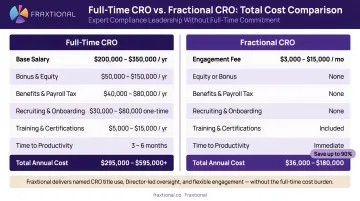
For Series A–B startups, a full-time CRO commands:
- Base salary: $180,000–$275,000
- On-target earnings (OTE): $350,000–$600,000
- Equity: 1.0%–2.5% (4-year vesting, 1-year cliff)
- Benefits overhead: 29.9% of total compensation (U.S. Bureau of Labor Statistics, December 2025)
All-in first-year cost easily exceeds $400,000–$700,000 when you include recruiting fees, ramp time, and equity dilution.
Fractional CRO Engagement Models and Pricing
Fractional pricing varies by scope, seniority, and engagement intensity:
Part-Time Retainer (1–2 days/week) — $5,000–$15,000/month
- Strategic oversight, playbook development, quarterly planning
- Monthly strategy sessions, sales process audits, hiring support
Embedded Fractional (10–20 hours/week) — $10,000–$22,000/month
- Hands-on execution, team coaching, pipeline ownership
- Weekly team meetings, deal reviews, CRM buildout, KPI dashboards
Project-Based Engagement — $10,000–$50,000/project
- Defined scope for GTM launches, pricing overhauls, or new market entry
- Clear milestones and exit criteria from day one
What Drives Cost Variation
Several factors influence pricing:
- Track record: Executives with exits or category expertise command premium rates
- Industry depth: FinTech, crypto, or highly regulated sectors require specialized knowledge
- Engagement intensity: Advisory calls vs. embedded execution with team management
- Geographic market: Coastal U.S. markets typically run 20–30% higher than other regions
True Cost Savings Beyond Salary
Those factors explain why prices vary — but they don't capture what you're not paying for. Fractional engagements eliminate:
- Employer taxes and benefits overhead (29.9% burden)
- Equity dilution (1.0%–2.5%)
- Severance risk and long-term employment commitments
- 3–6 month ramp period before full productivity
- Recruiting fees (typically 20–30% of first-year salary)
A $15,000/month embedded engagement runs $180,000 annually. That's access to $350,000+ executive talent — without the equity give-up, benefits burden, or severance exposure that come with a full-time hire.
The ROI of a Fractional CRO: Real Numbers
Two Primary ROI Levers
Fractional CROs drive returns through:
- Increased pipeline velocity – Faster deal cycles, higher conversion rates, shorter sales cycles
- Reduced customer acquisition cost (CAC) – Better targeting, improved win rates, optimized sales efficiency
These metrics compound quickly once a structured GTM system replaces unstructured selling.
Real-World Impact Examples
Case Study 1: Series B FinTech (Fraxtional client) A Series B FinTech firm engaged a fractional CRO for a 6-week gap analysis. By streamlining lead routing and redefining qualification criteria, conversion efficiency increased 17% within one quarter.
Case Study 2: SaaS Scale-Up A SaaS company saw +35% close rates and -22% CAC within six months after bringing in a fractional CRO to redesign the sales process, implement lead scoring, and rebuild compensation plans.
Speed to Value Advantage
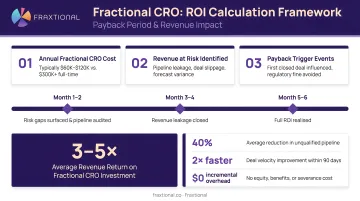
Fractional CROs deliver measurable impact within 2–4 weeks, with most clients seeing pipeline improvements within 60–90 days. By contrast, full-time executives take 3–6 months to reach full productivity, with McKinsey noting that 62% of external hires take at least six months to deliver real impact.
Simple ROI Framework
Use this calculation to model your scenario:
| Input | Value |
|---|---|
| Monthly fractional cost | $15,000 |
| Median ACV (SaaS) | $26,265 (SaaS Capital 2025) |
| Baseline monthly closed deals | 10 deals/month |
| Post-engagement improvement | +20% = 2 additional deals/month |
| Output | Value |
|---|---|
| New monthly ARR added | 2 × $26,265 = $52,530/year |
| 12-month engagement cost | $180,000 |
| ARR payback period | ~3.4 years at current rate — or sooner if win rates improve further |
| Realistic break-even trigger | +38% conversion improvement (4 additional deals/month) recovers cost in ~12 months |
The math shifts decisively when a fractional CRO addresses deal cycle time and win rates simultaneously — which is where most structured engagements focus first. Startups with ACVs above $40,000 or deal volumes above 15/month typically see payback within the first year.
5 Signs Your Startup Needs a Fractional CRO Now
1. Revenue Has Plateaued Despite Marketing Spend Increasing
Deals stall in late stages, win rates decline, and no one owns the diagnosis. The average B2B win rate sits at 21% across all opportunities, dropping to 19% in recent benchmarks. When pipeline grows but closed revenue doesn't, you have a conversion problem—not a lead volume problem.
2. Sales and Marketing Operate in Silos
Marketing generates leads that sales can't convert. There's no shared definition of a qualified lead, no unified revenue target, and finger-pointing replaces accountability. Forrester's 2024 research found 86% of B2B purchases stall during the buying process, often because internal teams aren't aligned on how to guide buyers through complexity.
3. The Founder Is Still Running Sales
When the CEO or co-founder remains the primary closer, growth caps at their personal bandwidth. Founder-led sales works in early stages. It breaks as the company scales, particularly when handoffs occur before the ICP, buying triggers, and qualification criteria are documented into repeatable systems.
4. You're Preparing for a Fundraise, New Market Entry, or Product Launch
High-stakes milestones demand a structured, credible revenue narrative. Improvisation doesn't close investors or new markets. Investors expect to see:
- Clear GTM strategy with defined TAM/SAM/SOM
- Repeatable sales motion with documented unit economics
- Pipeline visibility and forecast accuracy
- Evidence of scalable growth, not founder heroics
5. You Need Senior Guidance but Can't Justify a $300K+ Salary
Budget constraints make full-time C-suite hiring premature, but the strategic need for revenue leadership is real and urgent. A fractional CRO delivers executive-level strategy and execution at 20–30% of the full-time cost — no equity dilution, no long-term overhead, no waiting six months to hire.
How to Choose and Onboard the Right Fractional CRO
Key Evaluation Criteria
Industry-specific GTM experience matters most in regulated sectors. A fractional CRO who already understands sponsor bank onboarding, BSA/AML requirements, or MiCA compliance saves months of learning curve — time a seed-stage startup can't afford to lose.
Ask for examples of revenue frameworks they've built, not just deals they've closed. You need someone who can:
- Document ICP definitions and buying triggers
- Design sales playbooks and enablement programs
- Build forecasting models with stage-by-stage conversion metrics
- Coach teams to execute independently
Check references from comparable growth stages. A CRO who scaled enterprise SaaS from $50M to $200M ARR may not understand the lean, resource-constrained reality of a $2M seed-stage startup. Match their experience to where you are now — and where you need to be in 12–18 months.
Once you've identified the right candidate, how you structure the engagement determines whether they deliver or drift.
Engagement Setup for Success
Start by clarifying what they own versus what they advise on:
- Own: Pipeline targets, conversion metrics, sales process design, team coaching
- Advise: Hiring decisions, pricing strategy, market positioning
From there, set concrete 30-60-90 day milestones:
- Days 1–30: Revenue operations audit, team capability assessment, tech stack evaluation
- Days 31–60: Strategic plan development, priority initiative identification, success metrics definition
- Days 61–90: Quick wins implementation, process optimization, performance tracking setup
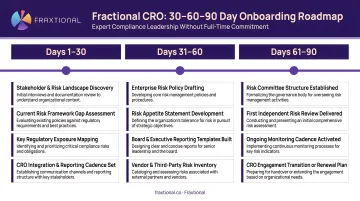
According to Cornerstone OnDemand research, structured onboarding plans result in 2.6× higher satisfaction and accelerate time-to-productivity.
Access is just as important as structure. Fractional CROs need:
- Direct CEO access for strategic alignment
- Full CRM data visibility (Salesforce, HubSpot, Pipedrive)
- Regular touchpoints with sales, marketing, and customer success teams
- Authority to make operational decisions within agreed scope
Without these inputs, even strong executives will underperform.
Plan the Transition from Day One
Structure engagements with an exit plan in mind:
- Recruit and hand off: Fractional CRO helps hire and onboard a full-time revenue leader as the business scales
- Evolve to advisory: Engagement shifts to lighter oversight as the internal team matures
- Convert to full-time: Fractional role becomes a permanent position if mutual fit emerges
Clear transition expectations prevent misalignment and ensure knowledge transfer happens systematically rather than reactively.
Frequently Asked Questions
What is a fractional CRO?
A fractional CRO is a senior Chief Revenue Officer engaged part-time or on contract to lead revenue strategy, GTM execution, and team alignment—giving startups executive-level leadership without the cost or commitment of a full-time hire.
How much does a fractional CRO cost?
Fractional CRO costs vary by engagement model and experience level, typically ranging from $5,000/month for light advisory to $15,000–$22,000/month for embedded, execution-focused roles. That's a significant reduction compared to the $350,000–$600,000 total cost of a full-time CRO.
What is the difference between a fractional CRO and a full-time CRO?
Both roles carry the same strategic accountability for revenue. A fractional CRO works part-time across a defined engagement period without salary, benefits, or equity overhead, making them the right fit for startups that need senior guidance before justifying a permanent hire.
When should a startup hire a fractional CRO?
The right time is typically when revenue growth has stalled, the founder is still running sales, or teams are misaligned. It's also worth acting before a critical inflection point—like a fundraise or new market launch—while there's still time to course-correct.
How long does it take to see results from a fractional CRO?
Most fractional CROs deliver initial diagnostic findings and quick wins within the first 30 days, with measurable pipeline and conversion improvements typically visible within 60–90 days, depending on GTM complexity and the startup's execution capacity.