Introduction
The Nevada Money Transmitter License (MTL) is a state-issued license required under NRS Chapter 671 for any person or entity engaging in money transmission in Nevada — including selling payment instruments, issuing stored value, or receiving money for transmission.
If your business falls into any of these categories, this license applies to you:
- Fintech companies and payment apps
- Crypto platforms and bitcoin ATM operators
- Digital wallet providers
- Embedded finance startups
Operating without a license exposes your business to criminal penalties, fines up to $10,000 per violation, and cease-and-desist orders from Nevada's Division of Financial Institutions.
Nevada revised its MTL framework in 2023 through Assembly Bill 21, raising capital and bond requirements, broadening the definition of money transmission, and tightening compliance obligations.
What follows is a practical breakdown of who needs the Nevada MTL, what the pre-application requirements look like, how to file through NMLS, and what compliance obligations come after approval.
Key Takeaways
- Nevada MTL (NRS Chapter 671) covers money transmission, payment instruments, stored value, and cryptocurrency operators
- Minimum bond of $100,000 and tangible net worth of $100,000 required (not the outdated $10,000 minimum)
- Applications filed through NMLS typically take 6–8 months, with strict 6-month withdrawal rule for incomplete filings
- Ongoing obligations: quarterly condition reports, annual audited financials, BSA/AML reporting, and permissible investments equal to outstanding transmission obligations
- Exemptions apply to banks, certain payment processors, broker-dealers, and government entities—eligibility must be documented and proven
What Is the Nevada Money Transmitter License?
The Nevada MTL is a regulatory authorization issued by the Division of Financial Institutions, a division of the Nevada Department of Business and Industry, under NRS Chapter 671. Nevada modernized its MTL framework effective July 1, 2023 via Assembly Bill 21 (AB21), aligning state law with the CSBS Model Money Transmission Modernization Act adopted by multiple states.
What "Money Transmission" Means
Under NRS 671.013, money transmission includes:
- Selling or issuing payment instruments (checks, money orders, traveler's checks) to Nevada residents
- Selling or issuing stored value products (prepaid cards, digital wallets)
- Receiving money or credits for transmission to another location or person
- Payroll processing services (explicitly included)
Nevada MTL vs. Federal FinCEN Registration
Federal MSB registration with FinCEN does not replace state licensing. FinCEN explicitly states that its registration "does not replace or supersede" state regulatory requirements — a distinction many fintech startups miss.
Bottom line: you must register with FinCEN and obtain a Nevada MTL to operate legally. Both are required; neither satisfies the other.
Who Needs a Nevada Money Transmitter License (and Who Is Exempt)?
Businesses That Require Licensure
NRS 671.040 applies the licensing requirement regardless of operational method—whether you operate in-person, via the internet, through a kiosk, or by telephone. Businesses that must hold a Nevada MTL include:
- Remittance companies and international money transfer operators
- Digital wallet providers and payment apps transmitting money on behalf of users
- Cryptocurrency platforms and digital asset exchanges
- Bitcoin ATM operators and crypto kiosks
- Stored value card issuers
- Payroll processors
- Peer-to-peer payment platforms
Nevada's Division of Financial Institutions has explicitly confirmed that cryptocurrency operators—including businesses that "facilitate the transmission of or hold fiat or digital currency by way of brick-and-mortar, kiosk, mobile, internet or any other means"—must obtain a money transmitter license.
Key Exemptions Under NRS 671.020
Not all businesses handling money require licensure. Exemptions include:
| Exemption Category | Statutory Criteria |
|---|---|
| Depository Institutions | Federally or privately insured depository financial institutions, bank holding companies, and foreign bank federal branches |
| Payment System Operators | Operators providing processing, clearing, or settlement services between or among exempt persons or licensees |
| Agent of the Payee | Must have a written agreement to collect/process payments; the payee must hold the agent out to the public as accepting payments; and payment must be treated as received by the payee upon receipt by the agent (extinguishing payor risk) |
| Securities Broker-Dealers | Persons registered as securities broker-dealers under federal or state laws, to the extent of their operation as such |
| Government Entities | Departments, agencies, or instrumentalities of the U.S. government, states, counties, or cities |
Proving Your Exemption
The burden of proof rests on the entity claiming an exemption. Under NRS 671.021, the Commissioner can require any entity to provide documentation proving it qualifies. Assuming an exemption without verification is a costly mistake. Confirm your status with the Division of Financial Institutions before operating.
The Commissioner may also grant additional exemptions by regulation or order if deemed in the public interest (NRS 671.0205).
Key Requirements Before You Apply for a Nevada MTL
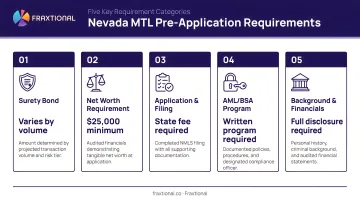
Nevada's 2023 reforms (AB21) overhauled the requirements for money transmitter applicants — raising the bond minimum from $10,000 to $100,000 and adding net worth and permissible investment thresholds. There are five distinct requirement categories you'll need to satisfy before submitting.
Surety Bond
Under NRS 671.100, applicants must maintain a surety bond payable to the State of Nevada equal to the greater of:
- $100,000 (minimum floor), or
- 100% of the applicant's average daily money transmission liability in Nevada for the most recently completed quarter
The bond is capped at a maximum of $500,000. The bond must be issued by a surety company authorized to do business in Nevada. Applicants may alternatively deposit securities instead of a bond under NRS 671.110.
Important: Many outdated guides cite a $10,000 bond minimum. This figure is no longer valid after AB21.
Tangible Net Worth
Per NRS 671.115, every applicant must maintain at all times a tangible net worth of the greater of:
- $100,000 (minimum floor), or
- 3% of total assets for the first $100 million in assets, 2% of additional assets between $100 million and $1 billion, and 0.5% of assets exceeding $1 billion
This must be evidenced by audited financial statements satisfactory to the Commissioner.
Permissible Investments
Under NRS 671.125 and 671.135, licensees must at all times maintain permissible investments with a market value equal to or exceeding their total outstanding money transmission obligations. Qualifying investments include:
- Cash and demand deposits
- U.S. government obligations
- Eligible rated securities
This means your investment coverage must be monitored and maintained on an ongoing basis — not just verified at the time of application.
Personal History and Background Requirements
Under NRS 671.098, every key individual, person in control, and owner/officer/director must submit through NMLS:
- Fingerprints for FBI background checks
- Personal and financial history disclosures
- Credit reports
- Disclosure of criminal convictions, regulatory actions, or civil litigation involving fraud or breach of fiduciary duty
- An independent investigative background report from an unaffiliated search firm (required for anyone who has lived outside the U.S. in the past 10 years)
Core Application Documents
Based on NRS 671.050, compile the following documents:
- Audited financial statements for the most recent fiscal year and two prior years
- Unaudited financials for the most recent quarter
- Certificate of good standing
- Formation documents (articles of incorporation, operating agreement)
- Organizational and management charts
- Business plan describing money transmission services
- Flow of funds diagram
- Sample payment instrument or stored value form
- Registered agent information in Nevada
- Bank account information
- List of proposed authorized delegates with Nevada locations
- Criminal conviction and material litigation history for past 10 years
How to Apply for a Nevada Money Transmitter License: Step-by-Step
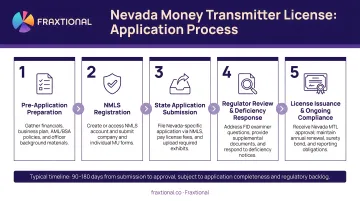
Nevada processes all money transmitter license applications through the Nationwide Multistate Licensing System (NMLS), as required under NRS 671.092 and 671.099. Before starting any step below, create your NMLS account — every document submission and fee payment flows through that portal.
Step 1: Register with FinCEN
Before submitting your state application, register as a Money Services Business with FinCEN. This federal registration is mandatory for all MSBs and must be completed first.
Step 2: Prepare and Assemble Application Materials
Gather all required documents before opening your NMLS submission. The core materials include:
- Nevada MTL Initial Addendum and Checklist
- MTL Application form
- Bond Form
- Personal History Record for each qualifying individual
All forms are available through the Nevada FID website and NMLS. Audited financial statements and background check submissions take the longest to obtain — start those immediately.
Step 3: Obtain the Surety Bond
Contact a Nevada-authorized surety company to obtain your bond. The bond amount is determined by the $100,000 minimum floor or average daily liability calculation. The surety company will conduct a credit check on principals (typically a soft pull). Rates generally range from 1.5% to 3% of the bond amount for applicants with strong credit—meaning a $100,000 bond could cost $1,500 to $3,000 annually.
Step 4: Submit Application via NMLS and Pay Fees
Submit the completed application, all supporting documents, bond form with power of attorney, and fees through NMLS.
Per NRS 671.050, the non-refundable application and survey fee is up to $500, and the licensing fee is between $200 and $400 (prorated based on the licensing year). Nevada Administrative Code currently sets the application fee at $375 and the license fee at $300. Additional investigation costs may apply if the Commissioner orders an on-site review.
Step 5: Commissioner Investigation and License Decision
Once the application is deemed complete, the Commissioner reviews the applicant's financial condition, business experience, and character fitness — including key individuals and persons in control. The Commissioner must confirm all requirements are met and that granting the license serves the public interest.
Critical 6-Month Rule: Under NRS 671.050(6), if all information and fees are not received within 6 months, the application is deemed withdrawn. You must start over with a new application and new fees.
If the application is denied rather than withdrawn, the applicant receives written notice and may appeal under NRS 233B.121.
Timeline: Based on industry experience, Nevada MTL applications typically take 6–8 months depending on application completeness and the Commissioner's investigation timeline.
Ongoing Compliance Obligations After Getting Licensed
A Nevada MTL comes with multiple ongoing reporting obligations — quarterly filings, event-driven disclosures, and annual audits — each with hard deadlines.
Reporting Requirements
Licensed money transmitters in Nevada must submit:
| Requirement | Deadline | Citation |
|---|---|---|
| Event-Driven Reports | Within 1 business day for bankruptcy, receivership, or license suspension in another state; within 3 business days for felony charges/convictions against key individuals or delegates | NRS 671.325 |
| Quarterly Report of Condition | Within 45 days after the end of each calendar quarter | NRS 671.305 |
| Quarterly Authorized Delegate Report | Within 45 days after the end of each calendar quarter | NRS 671.315 |
| Annual Audited Financial Statement | Within 90 days after the end of the fiscal year | NRS 671.285 |
BSA/AML Compliance
Per NRS 671.295, licensees and their authorized delegates must file all reports required under the Bank Secrecy Act, including:
- Currency Transaction Reports (CTRs)
- Suspicious Activity Reports (SARs)
This requires a documented BSA/AML compliance program with senior executive accountability — and the operational lift is heavier than most fintech companies expect post-licensure. A Fractional BSA Officer from Fraxtional can provide that ongoing oversight without the overhead of a full-time hire.
License Renewal and Key Individual Changes
Nevada MTLs expire on December 31 each year and must be renewed by filing a renewal application and paying a renewal fee (up to $400) between November 1 and December 31 (NRS 671.070). Late renewal through February 28 of the following year is possible with an additional fee.
Adding or replacing a key individual requires notifying the Commissioner within 15 days and submitting required information within 45 days under NRS 671.195. Any acquisition of control of a licensee requires prior Commissioner approval under NRS 671.155.
Common Mistakes and Misconceptions About the Nevada MTL
Underestimating the Bond and Net Worth Requirements
Many older articles cite a $10,000 surety bond minimum. The 2023 revision of NRS Chapter 671 increased the minimum bond to $100,000 (or 100% of average daily money transmission liability, capped at $500,000). Applicants also frequently cite outdated net worth figures — the current statutory minimum is $100,000.
Assuming Cryptocurrency or Digital Assets Don't Require a License
Nevada's Division of Financial Institutions has explicitly stated that cryptocurrency operators—including bitcoin ATM operators and businesses holding or transmitting digital or fiat currency by any means—must obtain a money transmitter license. Operating without a license on the assumption that digital assets fall outside NRS Chapter 671 can trigger a cease-and-desist order and civil penalties under NRS 671.395.
Overlooking Authorized Delegate Obligations
Many first-time applicants treat the authorized delegate framework as a minor administrative formality. NRS 671.205 imposes substantial obligations:
- Written contracts must meet specific statutory requirements
- Background investigations of delegates are required
- The licensee is responsible for the compliance of all authorized delegates
- Contracts must impose a trust on funds received for transmission (net of fees), protecting customers' money in transit
- Delegates must acknowledge consent to Commissioner examination
- Use of subdelegates is prohibited
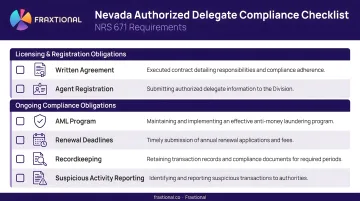
Failure to properly manage delegates is one of the grounds for license suspension under NRS 671.435. The Commissioner can suspend, revoke, or deny renewal if you fail to remove an authorized delegate after a final regulatory order.
The statute also reaches further: if a delegate violates anti-money laundering laws due to the licensee's "willful misconduct or willful blindness," the licensee bears that exposure directly.
Frequently Asked Questions
How much does it cost to get a money transmitter license?
Nevada state fees include a non-refundable application fee (up to $500), a licensing fee ($200–$400), and a surety bond premium on a minimum $100,000 bond — typically $1,500–$3,000 annually for applicants with strong credit. Add professional preparation fees, audits, and background checks, and total out-of-pocket costs often reach $5,000–$15,000 or more.
How hard is it to get a money transmitter license?
Nevada's MTL process is moderately complex, requiring audited financials, background checks for all key individuals, a surety bond, and a detailed business plan. The process typically takes 6–8 months, and incomplete applications are deemed withdrawn after 6 months if not completed, making thorough preparation essential.
What can you do with a money transmitter license?
A Nevada MTL authorizes:
- Domestic and international money transmission
- Selling and issuing payment instruments (money orders, checks)
- Issuing and selling stored value products
- Operating payroll processing services
The license is state-specific — it only covers Nevada residents or transactions occurring in Nevada.
What is a C21 license in Nevada?
A C21 license is a Nevada gaming-related contractor license category and is entirely unrelated to money transmission or financial services regulation. Anyone looking to operate a money transmission business in Nevada needs a license under NRS Chapter 671, not a C21.
Does a Nevada money transmitter license cover cryptocurrency operations?
Yes. Nevada's Division of Financial Institutions requires an MTL for any business that facilitates transmission or holding of fiat or digital currency, whether operating through a physical location, kiosk, mobile app, or online platform. Contact the Division directly to confirm whether your specific model triggers the requirement.
How long does it take to get a Nevada money transmitter license?
The process typically takes 6–8 months, depending on application completeness and the Commissioner's review timeline. Under the 6-month withdrawal rule, delays in document preparation can reset the clock entirely — start early and submit a complete application the first time.