This guide breaks down what triggers licensing, the federal baseline, how states are categorized, key jurisdictions to know, and how to plan a sequenced licensing strategy that aligns with your go-to-market roadmap.
Key Takeaways
- FinCEN MSB registration is required for nearly all crypto businesses regardless of state — non-compliance carries civil penalties up to $5,000 per day
- State licensing requirements vary widely: some states explicitly require a Money Transmitter License for crypto, others offer exemptions, and some have not yet clarified their position
- New York's BitLicense demands $5,000 in application fees and 18+ month timelines; Wyoming and Montana are among the most crypto-permissive states
- Most businesses launch in lenient (Tier 3) states first to generate revenue, then pursue stricter state licenses as they scale
Do Crypto Businesses Need a License in the U.S.?
"Licensing" for crypto businesses in the U.S. is not a single credential but a stack of registrations and licenses triggered by the type of activity performed and the states where the business operates. This creates a multi-jurisdictional compliance challenge from day one, even for businesses incorporated in crypto-friendly states.
Activity Types That Trigger Licensing
Different crypto business activities trigger different regulatory obligations:
- Money transmission (holding or moving customer funds) requires FinCEN MSB registration and state Money Transmitter Licenses
- Custody of digital assets on behalf of others may require trust charters or BitLicenses depending on the state
- Crypto-backed lending platforms must comply with state lending laws and possibly securities regulations
- Trading security tokens or derivatives triggers SEC broker-dealer or CFTC registration requirements
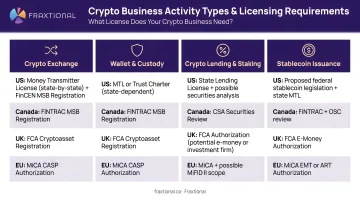
According to FinCEN guidance issued in 2019, administrators or exchangers of convertible virtual currency (meaning crypto exchanges and wallet providers) are classified as Money Services Businesses. A single platform can trigger MSB, broker-dealer, and state MTL obligations simultaneously — and that's before factoring in where your customers are located.
The Incorporation State Myth
Incorporating in Wyoming does not shield a business from nationwide compliance. That same FinCEN guidance makes clear that state licensing applies based on where customers are located, not where the company is incorporated. A Wyoming LLC serving New York residents must obtain New York's BitLicense.
The customer-location trigger is what turns crypto licensing into a 50-state puzzle — and it's why the first question isn't "where should we incorporate?" but "which states are our customers in?" The sections below break down what those state-level requirements actually look like.
Federal Licensing Requirements Every Crypto Business Must Meet
Federal compliance establishes the baseline for anti-money laundering (AML), sanctions screening, and tax reporting. All crypto businesses must navigate this federal layer before addressing state requirements.
FinCEN MSB Registration
Virtually all crypto businesses—exchanges, custodians, wallet providers, payment processors—must register as a Money Services Business with FinCEN via the BSA E-Filing System within 180 days of starting operations. Registration is free to file, but non-compliance carries civil penalties up to $5,000 per violation, with each day counted separately. Criminal penalties include fines and up to 5 years imprisonment.
Registration also requires designating a BSA/AML compliance officer. Early-stage crypto companies often fill this role through a fractional compliance leader rather than a full-time hire.
For startups without the budget for a $150K+ annual CCO salary, a fractional BSA Officer provides a named compliance executive who can represent the company to regulators and banks — without the full-time overhead.
AML Program Requirements Under the Bank Secrecy Act
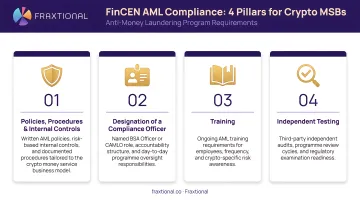
FinCEN requires every MSB to implement a comprehensive AML program with four pillars:
- Written policies and procedures — documented AML controls tailored to your business model and risk profile
- Designated compliance officer — a named individual responsible for day-to-day program oversight
- Ongoing employee training — staff education covering AML obligations and how to spot suspicious activity
- Independent testing — periodic audits to verify the program is functioning as designed
MSBs must also file Suspicious Activity Reports (SARs) and Currency Transaction Reports (CTRs) for transactions exceeding $10,000.
SEC Oversight — When Crypto Becomes a Security
If a token is classified as a security under the Howey Test, platforms trading it must register as a broker-dealer or Alternative Trading System (ATS) with the SEC. The registration pathway depends on trading volume, custody arrangements, and whether the platform operates as an exchange or an OTC venue. Misclassifying a token as a non-security — and operating without the appropriate registration — is one of the most common and costly compliance missteps in the industry.