
Introduction
Regulatory enforcement in fintech, crypto, and banking has never carried higher stakes. FinCEN's $3.4 billion penalty against Binance in 2023 and the FCA's £28.9 million fine against Starling Bank in 2024 — both for compliance failures — illustrate what's at risk: not just fines, but operating licenses, sponsor bank relationships, and market access across multiple jurisdictions.
Managing that exposure falls on the Compliance Director. This role sits at the intersection of regulatory knowledge and operational execution, translating complex legal obligations into programs that actually work inside a business.
This article covers what a Compliance Director does, the qualifications the role demands, current salary benchmarks across the US, UK, and Canada, and how to determine whether your organization needs one: full-time or fractional.
Key Takeaways
- A Compliance Director builds, runs, and improves a company's compliance program — including policies, audits, training, and regulatory filings
- In regulated industries, they often carry named titles: BSA Officer (US), MLRO (UK/EU), or CAMLO (Canada)
- US salary averages around $193,770 (BLS, 2024); UK equivalents range from £103,250–£195,500 depending on seniority and location
- Common hiring triggers include MSB or EMI licensing, sponsor bank requirements, and new jurisdiction entry
- Fractional Compliance Directors give seed-stage and Series A companies director-level accountability at a fraction of full-time cost
What Is a Compliance Director?
A Compliance Director is a senior leadership role responsible for building and operating a company's compliance infrastructure. In most organizations, they sit one level below the Chief Compliance Officer (CCO) — managing day-to-day program execution while the CCO focuses on board-level strategy and enterprise risk governance.
The distinction from a Compliance Manager is meaningful. Managers handle tactical, transactional work. A Compliance Director owns the program itself: how it's designed, what controls it runs, and whether it holds up under regulatory scrutiny.
Regulatory Titles by Jurisdiction
In financial services, the Compliance Director role often carries a formal regulatory designation:
- United States — BSA Officer or designated AML compliance person (required under 31 CFR 1022.210 for MSBs)
- United Kingdom — FCA-approved SMF16 (Head of Compliance) or SMF17 (MLRO) under the Senior Managers and Certification Regime
- Canada — Compliance Officer under FINTRAC, or CAMLO (Chief Anti-Money Laundering Officer) for federally regulated institutions under OSFI
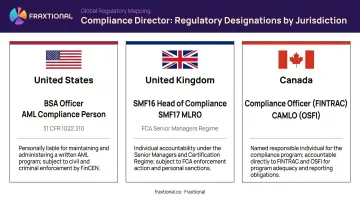
Fraxtional's Directors hold all of these titles across different client engagements — serving simultaneously as named BSA Officer for a US fintech, MLRO for a UK-regulated firm, and CAMLO for a Canadian reporting entity. Each designation carries direct personal accountability to the regulator, not just an advisory role on paper.
How Scope Varies by Company Size
- Seed/Series A fintech — Compliance Director often functions as the de facto compliance head, with no CCO above them
- Mid-size regulated firm — manages a compliance team, reports to the CCO
- Large bank or institution — leads a defined function (AML, regulatory affairs, or product compliance) within a broader compliance organization
Core Responsibilities of a Compliance Director
Designing and Maintaining the Compliance Program
The Compliance Director owns the end-to-end compliance program: written policies, internal controls, codes of conduct, and the procedures that govern how the business handles regulated activity.
Required elements vary by jurisdiction. Two examples:
- US banks (FFIEC BSA/AML Examination Manual): board-approved program covering internal controls, independent testing, a designated BSA compliance officer, staff training, CIP, and risk-based CDD
- Canadian reporting entities (FINTRAC): appoint a compliance officer, maintain written policies, complete a risk assessment, deliver ongoing training, and conduct a two-year effectiveness review
Program design isn't a one-time project. When regulations change, new products launch, or the company enters a new market, the Compliance Director is responsible for updating controls before the deadline — before the regulator asks.
Fraxtional builds these programs from scratch for fintech and crypto clients, including AML/BSA written policies, UDAAP controls, Reg E procedures, SAR/CTR workflows, and FINTRAC or FCA-aligned frameworks — depending on where the client operates.
Regulatory Monitoring and Change Management
A Compliance Director tracks rule changes from bodies like FinCEN, the FCA, FINTRAC, and OSFI — and acts on them. This isn't passive reading.
When the FCA extended its cryptoasset financial promotions regime to all firms marketing to UK consumers from 8 October 2023, companies needed new promotion routes, risk warnings, and cooling-off mechanisms in place before that date. When FinCEN issued its AML/CFT program NPRM in June 2024, compliance teams had to assess how proposed risk assessment requirements would affect their existing programs.
Enforcement actions are equally valuable intelligence. Each recent case signals where examiners are focusing:
- Binance — AML program gaps and sanctions screening failures at scale
- Bittrex — registration lapses and inadequate transaction monitoring
- Starling Bank — high-risk customer controls and financial crime framework gaps
- TD Bank — systemic AML failures resulting in a $3B penalty
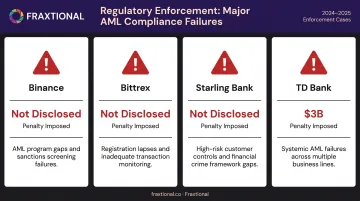
A Compliance Director studies these cases to benchmark their own program against what examiners actually test.
Risk Assessment and Internal Audits
Compliance Directors conduct and oversee formal risk assessments — identifying gaps across onboarding, transaction monitoring, vendor relationships, and sanctions screening — and assign risk ratings to prioritize remediation.
Internal audits and compliance testing verify that controls are working as documented, not just as written. When material gaps emerge, findings get escalated to senior management or the board.
Fraxtional's independent audit service covers this function explicitly: reviewing BSA/AML policies and controls, evaluating transaction monitoring effectiveness, and producing board-ready reports with prioritized remediation guidance. These audits are designed for firms preparing for regulatory examinations, sponsor bank due diligence, or investor reviews.
Training, Reporting, and Regulatory Liaison
Compliance training isn't a single annual video. A Compliance Director designs role-specific programs with different content for operations, product, sales, and customer success teams — ensuring training is trackable, updated regularly, and documented for examiner review.
The external-facing dimension is just as demanding. During regulatory examinations or sponsor bank due diligence, the Compliance Director serves as the company's primary point of contact. They present the compliance program, answer examiner questions, and defend control design under scrutiny.
For companies with sponsor bank relationships, this function is particularly high-stakes. Fraxtional's Directors sit on every due diligence call, review every policy, and handle bank and investor questions directly. One client described it plainly: the Fraxtional Director "was on every call, reviewed every policy, and handled investor questions like she was part of our internal team."
Key Skills and Qualifications Required
Most Compliance Director roles share a common baseline of formal credentials and experience:
- A bachelor's degree in law, finance, business, or a related field
- 5–10 years of compliance experience in a regulated industry
- A relevant professional certification
Common certifications by specialization:
| Credential | Body | Best For |
|---|---|---|
| CAMS | ACAMS | AML/BSA professionals; requires 40 eligibility credits |
| CCEP | SCCE/CCB | Ethics and compliance program professionals |
| CRCM | ABA | Bank regulatory compliance; US-based experience required |
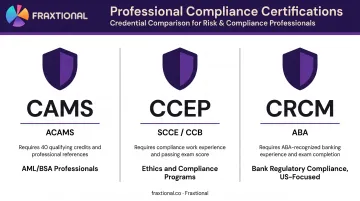
Credentials establish a floor. The competencies that actually differentiate strong performers are harder to verify on a resume:
- Regulatory interpretation — reading what a rule actually demands, not just its plain text
- Risk-based prioritization — focusing resources where exposure is highest
- Cross-functional communication — translating compliance requirements for product, engineering, and operations teams
- Regulator management — presenting a program clearly and defending it without becoming adversarial
- Jurisdictional fluency — in fintech and crypto, this spans BSA/AML, UDAAP, Reg E, GDPR/UK GDPR, and travel rule obligations for virtual assets
Compliance Director vs. Chief Compliance Officer
The organizational distinction matters most at scale. In a larger institution:
- The Compliance Director manages program execution — audits, training, regulatory filings, day-to-day controls, and compliance staff
- The CCO handles board reporting, enterprise risk strategy, and senior-level regulatory relationships
At a seed-stage fintech or early-stage crypto firm, one person typically fills both functions. The Compliance Director may carry a CCO title simply because there's no one above them. That separation only matters once a company is large enough that strategic governance and day-to-day program management can't reasonably sit with the same person.
Fraxtional structures its engagements around this distinction. Fractional Directors step in as named CCO or BSA Officer when a client has no existing compliance head — and move into a program-execution role beneath a client's CCO when that structure already exists.
Compliance Director Salary and Career Outlook
Compensation varies significantly by geography, industry, and the regulatory scope of the role.
Current salary benchmarks:
| Market | Role | Range | Source |
|---|---|---|---|
| United States | Regulatory Compliance Director | ~$193,770 average | Salary.com, 2025 |
| United States | Director of Compliance | $138K–$230K total pay | Glassdoor, 2026 salary guide |
| United Kingdom (national) | Director/Head of Compliance | £103,250–£143,750 | Robert Half, 2026 salary guide |
| London | Director/Head of Compliance | £140,500–£195,500 | Robert Half, 2026 salary guide |
| Canada | Compliance Director | CAD $126,750–$165,750 | Robert Half Canada, 2026 salary guide |
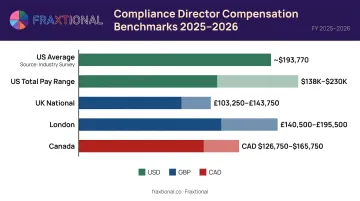
The BLS projects compliance officer employment to grow 3% from 2024 to 2034 — roughly in line with average occupational growth. In fintech, crypto, and multi-jurisdictional financial services, demand consistently outpaces that figure — as new licensing requirements, cross-border frameworks, and digital asset rules expand faster than firms can hire full-time compliance staff.
Career progression typically follows this path:
- Compliance Analyst
- Compliance Manager
- Compliance Director
- CCO or Chief Risk Officer
Specializing in AML, data privacy, or crypto regulation meaningfully accelerates both seniority and compensation at each stage.
When Does a Company Need a Compliance Director?
Regulatory Triggers
Certain business activities create a legal requirement for a designated compliance officer — not just a best practice recommendation:
- US MSBs must designate a person for day-to-day AML program compliance under 31 CFR 1022.210
- UK authorized firms often require FCA-approved SMF16 and SMF17 designations
- Canadian reporting entities must appoint a compliance officer under FINTRAC requirements
- OSFI-regulated institutions must designate a CAMLO
Beyond legal requirements, sponsor bank relationships create their own compliance infrastructure demands. The 2023 interagency guidance makes clear that banks can't outsource compliance accountability to their fintech partners — meaning the bank will assess your compliance program before and during the relationship.
Either way, those obligations land on someone. The question is whether that person needs to be full-time.
Full-Time Hire vs. Fractional Model
For Series A and beyond companies operating under a regulatory license, a full-time Compliance Director provides continuity and embedded institutional knowledge. The tradeoff is real: full-time salary, benefits, equity, and a hiring process that typically runs several months.
For companies at the seed or Series A stage, or those entering new markets, a fractional Compliance Director delivers director-level expertise and formal regulatory accountability — including named BSA Officer, MLRO, or CAMLO designations — without the full-time overhead.
Fractional engagements tend to fit best when:
- Preparing for MSB licensing or sponsor bank onboarding
- Launching a new regulated product category
- Entering a new jurisdiction (US + UK, or US + Canada)
- Bridging the gap while a full-time hire is being recruited
- A compliance leadership exit has created an immediate gap
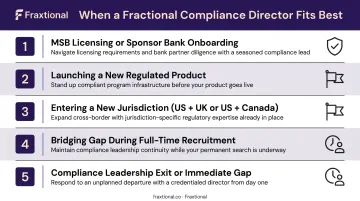
Fraxtional's fractional model, recognized with a T100 Finance Award, is built for each of these scenarios. Directors are embedded directly into the client organization, named on regulatory filings, and accountable for audits, SAR filings, and examiner interactions.
Clients like BayFirst and Trans Pecos Bank have used this structure to meet sponsor bank requirements without a full-time hire. When a permanent leader is eventually brought in, Fraxtional structures a clean handover with documented workflows, case summaries, and escalation paths.
Frequently Asked Questions
What does a compliance director do?
A Compliance Director oversees the design and operation of a company's compliance program — including regulatory monitoring, risk assessments, internal audits, staff training, and regulatory examinations. In financial services, they often carry a named regulatory title such as BSA Officer, MLRO, or CAMLO.
How much does a compliance director earn?
US-based Compliance Directors average $193,770 (Salary.com, 2025), with total pay ranging from $138K–$230K depending on sector and scope. UK roles range from £103,250–£195,500 (London at the higher end), and Canadian directors typically earn CAD $126,750–$165,750.
What is the difference between a Compliance Director and a Chief Compliance Officer?
A Compliance Director manages program execution: audits, training, filings, and day-to-day controls. The CCO holds board-level accountability for enterprise compliance strategy. In smaller organizations, one person fills both roles — a distinction that becomes operationally important as companies scale.
What qualifications does a Compliance Director need?
Most roles require a bachelor's degree in law, finance, or business, 5–10 years of relevant industry experience, and a professional certification such as CAMS (AML), CRCM (banking compliance), or CCEP (ethics and compliance programs).
Can a fintech startup use a fractional Compliance Director instead of hiring full-time?
Yes. Many fintech and crypto startups use fractional compliance directors to meet regulatory obligations — including named BSA Officer, MLRO, and CAMLO requirements — without a full-time hire. Fractional directors carry the same formal accountability as a permanent executive, with flexibility to scale engagement up or down as the business grows.