Introduction
The OFAC 50 Percent Rule establishes a simple threshold with far-reaching operational consequences: any entity owned 50% or more, directly or indirectly, by one or more blocked persons is itself treated as a blocked entity under U.S. sanctions law—even if that entity does not appear on the SDN List.
This rule creates acute compliance exposure for FinTech companies, crypto platforms, banks, money transmitters, and embedded finance providers that onboard counterparties, process transactions, or hold assets on behalf of clients with complex ownership structures.
OFAC does not publish a separate list of these indirectly blocked entities. The compliance burden falls entirely on the institution to investigate ownership chains and make clearing decisions—with no official reference to check.
This guide covers what compliance teams at financial institutions need to know:
- How the rule works mechanically and where the threshold applies
- How enforcement has evolved beyond the strict 50% cutoff
- Common compliance gaps that lead to violations
- What a practical compliance program looks like in practice
Key Takeaways
- The 50 Percent Rule means an entity is automatically blocked if SDN-listed persons collectively own 50% or more of it — even if the entity itself never appears on any sanctions list
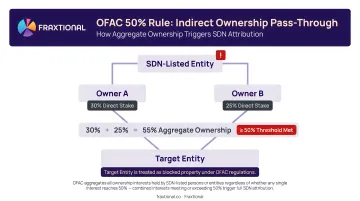
- OFAC aggregates ownership across all blocked persons: two SDNs each owning 25% of a company makes that company blocked
- Indirect ownership chains count: blocking flows downstream through each layer where a sanctioned party holds 50%+ control
- OFAC will pursue violations where sanctioned parties retain effective control or a meaningful property interest, even without formal majority ownership
- Compliance requires ongoing beneficial ownership due diligence, not just one-time name screening against lists
What Is the OFAC 50 Percent Rule?
Per OFAC's published guidance, "[a]ny entity owned in the aggregate, directly or indirectly, 50 percent or more by one or more blocked persons is itself considered to be a blocked person." The entity's property and interests in property are blocked by operation of law, not by formal listing.
This creates a critical distinction from standard SDN screening. No official published list identifies these indirectly blocked entities. Institutions must independently investigate and determine whether an entity crosses the 50% ownership threshold. OFAC establishes a clear independent investigative obligation, urging persons to "conduct appropriate due diligence on entities that are party to or involved with the transaction."
Scope and Program Exclusions
The rule applies to OFAC's SDN List and the Sectoral Sanctions Identification (SSI) List, but certain programs are excluded. The table below shows where the 50 Percent Rule applies and where it does not:
| Sanctions List | 50% Rule Applies? | Notes |
|---|---|---|
| SDN List | Yes | Entities 50%+ owned by an SDN-listed person are blocked |
| SSI List (Sectoral Sanctions) | Yes | Directive 1 covers entities 50%+ owned by one or more identified persons |
| Cuba Restricted List | No | Owned/controlled entities are not restricted unless specifically named |
| CAATSA Part 231 (NS-MBS List) | No | Non-blocking menu-based sanctions don't extend to 50%+ owned entities unless separately listed |
How OFAC Calculates Ownership Under the 50 Percent Rule
Aggregate Ownership Across Programs
OFAC adds together the ownership stakes of all blocked persons, regardless of whether they are designated under the same or different sanctions programs. If Blocked Person X owns 25% under one program and Blocked Person Y owns another 25% under a separate program, the entity is blocked.
Official language: "For the purpose of calculating aggregate ownership, the ownership interests of persons blocked under different OFAC sanctions programs are aggregated." (OFAC FAQ 399)
Direct vs. Indirect Ownership
"Indirect" means ownership held through intermediate entities that are themselves 50% or more owned by blocked persons.
Blocked Person X owns 50% of Entity A. Entity A owns 50% of Entity B. Entity B is therefore blocked — Person X indirectly holds 50% of Entity B through a blocked intermediate (Entity A is itself blocked, making its 50% stake in Entity B a blocked interest).
Pass-Through Calculation for Complex Chains
The pass-through logic extends to more complex structures. Per OFAC FAQ 401:
- Blocked Person X owns 50% of Entity A (making Entity A blocked) and 10% of Entity B directly
- Entity A owns 40% of Entity B
- Because Entity A is itself blocked, its 40% stake passes through to X
- Total ownership of Entity B: 40% indirect + 10% direct = 50% → Entity B is blocked
When Indirect Ownership Does NOT Trigger the Rule
The pass-through logic only applies when the intermediate entity is itself blocked. If the intermediate company falls below the 50% threshold, the blocked person's stake stops there and cannot be pushed to downstream entities.
Consider this scenario: Blocked Person X owns 25% of Entity A and 25% of Entity B. Entities A and B each own 50% of Entity C. Entity C is not blocked — because neither A nor B crosses the 50% threshold, X's indirect interest in C is treated as 0%. Ownership does not pass through unblocked intermediaries.
Divestment Scenarios and Blocked Property Persistence
If blocked persons divest to bring combined ownership below 50%, the rule no longer applies to future dealings. However, property that came into the possession of a U.S. person while the entity was blocked remains blocked even after divestment.
OFAC FAQ 402 states: "The property remains blocked even if the blocked person's ownership of the entity subsequently falls below 50 percent. This is so because the blocked person is considered to have an interest in the blocked property, and OFAC does not recognize the unlicensed transfer of the blocked person's interest."
OFAC will scrutinize whether the divestment is a sham transaction designed to evade sanctions.
Why the 50 Percent Rule Matters for FinTech and Financial Services
FinTech platforms, payment processors, and crypto firms often onboard counterparties at scale, process high transaction volumes, and maintain third-party integrations. Complex or opaque ownership structures in these relationships create compounded risk if beneficial ownership due diligence is not built into onboarding workflows.
Recent Enforcement Actions Illustrate the Stakes
2025 headliner penalties:
- GVA Capital Ltd. (June 12, 2025): $215,988,868 penalty for knowingly managing an investment for sanctioned Russian oligarch Suleiman Kerimov while aware of his blocked status, working through Kerimov's nephew who served as a proxy
- IPI Partners, LLC (December 2, 2025): $11,485,352 settlement for soliciting and receiving investments from Kerimov through legal structures and maintaining those investments for four years after his designation
- Individual Fiduciary (December 9, 2025): $1,092,000 penalty for an attorney/fiduciary who obtained legal advice that a trust connected to a sanctioned Russian oligarch was not blocked property—OFAC found this insufficient because the proxy's continued involvement allowed the SDN to retain control
Other 2024-2025 cases:
- Gracetown, Inc.: $7,139,305 for receiving payments connected to designated Russian oligarch Oleg Deripaska through a BVI company
- State Street Bank / Charles River Systems: $7,452,501 for reissuing invoices for SSI customers (majority-owned subsidiaries of Sberbank/VTB Bank subject to Directive 1 50% rule applicability)
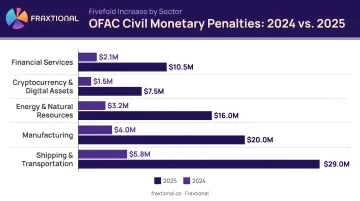
Total 2025 OFAC civil monetary penalties: $265,746,819 across 14 actions—a fivefold increase from 2024's $48,790,404.
OFAC has made clear that compliance programs relying solely on automated name screening against published lists, without deeper ownership investigation, will be found deficient in enforcement actions. This applies particularly to high-risk sectors like crypto, cross-border payments, and institutional investment.
Beyond the 50% Threshold: OFAC's Evolving Enforcement Posture
The Floor, Not the Ceiling
OFAC's March 2026 guidance on "Sham Transactions and Sanctions Evasion" confirmed that the 50% Rule is a floor, not a ceiling. Institutions must look "beyond legal formalities to underlying practical and economic realities," meaning formal ownership structures that don't reflect actual control or property interest are insufficient as a defense.
OFAC's March 2026 guidance states: "Because OFAC implements functional definitions of 'interest' and 'property interest' that look beyond legal formalities to underlying practical and economic realities, sham transactions do not terminate a blocked interest in property."
Red Flags for Enhanced Scrutiny
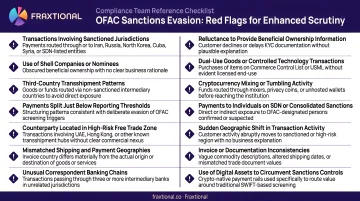
OFAC's 2026 guidance identifies specific red flags warranting investigation beyond the ownership calculation:
- Commercially unreasonable transfers lacking arm's-length consideration
- Transfers to family members or close associates of a blocked person (transferee may be acting as a proxy, facilitator, money manager, or agent)
- Transfers with no apparent business purpose, or to individuals with no relevant expertise
- Unnecessarily complex legal structures in higher-risk jurisdictions (multi-layered LLCs, partnerships, or trusts without legitimate purpose)
- Continued involvement of a blocked person in management, use, or disposition of property through proxies
- Transfers timed around a designation — completed immediately before or after a person is sanctioned
- Evasive or non-responsive answers about a blocked person's involvement
Enforcement Precedents: When Legal Opinions Weren't Enough
All three 2025 enforcement actions (GVA Capital, the individual fiduciary, and IPI Partners) involved parties who relied on legal opinions confirming the 50% Rule was not triggered. OFAC still penalized them because each had actual knowledge of a sanctioned party's continuing property interest or decision-making role.
The takeaway: evidence of a sanctioned person exercising control — managing investments, directing decisions through proxies — is enough to trigger liability, even when formal ownership sits below 50%. A clean legal opinion does not override demonstrated facts of control.
Trusts and Nominee Structure Warning
Trusts and nominee structures carry heightened scrutiny under the 2026 Advisory. OFAC warns directly:
"Trusts and similar legal arrangements vary significantly... [and] have at times been used in sham transactions to obscure links between blocked persons and their interests in property."
When these structures appear in a transaction, treat them as a prompt for deeper diligence — not a compliance endpoint.
Key Compliance Challenges and Common Misconceptions
Misconception 1: "If it's not on the SDN List, it's safe to deal with"
The 50 Percent Rule means that unlisted entities can still be blocked. OFAC's evolving enforcement shows that even sub-50% ownership with retained control creates material risk that should trigger enhanced due diligence.
Official language: "The property and interests in property of such an entity are blocked regardless of whether the entity itself is listed in the annex to an Executive order or otherwise placed on OFAC's list of Specially Designated Nationals."
Misconception 2: "A legal opinion saying we're compliant is sufficient protection"
The GVA Capital, IPI Partners, and individual fiduciary enforcement cases all involved parties who had obtained legal opinions confirming the 50% Rule was not triggered. OFAC still found violations because those parties had actual or constructive knowledge of sanctioned party involvement beyond what was disclosed to counsel.
Legal opinions are a mitigating factor in enforcement, not an absolute defense.
Misconception 3: "One-time screening at onboarding is enough"
Ownership structures change. A counterparty that was clean at onboarding can become blocked if a sanctioned party subsequently acquires a stake. Compliance programs must include ongoing monitoring and periodic re-screening, not just point-in-time checks.
Challenge: Data and Transparency Gaps
These misconceptions share a common thread: they assume ownership data is reliable. In practice, it often isn't.
In many jurisdictions, corporate registries are unreliable, nominee shareholder arrangements are common, and beneficial ownership data is incomplete. Institutions operating in high-risk markets face compounded difficulty tracing indirect ownership chains beyond two or three levels.
Three documented examples illustrate the scale of the problem:
- The FATF Mutual Evaluation of the Russian Federation (2019) states: "The risk of misuse of legal persons in ML schemes is high"
- The British Virgin Islands (BVI) and Cayman Islands have long provided offshore shell companies with little visibility over their true owners
- The FinCEN Beneficial Ownership Information Reporting Requirements final rule notes that "deliberate misuse of legal entities, including limited liability companies and other corporate vehicles, trusts, partnerships, and the use of nominees continue to be significant tools for facilitating money laundering"
OFAC's Framework for Compliance Commitments explicitly cites "Improper Due Diligence on Customers/Clients (e.g., Ownership, Business Dealings, etc.)" and "Sanctions Screening Software or Filter Faults" as root causes of violations.
Building a Practical OFAC 50 Percent Rule Compliance Program
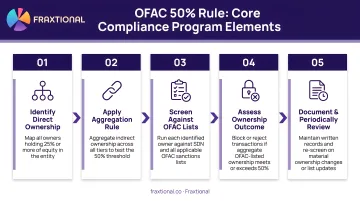
Five Core Program Elements
1. Go beyond name screening
Use beneficial ownership databases and due diligence tools that surface ownership data. Automated screening against the SDN List alone will miss indirectly blocked entities.
2. Map indirect ownership chains at onboarding
Flag entities with significant (such as 10% or more) sanctioned-party stakes even below the 50% threshold. These require enhanced scrutiny under OFAC's 2026 guidance.
3. Establish ongoing monitoring with periodic re-screening triggers
Ownership structures change. Build workflows that detect ownership changes and trigger re-investigation when blocked persons acquire stakes in existing counterparties.
4. Document the due diligence process
Good-faith, documented compliance efforts are a mitigating factor in enforcement. Record data sources relied upon, ownership calculations performed, and the rationale for clearing a counterparty. Under 31 CFR Part 501, Appendix A, OFAC treats voluntary self-disclosure and cooperation as factors that reduce base penalty amounts.
5. Train relevant staff to recognize red flags
Ensure onboarding teams, transaction monitoring analysts, and compliance reviewers understand the red flags in OFAC's 2026 guidance and know when to escalate complex ownership scenarios for senior review.
The Resource Challenge for Growing Companies
Many FinTech startups and Series A/B companies lack in-house sanctions expertise. Building a defensible OFAC compliance framework requires director-level sanctions program design — a level of oversight that few early-stage companies can justify as a full-time hire.
Fractional compliance leadership offers a practical path forward. Rather than leaving sanctions expertise gaps unaddressed, companies can access experienced directors on a flexible engagement basis. This model gives growing fintechs:
- Director-led oversight of sanctions screening workflows and ownership analysis
- Documented program design that satisfies OFAC's good-faith compliance standard
- Scalable support that grows alongside the business without full-time executive overhead