Introduction
Choosing the wrong SOC 2 compliance consultant carries immediate, tangible business consequences: delayed audits, failed certifications, and lost enterprise deals. For fintech companies, crypto firms, and startups managing sensitive financial data, SOC 2 compliance has evolved from a "nice-to-have" into a prerequisite for closing contracts, securing banking partnerships, and winning investor trust. The consultant guiding that journey fundamentally shapes the outcome—and the stakes are higher than many organizations realize.
The numbers are hard to ignore. 83% of enterprise buyers require SOC 2 compliance before vendor onboarding, and 63% actively seek detailed security information before engaging potential vendors. The financial services sector alone recorded 3,336 security incidents in 2025, with 30% of all breaches involving third parties.
This guide breaks down how to evaluate and select a SOC 2 consultant—covering the criteria that separate effective partners from costly mistakes, the questions worth asking before you sign, and the red flags most companies miss.
Key Takeaways
- SOC 2 consultants handle controls, policies, and evidence prep — the licensed CPA firm conducts the actual audit
- The right consultant advises which of the five Trust Service Criteria apply to your business and builds accordingly
- Evaluate on credentials, fintech experience, scope clarity, tech stack familiarity, and billing transparency
- Watch for vague deliverables, bloated 12–18 month timelines, template-only policies, and open-ended hourly billing
- Fractional compliance leadership gives fintech startups director-level SOC 2 guidance without the full-time executive cost
What Is a SOC 2 Compliance Consultant?
A SOC 2 compliance consultant is a strategic advisor who prepares an organization for a SOC 2 audit—mapping controls to AICPA Trust Service Criteria, writing policies, building evidence packages, and coordinating with the auditor. Consultants are distinct from the licensed CPA firm that conducts the formal audit and issues the official report — a separation mandated by AICPA standards to preserve auditor independence.
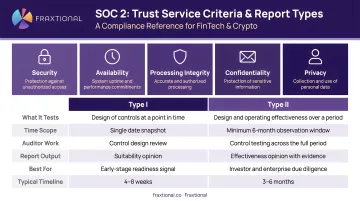
The framework centers on five Trust Service Criteria — Security is mandatory for every engagement; the remaining four are selected based on your service commitments and customer expectations:
- Security — required for all SOC 2 engagements
- Availability — uptime and performance commitments
- Processing Integrity — complete, accurate, and timely processing
- Confidentiality — protection of designated sensitive data
- Privacy — personal information handling (common for healthcare SaaS)
A fintech platform processing payments typically covers Security, Availability, and Confidentiality. A healthcare SaaS provider would likely add Privacy.
Two report types exist:
- Type I demonstrates controls are designed and in place at a point in time—useful for unblocking near-term deals
- Type II proves controls operated effectively over a 3–12 month observation period—required by most enterprise and Fortune 500 buyers
The right consultant builds for Type II from day one, even when you're initially pursuing Type I. This avoids rework and keeps your control environment sustainable for annual re-audits.
Key Factors to Evaluate When Selecting a SOC 2 Compliance Consultant
The right consultant varies by company size, industry complexity, and compliance maturity. Connecting each evaluation factor to tangible business outcomes—deal velocity, audit timelines, banking partner approval—makes the decision rational rather than reactive.
Credentials and Regulatory Alignment
While only AICPA-affiliated licensed CPA firms can conduct SOC 2 audits, compliance consultants should demonstrate formal grounding in recognized frameworks. Verify consultants claiming to "do the audit" are either licensed CPA firms or have formal auditor relationships. Any consultant offering to issue SOC 2 reports directly is misrepresenting their authority.
Look for expertise in:
- AICPA Trust Service Criteria
- NIST Cybersecurity Framework (CSF)
- ISO 27001
- COSO Internal Controls framework
For regulated sectors—fintech, banking, crypto, embedded finance—the consultant should demonstrate familiarity with overlapping frameworks such as BSA/AML, UDAAP, Reg E, and data privacy requirements like GDPR or CCPA. SOC 2 controls often intersect with these obligations; a consultant who understands this overlap prevents duplicative work and identifies control gaps that could derail banking or investor reviews.
Industry-Specific Experience
A fintech company processing payments, a crypto firm managing digital assets, or an embedded finance platform has significantly different risk exposures than a generic SaaS provider. A consultant without that context will design generic controls that may not satisfy enterprise or banking-partner expectations.
Proof of industry experience includes:
- Past client references in the same vertical (payments, crypto, lending)
- Demonstrated knowledge of sponsor bank expectations and compliance requirements
- Familiarity with high-risk business models (money transmission, digital asset custody)
- Experience advising companies that successfully secured banking partnerships or investor due diligence approvals
Ask prospective consultants: "What sponsor bank or investor reviews have your fintech clients passed with the controls you designed?" Vague answers signal lack of relevant experience.
Scope Clarity and Engagement Model
A trustworthy consultant defines the full scope upfront: which Trust Service Criteria will be covered, what deliverables will be produced, by when, and at what fixed cost. Vague engagements priced hourly with no defined scope create misaligned incentives and runaway timelines.
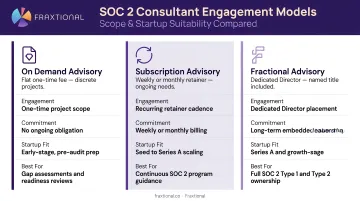
Engagement models vary:
- One-time readiness assessment: Identifies gaps but leaves implementation to the client
- Full implementation project: Designs controls, writes policies, and prepares evidence packages
- Ongoing fractional compliance leadership: Provides continuous advisory and program management
Match the model to your internal bandwidth and compliance maturity. Startups with no internal compliance function benefit most from continuous advisory or fractional leadership rather than one-time gap assessments that deliver an 80-item deficiency list with no remediation support.
Technical Expertise and Tech Stack Familiarity
A consultant who doesn't understand your cloud infrastructure, SaaS tooling, or data architecture will produce controls that don't map to actual systems. The result: evidence requests require rework, control documentation breaks down during auditor walkthroughs, and your audit timeline slips.
Ask prospective consultants:
- Have you worked with companies using our cloud environment (AWS, GCP, Azure)?
- How do you handle infrastructure-as-code environments or microservices architectures?
- Can you provide examples of control mappings for companies with similar tech stacks?
Tech stack alignment is one of the clearest predictors of how quickly a company reaches audit-ready status.
Communication, Availability, and Accountability
SOC 2 preparation involves iterative evidence gathering, control testing, and stakeholder coordination. A consultant available only for monthly check-in calls creates bottlenecks that delay audit timelines and increase internal burden on your team.
Strong communication looks like:
- Defined point of contact with clear response time expectations
- Direct involvement of senior advisors, not just junior analysts
- Transparent reporting on progress against the readiness roadmap
- Proactive identification of blockers before they derail timelines
Ask: "Who will be my primary contact, and what's the expected response time for questions during evidence collection?" Generic answers like "our team will support you" indicate poor accountability structures.
Budget Transparency and Multi-Year Cost Planning
SOC 2 compliance is an annual commitment—reports are valid for 12 months and re-audits are required. Organizations should budget for both the consultant fee and the auditor fee (always separate), and plan across at least two to three years to understand the true cost of compliance.
2025–2026 Pricing Ranges:
| Cost Category | Typical Range | Notes |
|---|---|---|
| Readiness & Gap Analysis | $5,000 – $20,000 | Identifies missing controls before audit |
| Implementation Consulting | $15,000 – $75,000+ | Policy writing, control implementation, audit support |
| SOC 2 Type I Audit (CPA) | $5,000 – $25,000 | Point-in-time assessment |
| SOC 2 Type II Audit (CPA) | $12,000 – $50,000 (SMBs) | 3–12 month observation; enterprise engagements $60K–$450K |
| Annual Maintenance | $10,000 – $60,000/year | Recurring Type II audit fees, continuous monitoring |
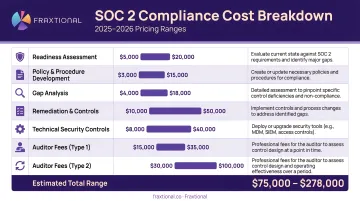
First-year costs typically range from $45,000 to $200,000+ when combining consulting, audit fees, and internal labor. Unusually low prices typically mean template-only deliverables with no implementation support. If a consultant quotes 12–18 months for a straightforward cloud-native environment, that's a staffing problem—not a complexity one.
Red Flags to Avoid When Hiring a SOC 2 Compliance Consultant
Avoid consultants whose primary deliverable is a gap assessment PDF. A readiness assessment is the beginning of an engagement, not a standalone product. A consultant who identifies 80+ gaps and then exits has left all the hard work—and the compliance risk—to your team.
Watch for these warning signs before signing any engagement:
- Delivers generic policy templates with placeholder text that hasn't been adapted to your environment, industry, or tech stack — auditors can spot boilerplate, and it undermines your entire security program
- Recommends "Security only" without first understanding your customer base, sales pipeline, or contractual obligations — scoping requires actual discovery, not a default answer
- Has no established relationships with CPA audit firms and tells you to "find your own auditor" — direct auditor coordination is one of the most time-intensive parts of the process, and organizations that complete coordinated readiness assessments are 70% less likely to have significant control deficiencies
- Quotes 12–18 month timelines for straightforward cloud-native setups — most companies can reach audit readiness in weeks with an experienced consultant; extended timelines signal an understaffed team
How Fraxtional Can Help
Fraxtional is a fractional compliance leadership provider supporting fintech, crypto, and banking companies in building and maintaining SOC 2-ready compliance programs. A T100 Finance Award winner for compliance leadership, the firm has a track record supporting companies like PayForGo, Rolla, Swap Global, and others across the US, UK, Canada, and EU.
Fraxtional's director-led model means clients work directly with experienced compliance directors (not junior analysts), with expertise spanning SOC 2-adjacent frameworks including BSA/AML, UDAAP, Reg E, privacy, and cyber risk. This makes Fraxtional particularly well-suited to fintech and embedded finance companies managing multiple compliance obligations at once.
Key differentiators:
- Fractional CCO, CRO, BSA Officer, CAMLO, and MLRO services
- Flexible engagement models from short-term advisory to long-term fractional leadership
- Global coverage across US, UK, Canada, and EU
- Deep experience with sponsor bank relationships and investor due diligence reviews
- Trusted by sponsor banks and investors for pre-deal compliance reviews
Conclusion
Selecting a SOC 2 compliance consultant is a business-critical decision that directly affects deal velocity, investor confidence, and regulatory standing. Treat it accordingly. The goal is not to find the most well-known consultant, but one whose credentials, industry experience, engagement model, and communication style align with your organization's specific risk profile and growth stage.
SOC 2 compliance is an ongoing commitment — annual re-audits, continuous control monitoring, and evolving regulatory expectations mean the relationship doesn't end at certification. The right consultant is a long-term partner, and the standards for that relationship should be set from the first engagement.
When evaluating candidates, hold them to a clear bar:
- Verify credentials and CPA firm independence
- Demand written scope clarity before signing
- Confirm industry-specific experience (fintech, crypto, or your vertical)
- Ensure they can navigate your tech stack and regulatory landscape
Done right, the selection process itself accelerates your first audit — and every one that follows.
Frequently Asked Questions
What are the key areas covered by SOC 2 compliance?
SOC 2 covers five Trust Service Criteria: Security (always required), Availability, Processing Integrity, Confidentiality, and Privacy. Organizations select applicable criteria based on their service commitments and customer requirements—fintech platforms typically include Security, Availability, and Confidentiality.
What is the SOC 2 compliance checklist?
A SOC 2 compliance checklist covers policy documentation, access controls, encryption configurations, incident response procedures, vendor records, and employee training logs. A strong consultant builds and organizes this evidence for you, ensuring everything is audit-ready before the CPA firm walks in.
What is the difference between a SOC 2 consultant and a SOC 2 auditor?
A SOC 2 consultant prepares the organization by designing controls, writing policies, and building evidence. A SOC 2 auditor is a licensed CPA firm that independently examines those controls and issues the official report. These must always be separate entities to maintain auditor independence.
How much does a SOC 2 compliance consultant cost?
Consultant fees and auditor fees are separate costs. Implementation consulting ranges from $15,000 to $75,000+, while Type II CPA audits range from $12,000 to $50,000 for SMBs. Ongoing compliance management typically adds $10,000 to $60,000 annually for continuous monitoring and re-audit support.
Do I need SOC 2 Type I or Type II?
Type I demonstrates controls are designed at a point in time (useful for unblocking near-term deals). Type II proves controls operated effectively over a 3–12 month period (required by most enterprise and Fortune 500 buyers). The right consultant builds for Type II from day one, even when starting with Type I.
How long does SOC 2 take with a consultant?
Most cloud-native or SaaS companies reach audit-readiness within weeks of engagement, but the finalized Type II report takes 6 to 18 months due to the required observation period. If a consultant is projecting 12–18 months for a straightforward setup, that's a resourcing problem—not a complexity one.