This scenario plays out regularly for SaaS companies scaling toward enterprise buyers. Fraxtional sees it with fintech and SaaS clients at Series A and beyond: investors, sponsor banks, and enterprise procurement teams routinely ask for audit reports or security posture summaries, and missing documentation creates friction that product quality alone can't overcome.
This guide is written for seed-to-Series B SaaS and fintech founders, CTOs, and compliance leads who know SOC 2 is something they need but want a clear operational picture of what it actually requires. We'll cover what SOC 2 is, why it matters commercially, how the audit process works end-to-end, what the five Trust Services Criteria cover, and where teams most commonly go wrong.
Key Takeaways
- SOC 2 is an AICPA auditing standard that produces an attestation report — not a certification — evaluating whether a service organization's controls protect customer data
- Built around five Trust Services Criteria; Security is mandatory, the rest are optional based on your services and commitments
- Type 1 assesses control design at a point in time; Type 2 assesses operating effectiveness over a 3–12 month period
- Not legally required, but functionally unavoidable for enterprise, financial services, or regulated-sector deals — and Type 2 is almost always what those buyers demand
- Full process from readiness assessment to final report typically takes 6–12 months
What Is SOC 2 Compliance for SaaS?
System and Organization Controls 2 (SOC 2) is an auditing standard developed by the AICPA. It evaluates whether a service organization's security controls adequately protect customer data across its systems and operations. The end product is an attestation report issued by an AICPA-accredited CPA firm — not a badge, not a certification.
Calling SOC 2 a "certification" signals to sophisticated buyers that you may not understand what you're presenting. The AICPA uses terms like "examination," "attestation standards," and "assurance reports" — and procurement and security teams who read these reports regularly will notice the difference.
SOC 2 gives enterprise customers and partners independent assurance that a SaaS vendor has implemented and maintained the controls needed to keep their data secure, available, and confidential. It shifts the burden of vendor security evaluation off the buyer's internal security team.
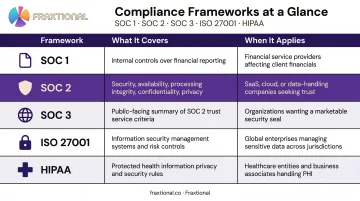
How SOC 2 Compares to Related Frameworks
| Framework | What It Covers | When It Applies |
|---|---|---|
| SOC 1 | Financial reporting controls | If your platform affects how customers produce financial statements (payroll, ERP, accounting) |
| SOC 2 | Information security and operational controls | Most SaaS companies handling customer data |
| SOC 3 | Simplified public-facing SOC 2 summary | When you want to share assurance publicly without disclosing full report details |
| ISO 27001 | Information security management system (ISMS) | More common in European and APAC markets |
| HIPAA | Healthcare data privacy and security | When processing protected health information |
Why SOC 2 Compliance Matters for SaaS Companies
The Commercial Driver
Enterprise procurement teams in financial services, healthcare, legal tech, and government routinely require a SOC 2 report before onboarding a new software vendor. A missing report can disqualify a vendor regardless of product quality — the result is lost revenue and blocked market access, not a failed security audit.
Vendor-published research from Drata's 2023 compliance survey of 300 established and enterprise organizations found that 41% said reactive compliance slows new-customer sales cycles, and 67% said continuous compliance maturity helps attract customers. These figures aren't SOC 2-specific, but they reflect the commercial reality: compliance posture directly influences deal velocity.
Without a SOC 2 report, SaaS companies face:
- Extended sales cycles while security teams conduct ad-hoc vendor assessments
- Security questionnaire overhead that consumes engineering and operations time
- Outright disqualification from formal procurement processes at larger organizations
- Uncertainty during investor due diligence and pre-deal reviews
The Fintech and BaaS Dimension
The commercial pressure intensifies for SaaS companies targeting fintech, embedded finance, or banking segments — because here, SOC 2 isn't just a sales enablement tool. The May 2024 interagency guide for community banks from the OCC, FDIC, and Federal Reserve explicitly names SOC reports as materials banks may review during third-party due diligence and ongoing monitoring.
That means for a fintech pursuing a sponsor bank relationship, a SOC 2 report reduces friction when the bank must evidence third-party control review. It doesn't guarantee approval, but its absence creates a gap that reviewers will flag — and that can stall or kill the relationship entirely.
The Internal Security Benefit
The process of mapping controls, documenting policies, and preparing for an independent audit forces SaaS companies to surface gaps that might otherwise go unaddressed. Common issues that emerge during readiness work include:
- Missing or outdated policy documentation
- Unclear ownership of key controls
- Weak audit trails that would fail independent review
Catching these gaps through a structured readiness process is far less costly than discovering them through a customer security review — or a breach.
How the SOC 2 Audit Process Works
SOC 2 is CPA-led. Only an AICPA-accredited CPA firm can issue a SOC 2 report — internal teams cannot self-certify, and compliance automation tools alone don't produce a valid attestation. The process moves through five distinct stages.
Stage 1: Define Scope and Select Audit Type
Scoping determines which systems, infrastructure, and processes are "in scope" — typically anything touching customer data: cloud environments, CI/CD pipelines, identity and access management, HR systems.
The company also chooses between:
- Type 1: Evaluates whether controls are designed appropriately at a specific point in time
- Type 2: Evaluates whether controls operated effectively over a defined period (typically 3–12 months)
Most teams starting a compliance program pursue Type 1 first as a milestone, then progress to Type 2 as the primary deliverable for enterprise customers.
Stage 2: Readiness Assessment and Gap Identification
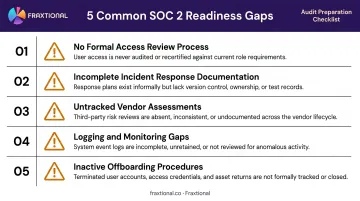
A readiness assessment compares existing controls against SOC 2 criteria to identify what's missing or undocumented. The most common gaps auditors find include:
- No formal access review process (who has access to what, reviewed how often)
- Incomplete incident response documentation
- Untracked vendor and subservice organization assessments
- Logging and monitoring gaps across production systems
- Offboarding procedures that leave access active after employees depart
Getting experienced compliance guidance at this stage — in-house or through a fractional advisor — prevents costly rework later. Fraxtional's SOC 2 engagements map controls to how a business actually operates, avoiding the generic framework bloat that creates unnecessary audit complexity.
Stage 3: Implement Controls and Collect Evidence
Once gaps are identified, controls must be designed, implemented, and documented before the observation period begins. This includes both technical and policy controls:
Technical controls:
- MFA enforcement
- Encryption at rest and in transit
- Vulnerability scanning
- Logging and monitoring
- Endpoint protection
Policy controls:
- Access control policy
- Incident response plan
- Employee security training records
- Vendor risk assessments
For Type 2, evidence collection is continuous throughout the observation window — logs, access reviews, change tickets, training completions — stored in a format auditors can examine.
Stage 4: Engage an AICPA-Accredited Auditor
The auditor reviews control documentation, tests operating effectiveness (for Type 2), and may request walkthroughs or supplemental evidence. When evaluating prospective auditors, ask specifically about their experience with cloud-native SaaS environments. A firm that primarily audits traditional enterprises can struggle with multi-cloud fintech architectures.
Fraxtional coordinates directly with auditors throughout this phase, flagging issues before they become delays and ensuring documentation is complete before the formal review starts.
Stage 5: Receive the Report and Plan for Annual Renewal
The final SOC 2 report is valid for 12 months. Annual re-audits are required to maintain currency — organizations that let reports lapse create coverage gaps that raise immediate red flags with enterprise prospects.
The report includes three key components:
- Auditor's opinion: The formal conclusion on control effectiveness
- Control descriptions: Documentation of all in-scope systems and processes
- Exceptions: Specific areas where controls fell short (if any)
A qualified opinion is not a failure. It identifies areas the auditor found insufficient, which must be addressed before the next cycle. Teams should operate controls continuously year-round rather than preparing intensively before each audit window.
The Five Trust Services Criteria: What Gets Audited
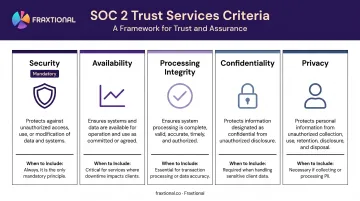
All SOC 2 reports must include the Security criterion. The remaining four are selected based on what services the company provides and what commitments it makes to customers. The AICPA's 2017 Trust Services Criteria govern all five categories.
Most SaaS companies start with Security alone and add criteria based on customer demands or the nature of data processed. The table below maps each criterion to what it covers and when it applies.
| Criterion | What It Covers | When to Include | |-----------|----------------|-----------------|| | Security (mandatory) | Protection against unauthorized access — MFA, logical access, firewalls, endpoint protection, monitoring | Every SOC 2 report | | Availability | Uptime commitments, backup and recovery, disaster recovery, infrastructure redundancy | When your contracts include SLAs | | Processing Integrity | Complete, accurate, and timely data processing | Payment processors, analytics platforms, financial SaaS | | Confidentiality | Protection of information designated as confidential — role-based access, encryption, secure disposal | When contracts or data classification require confidentiality controls | | Privacy | Collection, use, retention, and deletion of personal information per privacy policy commitments | When processing personal data; overlaps with GDPR and CCPA obligations |
Selecting all five criteria without justification is a common scoping mistake. It increases audit complexity and cost without added benefit. Pick criteria based on what your service actually does and what your customers contractually require — nothing more.
Common SOC 2 Misconceptions and Mistakes SaaS Teams Make
Misconception 1: SOC 2 Is a One-Time Certification
SOC 2 is an ongoing commitment. Controls must operate continuously, evidence must be collected throughout the observation period, and annual re-audits are expected to maintain currency. Teams that treat it as a project with a finish line typically struggle at renewal — the second audit reveals gaps that accumulated between cycles.
Misconception 2: Receiving a Report Means You Passed
Auditors issue a report with an opinion, not a pass/fail grade. A qualified opinion — where specific controls were found insufficient — is common on a first audit. What matters is whether the exceptions are scoped and addressable. The Journal of Accountancy has noted that "fast and easy" SOC 2 messaging can undermine report credibility with buyers who understand how attestation examinations actually work.
Misconception 3: SOC 2 and ISO 27001 Are Interchangeable
They serve different markets and produce different outputs. SOC 2 produces an attestation report based on AICPA standards — the default expectation for US enterprise buyers. ISO 27001 is a certification built around an operational information security management system, more common in EU and APAC markets.
Even if your organization is ISO-aligned, US buyers will still expect SOC 2-specific controls and documentation. That overlap is where advisory support often adds real value — Fraxtional regularly helps clients map existing ISO controls to SOC 2 requirements, reducing duplication without starting from scratch.
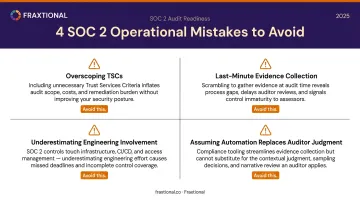
Operational Mistakes That Extend Timelines
- Selecting all five TSCs without business justification inflates audit scope — define your scope around what customers actually care about
- Treating evidence collection as a last-minute task; for Type 2, evidence must be continuous and retroactive assembly rarely satisfies auditors
- Underestimating engineering team involvement — the systems under review belong to engineering and operations, and their time is required, not optional
- Assuming compliance tools replace auditor judgment; automation helps organize evidence, but no tool substitutes for the CPA's examination itself
Frequently Asked Questions
What is SOC 2 compliance for SaaS?
SOC 2 compliance means a SaaS company has had its data security controls independently evaluated by an AICPA-accredited CPA firm against one or more of the five Trust Services Criteria. The result is a formal attestation report — not a certification — that customers and partners use to assess the vendor's security posture.
Who needs SOC 2 Type 2 compliance?
Any SaaS company selling to enterprise buyers or regulated industries (financial services, healthcare, legal tech) will typically need a Type 2 report. Enterprise procurement teams prefer it over Type 1 because it demonstrates controls operated consistently over time, not just at a single point.
Do SaaS systems require SOC 1?
SOC 1 applies only when a SaaS platform directly affects a customer's financial reporting processes (payroll, ERP, or accounting systems). Most SaaS companies need SOC 2, not SOC 1.
Is SOC 2 mandatory for SaaS companies?
SOC 2 is not legally mandated, but it becomes treated as a requirement once a SaaS company targets enterprise customers or regulated industries. Procurement teams routinely include it in vendor onboarding checklists — without it, deals stall regardless of product quality.
What is the difference between SOC 2 Type 1 and Type 2?
Type 1 evaluates whether controls are designed correctly at a specific point in time. Type 2 evaluates whether those controls operated effectively over a defined observation period, typically 3–12 months. Most enterprise customers require Type 2 because it provides stronger assurance of sustained security performance.
How long does a SOC 2 audit take for a SaaS company?
The full process (readiness assessment through final report) typically takes six months to a year. The Type 2 observation period alone runs 3–12 months, followed by 4–6 weeks for auditor review — missing documentation and unclear policy ownership are the most common causes of delay.