Introduction
In late 2023, FinCEN assessed a $3.4 billion penalty against Binance, explicitly noting that the exchange failed to designate a qualified AML compliance officer until April 2018 — and even then, the individual "lacked knowledge of AML/CFT obligations." Just months later, Paxful faced a $3.5 million penalty for operating without "a qualified individual to assure day-to-day compliance with the BSA."
The pattern is consistent: FinCEN, NYDFS, FCA, and other regulators now cite the absence of named, accountable compliance officers — not just weak programs — as a primary violation in enforcement actions.
If you're operating a crypto exchange or building one, this guide covers exactly what those officer designations require: which roles you must fill, what qualifications regulators actually check for by jurisdiction, and how exchanges of any size can staff these positions without overextending budgets.
Why Crypto Exchanges Must Designate Compliance Officers
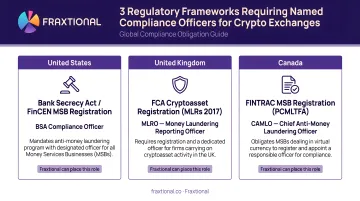
Regulators don't just require compliance programs — they demand accountable human officers. Three major frameworks make this explicit:
- FinCEN/BSA: Registered MSBs must designate a specific individual to "assure day to day compliance with the program"
- NY BitLicense: Requires a qualified individual dedicated to coordinating AML programs
- EU MiCA: Management body members must possess "appropriate knowledge, skills and experience" and commit sufficient time to compliance duties
Personal liability amplifies this requirement. In 2025, the DOJ indicted Iurii Gugnin (who served as President, Treasurer, and Compliance Officer of crypto company Evita) for failing to implement an effective AML program. Individual officers now face criminal prosecution, not just corporate penalties.
Beyond regulatory mandates, named compliance officers signal trustworthiness to sponsor banks, payment processors, and institutional partners. Without a credible CCO or BSA Officer, banks often decline partnerships, treating the gap as a signal that compliance infrastructure isn't ready for a banking relationship.
The Key Compliance Officer Roles Every Crypto Exchange Needs
The specific titles vary by jurisdiction and business model, but most crypto exchanges operating across the US, UK, EU, or Canada need some combination of the roles below.
Chief Compliance Officer (CCO)
The CCO serves as the top-level compliance authority responsible for overall program design, board and executive reporting, regulatory relationships, and compliance culture. The CCO must have sufficient seniority and independence — they cannot report solely to revenue-generating business units.
At a crypto exchange, the CCO oversees:
- AML/KYC program design and implementation
- Regulatory examination management
- Signing off on compliance policies
- Ensuring timely Suspicious Activity Reports (SARs) and Currency Transaction Reports (CTRs)
BSA Officer (Bank Secrecy Act Officer)
Any crypto business registered as a Money Services Business (MSB) with FinCEN must designate a BSA Officer — a named individual accountable for BSA/AML program implementation. This is not a generic compliance title.
Day-to-day responsibilities include:
- Maintaining and updating the AML program
- Supervising transaction monitoring systems
- Filing SARs and CTRs
- Conducting or overseeing independent AML testing
MLRO and CAMLO
Money Laundering Reporting Officer (MLRO): Required for FCA-registered crypto firms and MiCA-regulated Crypto Asset Service Providers (CASPs) in the UK and EU. The MLRO serves as the designated point of contact for submitting Suspicious Activity Reports to the National Crime Agency (NCA) in the UK or equivalent EU bodies.
Chief Anti-Money Laundering Officer (CAMLO): Required under FINTRAC regulations for Virtual Currency Dealers and payment service providers operating in Canada. The CAMLO holds similar accountability for AML program implementation and reporting.
Chief Risk Officer (CRO)
While not always legally mandated by name, regulators and sponsor banks now routinely expect a defined CRO function. The CRO covers broader operational, market, and counterparty risk alongside compliance risk — distinct from the narrower AML focus of the CCO.
For early-stage exchanges, one person often handles both roles. That works initially, but exchanges should separate them when:
- Seeking sponsor bank relationships or institutional partnerships
- Scaling transaction volume into higher-risk corridors
- Preparing for regulatory examination or licensing in new jurisdictions
What Regulators Actually Require: A Jurisdiction-by-Jurisdiction Breakdown
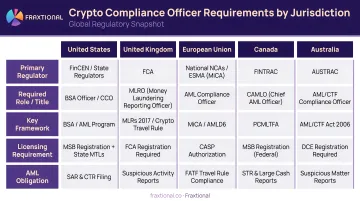
Compliance officer requirements are not uniform globally. What New York requires differs from London, Frankfurt, or Toronto — and exchanges serving users across multiple jurisdictions may need to satisfy several overlapping frameworks simultaneously.
United States
Three separate frameworks can apply to US-based exchanges, each with its own officer mandate:
- FinCEN MSB Registration — 31 CFR § 1022.210(d)(2) requires a designated person to oversee day-to-day BSA program compliance, including report filings, record retention, program updates, and staff training.
- NYDFS BitLicense — 23 NYCRR § 200.15 requires a "qualified individual" to monitor AML law changes, maintain records, review filings, escalate issues to senior management, and deliver at least annual compliance reporting.
- SEC/CFTC — Platforms trading security tokens or derivatives face additional registration requirements, which may impose further officer designation mandates depending on the products offered.
United Kingdom and European Union
The UK and EU apply overlapping but distinct frameworks, with officer requirements tightening under both:
- FCA Registration — UK crypto firms must appoint a Money Laundering Reporting Officer under the Money Laundering Regulations 2017. The FCA assesses MLROs on the "fit and proper" test: honesty, integrity, competence, and capability.
- Senior Managers Regime — FCA Consultation Paper CP25/25 proposes that existing MLR-registered crypto firms will need full FSMA authorisation and become subject to the Senior Managers and Certification Regime (SMCR), including formal Senior Management Functions (SMFs).
- MiCA — EU-based CASPs must appoint at least one dedicated compliance person with regular reporting to the executive management board and defined escalation procedures to the supervisory board.
Canada and Other Key Jurisdictions
Several additional jurisdictions have codified or are formalizing officer-level requirements:
- Canada (FINTRAC) — Exchanges must appoint a compliance officer with the authority, resources, and sector-specific ML/TF knowledge to meet PCMLTFA obligations.
- Australia (AUSTRAC) — The AML/CTF Amendment Act 2024 (effective March 2026) requires reporting entities to appoint a "fit and proper AML/CTF compliance officer" at the management level.
- Singapore (MAS) — The 2025 consultation on digital payment token services signals emerging officer-level requirements for licensed platforms.
Qualifications and Skills Required for Crypto Compliance Officers
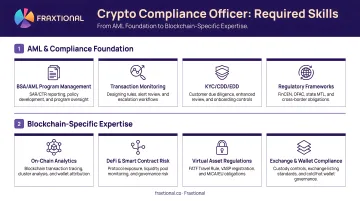
Most regulators evaluate whether designated officers are "fit and proper." In practice, this means relevant professional experience (typically 3–5+ years in AML, financial crime compliance, or regulatory roles), demonstrated knowledge of the applicable regulatory framework, and no disqualifying criminal or regulatory history.
How NYDFS and FCA Define Fit and Proper
The NYDFS BitLicense regulation requires a "qualified individual" but does not prescribe minimum years of experience. The FCA's fit and proper test assesses honesty, integrity, reputation, competence, and capability. No formal qualifications are mandatory under FCA rules, but prior regulated experience in financial crime — and crypto-specific training — strengthen a candidate's case considerably.
Crypto-Specific Skills That Set Candidates Apart
General AML experience is a starting point, not a finish line. Crypto compliance officers need hands-on familiarity with risks that simply don't exist in traditional finance:
- Blockchain transaction monitoring tools and how to interpret on-chain data
- Wallet types and on-chain risk indicators (including unhosted wallets)
- VASP-to-VASP Travel Rule compliance across jurisdictions
- Crypto-specific typologies: mixers, chain-hopping, DeFi exposure, and peer-to-peer transaction risks
Certifications: Useful, But Not the Deciding Factor
CAMS (Certified Anti-Money Laundering Specialist) and CFCS (Certified Financial Crime Specialist) signal baseline qualification to regulators and are worth holding. That said, neither NYDFS, FCA, nor FINTRAC explicitly mandate them.
What regulators actually weigh is operational competence: whether the officer understands the typologies and risks specific to their business. Familiarity with FinCEN's 2019 guidance and FATF's 2021 updated guidance on virtual assets is a concrete indicator of that competence.
Full-Time Hire vs. Fractional Compliance Officer: Which Makes Sense?
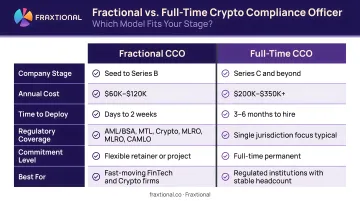
A qualified CCO or BSA Officer with crypto experience commands significant compensation. According to 2024–2026 market data, a Chief Compliance Officer in New York City earns $263,000 to $474,000 in total pay. BSA Officers command $94,000 to $161,000 base pay. In London, CCOs and MLROs earn £140,000 to £200,000+.
For seed-stage or Series A exchanges, this can consume a disproportionate share of the compliance budget, leaving no resources for transaction monitoring tools, training, and audits the officer is hired to oversee.
The Fractional Compliance Officer Model
A fractional compliance officer serves the exchange on a part-time or retainer basis, providing the same regulatory accountability, relationship management, and program oversight as a full-time hire — but without the full-time cost and hiring overhead.
Regulators explicitly recognize this model as compliant, provided the officer has sufficient time and authority to perform the role. FinCEN guidance (FIN-2016-G001) notes that while entities may contractually allocate responsibility for developing policies, the MSB "remains independently and wholly responsible for implementing adequate AML program requirements." The FCA explicitly permits part-time MLROs for smaller firms, provided "their commitment to the role must be proportionate and sufficient." NYDFS permits part-time or outsourced CISOs under its Cybersecurity Regulation, provided a senior member of personnel oversees them.
When Fractional Makes Sense vs. Full-Time
Fractional works well for:
- Exchanges in the licensing phase
- Pre-Series B companies managing costs
- Firms entering a new jurisdiction
- Companies securing initial sponsor bank relationships
Full-time is typically necessary when:
- Transaction volumes require daily SAR reviews
- The firm faces an active regulatory examination
- Institutional investors require a named full-time CCO as a condition of investment
- The exchange operates at scale across multiple high-risk jurisdictions
Fraxtional's fractional CCO, BSA Officer, MLRO, and CAMLO services give growing crypto exchanges a direct path to meeting their regulatory obligations without overextending budgets. The director-led model means every client works with experienced Director-level officers who can be named in regulatory filings, audits, and contracts — providing the accountability that regulators and sponsor banks expect.
Frequently Asked Questions
What is the main role of a compliance officer?
A compliance officer designs, implements, and oversees a firm's compliance program, ensuring it meets all applicable laws and regulations including AML/KYC, reporting obligations, and regulatory filings. At a crypto exchange, this includes managing transaction monitoring, SAR filings, and regulatory relationships.
Who regulates crypto exchanges in the US?
U.S. crypto exchange oversight is split across multiple agencies: FinCEN (BSA/AML and MSB registration), the SEC (security tokens and broker-dealer rules), the CFTC (crypto derivatives), NYDFS (BitLicense for NY activity), and state money transmitter regulators. Which agencies apply depends on the exchange's specific activities and the states where it operates.
How much do compliance officers earn?
Chief Compliance Officers in New York City earn $263,000 to $474,000 in total pay, while BSA Officers earn $94,000 to $161,000 base pay. In London, CCOs and MLROs command £140,000 to £200,000+.
What is blockchain compliance?
Blockchain compliance refers to the practices, controls, and regulatory obligations that apply to businesses operating on or with blockchain networks — including AML/KYC requirements, transaction monitoring for on-chain activity, sanctions screening, and suspicious activity reporting for crypto transactions.
Do crypto exchanges need a designated BSA officer?
Yes. Any crypto exchange registered as a Money Services Business (MSB) with FinCEN in the US is legally required to designate a BSA Officer — a named individual accountable for the AML program. This is a named obligation under the Bank Secrecy Act.
Can a crypto exchange use a fractional compliance officer instead of a full-time hire?
Yes. Regulators generally permit fractional or part-time compliance officers provided they have sufficient authority, availability, and expertise to fulfill the role's obligations. Growth-stage exchanges commonly use this model to meet officer designation requirements without a full-time hire.