These aren't hypothetical scenarios. According to WorldCC's 2025 contract management whitepaper, companies lose an average of 8.6% of contract value through poor contract management, with the weakest performers losing 15% or more. In financial services, those losses compound quickly — through fines, damaged bank relationships, and regulatory action.
That's the problem a contract compliance officer exists to prevent.
This guide covers everything you need to know: the role definition, core responsibilities, must-have skills, qualifications, current salary benchmarks across the US, UK, and Canada, and how fast-moving fintechs can access this expertise without committing to a full-time hire.
Key Takeaways
- A contract compliance officer ensures all parties fulfill their obligations under signed agreements while staying compliant with applicable laws and regulations.
- Core responsibilities include contract auditing, risk identification, compliance reporting, and cross-functional coordination.
- Strong performers bring regulatory knowledge, sharp analytical ability, attention to detail, and clear communication.
- US median salary is $78,420 (BLS, May 2024); fintech and financial services roles trend higher.
- Fractional compliance leadership gives growing fintech and crypto firms director-level contract expertise without a full-time hire.
What Is a Contract Compliance Officer?
A contract compliance officer ensures that all parties — vendors, partners, and internal teams alike — meet the obligations in a signed agreement and that those agreements stay aligned with applicable laws throughout their lifecycle.
The role differs from a general compliance officer, who oversees broad adherence to laws and internal policies. Contract compliance is narrower: post-signature enforcement — tracking obligations, identifying gaps, and escalating issues before they become disputes or penalties. In smaller fintechs and startups, one person often covers both functions.
Where that person sits organizationally shapes how the role operates in practice.
Where the Role Sits
Contract compliance officers typically sit within legal, procurement, risk, or a dedicated compliance function. The role has grown in importance as organizations manage larger, more complex contract portfolios spanning multiple jurisdictions and regulatory frameworks.
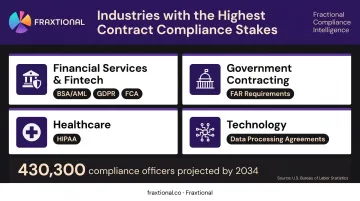
Industries where contract compliance carries the most consequence include:
- Financial services and fintech — governed by BSA/AML, Reg E, UDAAP, GDPR, FCA rules, and FINTRAC obligations
- Government contracting — subject to FAR requirements and strict performance accountability
- Healthcare — where HIPAA obligations and payer agreements require continuous monitoring
- Technology — where data processing agreements and SaaS contracts carry significant regulatory weight
The demand for this expertise is growing. The BLS projects compliance officer employment to increase from 418,000 in 2024 to 430,300 by 2034, with roughly 33,300 openings per year — a figure that reflects how hard it has become for fintechs and regulated businesses to keep contract obligations from slipping through the cracks.
Key Responsibilities of a Contract Compliance Officer
Contract Auditing and Monitoring
The officer regularly compares active contracts against actual performance data — checking delivery timelines, payment terms, service-level agreements, and quality standards. This is an ongoing process, often supported by contract lifecycle management (CLM) platforms, that continues for the full duration of each agreement.
Risk Identification and Escalation
Compliance gaps rarely announce themselves. The officer's job is to spot early warning signs and flag them to legal and management before they become enforceable issues. Common signals include:
- A vendor consistently missing SLA thresholds
- A regulatory clause approaching expiration
- Counterparty behavior inconsistent with agreed terms
Compliance Reporting
The officer prepares structured reports for internal management, external auditors, and regulatory bodies. These reports track which obligations are fulfilled, which are pending, and which are at risk. In regulated industries, the quality of these reports directly affects how regulators and sponsor banks assess an organization's compliance maturity.
Policy and Procedure Development
Contract compliance officers draft and maintain internal policies, compliance checklists, and standard operating procedures. They also integrate regulatory changes — updated BSA/AML requirements, revised GDPR obligations, new FCA guidance — into contract frameworks before those changes create exposure.
For fintech clients, this work typically includes Vendor Management Policies, AML compliance frameworks, and internal controls documentation designed to hold up under sponsor bank and regulatory review.
Cross-Functional Stakeholder Coordination
The officer works closely with legal, finance, procurement, and business unit leaders to resolve compliance issues, guide renegotiations, and ensure frontline teams understand their contractual obligations. This requires real communication and influence skills: translating complex contractual language into clear direction for people who didn't sign the agreement and may not have read it.
Essential Skills Every Contract Compliance Officer Needs
Regulatory and Legal Knowledge
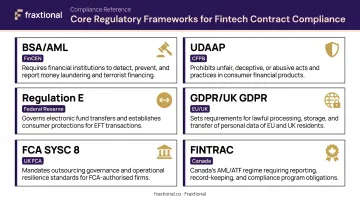
The officer must understand the legal and regulatory frameworks governing their industry. For fintech and banking, this means working familiarity with:
- BSA/AML — FinCEN reporting, transaction monitoring, and program management
- UDAAP — CFPB examination procedures covering unfairness, deception, and abuse
- Regulation E — electronic fund transfer obligations and error resolution timelines
- GDPR / UK GDPR — Article 28 processor contract requirements, data subject categories, and instruction documentation
- FCA SYSC 8 — outsourcing rules requiring written agreements with clear rights and obligations
- FINTRAC — Canadian AML reporting obligations under the Proceeds of Crime Act
This knowledge can't be static. Thomson Reuters' 2023 Cost of Compliance report found 73% of compliance practitioners expected the volume of regulatory information to increase — a signal that staying current isn't optional, it's the job.
Analytical and Audit Skills
The officer must dissect complex contracts, identify gaps between agreed terms and actual performance, and produce defensible audit findings backed by data — performance metrics, invoice records, delivery logs, and transaction data. Without that evidentiary backing, audit findings carry no weight with regulators or leadership.
Attention to Detail
A single missed renewal clause can trigger automatic unfavorable terms. An untracked indemnity obligation surfaces only when there's a claim. An expired regulatory clause gets flagged by an examiner, not the team. Precision isn't a soft skill here — it's the core mechanism of the role.
Communication and Negotiation
This role demands more than knowing what's wrong — it requires getting the right people to act on it. Core communication responsibilities include:
- Translating findings into plain language for non-legal stakeholders
- Presenting corrective action plans to leadership with clear timelines
- Negotiating contract amendments when compliance gaps require vendor changes
Making a legal problem legible to an operations team matters as much as identifying it in the first place.
Technical Proficiency
Organizations expect contract compliance officers to work with CLM platforms, compliance tracking tools, and reporting dashboards. As contract volumes grow, manual monitoring breaks down — these systems are what make consistent oversight possible across hundreds of active agreements.
Qualifications, Certifications, and Career Path
Education and Experience
Most employers expect at minimum a bachelor's degree, typically in business administration, law, finance, or a related field. The BLS notes that employers often prefer candidates with industry experience or backgrounds in legal or auditing work — meaning formal credentials alone rarely substitute for practical exposure to contract-heavy environments.
For senior roles in regulated industries, advanced degrees (MBA, JD) are common, though most mid-size firms don't mandate them.
Relevant Certifications
Three credentials carry the most weight with employers and regulators:
| Certification | Issuing Body | Key Requirements |
|---|---|---|
| CPCM (Certified Professional Contracts Manager) | NCMA | Bachelor's degree, 5 years' experience, 120 CPE hours |
| CCCM (Certified Commercial Contract Manager) | NCMA | Bachelor's degree, 2 years' experience, 80 CPE hours |
| CCEP (Certified Compliance and Ethics Professional) | SCCE/CCB | 1 year in a full-time compliance role or 1,500 hours of compliance duties |
The CPCM is ANAB accredited and based on the NCMA Contract Management Standard — it's the more senior designation for professionals in complex contract environments. The CCCM has a lower experience threshold, making it a practical starting point. Both require recertification every five years.
Career Progression
Most professionals enter through adjacent roles — paralegal, procurement analyst, contract administrator, or project coordinator. From there, the typical path runs:
- Contract Administrator / Compliance Analyst
- Contract Compliance Officer
- Senior Compliance Officer or Compliance Manager
- Head of Compliance or Chief Compliance Officer (CCO)
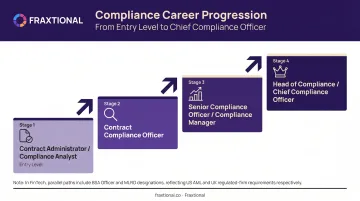
Fintech adds another layer. Professionals moving through this path in financial services often build specialized regulatory credentials alongside their contract expertise: BSA Officer designation, CAMLO experience, or MLRO qualification for UK/EU-facing roles.
Contract Compliance Officer Salary
Current Benchmarks by Region
| Region | Benchmark | Source |
|---|---|---|
| United States | Median $78,420; below 10th percentile under $46,230; above 90th percentile over $130,030 | BLS, May 2024 |
| United Kingdom | Average £46,485; range £43,662 – £51,180 | Reed, 2026 |
| Canada | CAD $24.04 – $66.67/hour; median CAD $38.46/hour | Canada Job Bank, Nov 2025 |
Note: older content still circulating online cites a US range of $40,160–$115,220, which reflects BLS data from 2020. The figures above are current.
Those ranges shift considerably depending on where you sit in the market.
What Drives Compensation
Five variables consistently separate the lower and upper ends of these ranges:
- Industry — Finance and insurance compliance officers earned a median of $79,920 in May 2024 (BLS), above the overall median. Fintech, financial services, and government contracting pay the most due to regulatory complexity.
- Seniority — Director-level and CCO roles reach a different tier entirely. Robert Half's 2026 guide puts US compliance officer salaries between $90,000 and $132,000, with a midpoint of $114,500.
- Certifications such as CPCM, CCCM, and CCEP command premiums — especially in government contracting and regulated financial services.
- Geography matters: New York, London, and Toronto consistently trend above their national medians.
- Fully loaded cost — BLS data shows benefits average 29.9% of total compensation in private industry. A $100,000 base salary carries roughly $30,000 in additional employer cost.
Do You Need a Full-Time Contract Compliance Officer or a Fractional One?
The Core Decision
For large enterprises with high contract volumes, dedicated compliance teams, and ongoing regulatory interactions, a full-time contract compliance officer makes sense. The workload justifies the headcount.
For seed-stage and Series A/B fintechs, crypto firms, and money transmitters, the calculation is different. Regulatory requirements are real — BSA/AML obligations, Reg E, GDPR, FCA rules — but the workload often doesn't yet justify a permanent senior hire. A fully-loaded compliance director can cost well north of $130,000 in base salary alone, before benefits, recruiting, and onboarding.
What the Fractional Model Provides
Fractional compliance leadership gives organizations director-level expertise on a flexible engagement basis — covering CCO, BSA Officer, CAMLO, or MLRO responsibilities — without the commitment or cost of a full-time hire.
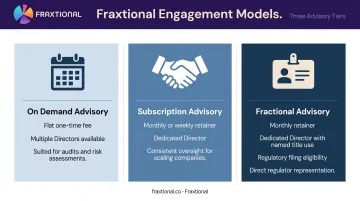
Fraxtional offers three engagement structures for fintech and crypto clients:
- On Demand Advisory: flat one-time fee, access to multiple Directors, suited for audits, risk assessments, procedure development, and sponsor bank introductions
- Subscription Advisory — monthly or weekly retainer with a dedicated Director, ideal for scaling companies needing consistent oversight without long-term commitment
- Fractional Advisory: monthly retainer with a dedicated Director carrying named title use, meaning the Director can be listed on regulatory filings, serve as the named BSA Officer or CCO, and represent the company directly to sponsor banks, FinCEN, and other regulators
Sponsor banks and investors expect designated compliance officers with clear accountability. When a fintech can present a named CCO or BSA Officer with verifiable credentials and regulatory recognition, it removes a significant friction point from bank onboarding and investor due diligence.
Fraxtional's Directors have helped clients pass sponsor bank reviews and remediate AML frameworks under tight timelines — one crypto wallet client resolved a sponsor bank compliance failure within days of engagement. Fraxtional has been recognized as a Top 10 Best Fractional Compliance Firm in the US for both 2024 and 2025, a benchmark regulators and sponsor banks reference during partner vetting.
Signs You Need Compliance Support Now
Act on compliance support — whether full-time or fractional — when you're facing any of these:
- Approaching a regulatory filing deadline without a designated compliance officer on record
- Scaling into a new jurisdiction (UK, EU, Canada) where local regulatory requirements apply
- Preparing for a sponsor bank review or investor due diligence process
- Experiencing a contract compliance breach or receiving an MRA from a regulator
- Transaction volumes increasing to the point where manual contract monitoring is no longer reliable
Frequently Asked Questions
What is the main role of a contract compliance officer?
A contract compliance officer ensures all parties fulfill their obligations under signed agreements while maintaining compliance with applicable laws and regulations. The role covers ongoing monitoring, audit, risk escalation, and compliance reporting — starting after the contract is signed and continuing throughout its lifecycle.
How much does a contract compliance officer earn?
In the US, the BLS reports a median annual wage of $78,420 (May 2024), with the top 10% earning over $130,000. Compensation varies by industry, seniority, certifications, and geography — financial services and fintech roles typically sit at the higher end of the range.
What qualifications are needed to become a contract compliance officer?
Most roles require a bachelor's degree in law, business, or finance, plus relevant experience in contract administration, procurement, or legal operations. Certifications such as the CPCM (NCMA) or CCEP (SCCE) strengthen candidacy, particularly for roles in regulated industries.
How does a contract compliance officer differ from a general compliance officer?
A contract compliance officer focuses specifically on enforcing post-signature contractual obligations. A general compliance officer oversees the organization's broader adherence to laws, regulations, and internal policies. In smaller organizations, one person often covers both functions.
Do fintech startups need a full-time contract compliance officer?
Regulatory requirements in fintech make compliance expertise essential from early stages — but many startups meet this need through fractional compliance leadership. This provides the same director-level expertise, including named title use on regulatory filings, without the cost of a permanent hire.
What are the biggest challenges contract compliance officers face?
The most common challenges include managing high contract volumes across multiple jurisdictions, keeping pace with regulatory change, and addressing ambiguous contract language. Internal resistance is equally persistent — frontline teams often treat compliance as friction rather than the protection it provides.