Introduction
Any business receiving or transmitting money for a fee in New Jersey must obtain a money transmitter license from the New Jersey Department of Banking and Insurance (NJDOBI) before operating in the state. If you're launching a fintech startup, payment platform, crypto firm, or embedded finance company in New Jersey, don't underestimate the complexity of the licensing process. Missing requirements or submitting incomplete applications triggers costly delays — NJDOBI's review process typically runs 3–6 months for complete applications, and deficiencies can push that timeline significantly further.
This guide covers both license types, exact requirements, the application process, post-licensing obligations, and the most common pitfalls that derail approvals.
Key Takeaways
- New Jersey issues two license types: Money Transmitter (standard) and Foreign Money Transmitter (for transmissions outside the U.S. only)
- Applications are paper-based (not through NMLS) and mailed to NJDOBI's Licensing Services Bureau in Trenton
- Requirements include minimum net worth, audited financials, surety bond, and LiveScan fingerprinting
- Non-refundable application fee is $700 for both license types
- Licenses expire June 30 of every odd-numbered year; renewal follows the same biennial cycle
- Ongoing obligations include annual reports, delegate management, and BSA/AML compliance
What Is a New Jersey Money Transmitter License?
A New Jersey money transmitter license is legal authorization issued by NJDOBI under the New Jersey Money Transmitters Act (N.J.S.A. 17:15C). It permits businesses to sell or issue payment instruments, transmit money domestically or internationally, or receive money to pay consumer bills—all for a fee, commission, or other benefit.
Two License Types: Understanding the Difference
New Jersey offers two distinct money transmitter licenses:
Standard Money Transmitter License covers:
- Sale or issuance of payment instruments for a fee
- Receipt of money for transmission domestically or internationally by any means
- Receipt of money to pay consumer bills, invoices, or accounts for a fee
Foreign Money Transmitter License covers:
- Receipt and transmission of money to locations outside the United States only
- Narrower scope with less stringent requirements (lower net worth and bond thresholds)
What Activities Trigger Licensing?
New Jersey's statutory definition in N.J.S.A. 17:15C-2 is broader than many applicants assume. These activities require a license:
- Processing payments on behalf of a platform when you take custody of funds
- Holding customer funds in transit, even temporarily
- Operating as an authorized delegate of another licensee
- Facilitating payment transmission through any means—wire, electronic transfer, mobile app, or payment instrument
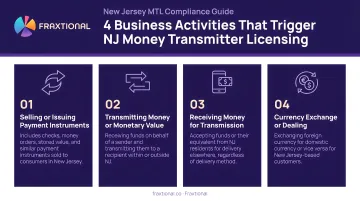
If your business model involves receiving money from New Jersey customers and transmitting it elsewhere—or paying bills on their behalf—for any form of compensation, you need a New Jersey money transmitter license.
Who Needs a New Jersey Money Transmitter License (and Who Is Exempt)?
Business Types That Must Be Licensed
Under N.J.S.A. 17:15C, the following business types must obtain a license before operating:
- Payment platforms that receive and transmit funds between parties
- Remittance services facilitating domestic or international money transfers
- Bill payment services receiving money to pay consumer bills
- Mobile wallet providers holding customer funds for transmission
- Digital currency exchangers converting or transmitting cryptocurrency
- Any entity receiving money from New Jersey customers for transmission
Is a Payment Processor a Money Transmitter?
A payment processor is not automatically a money transmitter. The key question is whether the processor takes custody of customer funds. If the processor merely routes transactions without holding money in its own name, it may not trigger licensing requirements.
However, if it receives, holds, or transmits funds for a fee, licensing is likely required. This is a fact-specific determination, and legal review is recommended before assuming exemption.
Statutory Exemptions
Banks, credit unions, and entities already regulated under federal or New Jersey banking law are generally exempt from money transmitter licensing. However, the Act does not include a de minimis transaction volume exemption. Even low-volume operators who meet the activity definition must obtain a license.
NJ Money Transmitter License Requirements
NJDOBI requires applicants to satisfy financial, operational, and personal background requirements before issuing a license. Incomplete applications are returned in their entirety — there is no opportunity to supplement after submission, so preparation matters.
Net Worth and Financial Statements
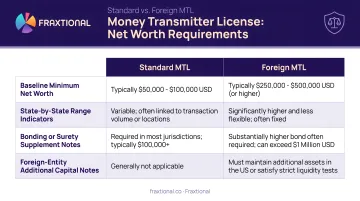
Minimum net worth thresholds vary by license type:
| License Type | Base Net Worth | Per Agent/Location | Maximum Cap |
|---|---|---|---|
| Standard Money Transmitter | $100,000 | $25,000 | $1,000,000 |
| Foreign Money Transmitter | $50,000 | $10,000 | $400,000 |
Financial statements submitted with the application must meet strict standards:
- Submit unqualified audited financial statements for the most recent fiscal year (plus two prior years if available)
- Statements must be prepared by a Certified Public Accountant in good standing
- Clearly demonstrate net worth (assets minus liabilities) — unaudited or internally prepared financials are not accepted
Surety Bond Requirement
Applicants must obtain a surety bond as a condition of licensure:
- Standard Money Transmitter License: $100,000
- Foreign Money Transmitter License: $25,000 (or higher based on annual volume tiers)
The bond protects consumers against fraud or failure to transmit funds. Bond cost vs. bond amount: the premium paid is a fraction of the face amount, typically ranging from 0.5%–5% annually (industry average around 2%) depending on credit score, financials, and fixed/liquid assets.
Business and Personal Documentation
Beyond financial requirements, the application requires documentation across three categories: business formation, personal background, and operations.
Business formation and registration:
- Business formation documents and New Jersey registration (corporations/LLCs register with NJ Dept. of Treasury; sole proprietors file trade names with County Clerk)
- Tax registration with the NJ Division of Revenue
Personal background:
- Personal Certification Forms for all officers, directors, key shareholders (25%+ ownership), members, and partners
- LiveScan fingerprinting for all executive officers and owners
Operational documentation:
- Letters from all clearing banks confirming payment instruments will be drawn through them
- Sample authorized delegate agreement and list of all proposed NJ authorized delegates
- Sample payment instrument (if applicable)
- Description of corporate structure and business activities
- Copies of SEC filings or equivalent foreign regulatory filings (if applicable)
- For foreign transmitters, a list of countries to which money will be transmitted
How to Apply for a New Jersey Money Transmitter License
New Jersey does not use the Nationwide Multistate Licensing System (NMLS) for money transmitter licenses. The process is paper-based and submitted by mail to NJDOBI's Licensing Services Bureau in Trenton.
Step 1: Register Your Business Entity
Complete business registration before submitting a license application:
- Corporations, LLCs, and LLPs: Register with the NJ Department of Treasury via the NJ Business Portal
- Sole proprietors and general partnerships: Register trade names with County Clerk's Office
- All entities: Register for tax/employer purposes with the NJ Division of Revenue
Step 2: Prepare Your Full Document Package
Download the application form and complete it in full with all supporting documents attached. NJDOBI returns incomplete applications in their entirety—there is no opportunity to supplement after submission.
Create a pre-submission checklist covering:
- Every required document listed in the requirements section
- All required signatures
- Completed Personal Certification Forms with proper attachments
- Confirmation that audited financials clearly demonstrate required net worth
- Surety bond in the correct amount
- Complete list of proposed NJ authorized delegates in Excel format
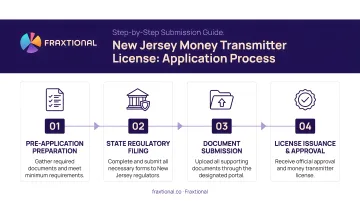
Step 3: Submit the Application and Pay the Fee
Mail the completed application package with a company check or money order for $700 (non-refundable) payable to "New Jersey Treasurer" to:
Licensing Services Bureau
N.J. Dept. of Banking & Insurance
PO Box 473
Trenton, NJ 08625
There is no online submission option. Once mailed, the application enters NJDOBI's review queue.
Step 4: Await NJDOBI Review and Respond to Any Deficiencies
NJDOBI will review the application and may issue a deficiency notice requesting clarification or additional information. While NJDOBI does not publish official processing timelines, industry experience suggests review can take several weeks to several months depending on application completeness. Submitting a fully complete package the first time is the most effective way to reduce delays.
During the review period, expect:
- A deficiency notice if NJDOBI requires clarification or missing documentation
- No fixed timeline — review can range from several weeks to several months
- Faster processing when the initial submission is complete and error-free
Ongoing Compliance Obligations After Licensing
License Renewal
New Jersey money transmitter licenses expire on June 30 of every odd-numbered year (e.g., 2025, 2027). NJDOBI mails renewal instructions approximately 60 days before expiration. Renewals are processed electronically through NJDOBI's Banking Online Services portal at no fee for non-mortgage licensees.
Annual Report Obligation
Licensed money transmitters must file an annual report with NJDOBI by May 1 each year for the prior calendar year. Reports must cover:
- NJ-specific transaction volumes (domestic and foreign)
- Payment instruments sold
- Bill pay volumes
- Surety bond status
Reports are filed electronically through NJDOBI's online portal.
BSA/AML and Operational Compliance
Licensees must maintain:
- A compliant anti-money laundering program
- Authorized delegate agreements and oversight
- Permissible investments equal to outstanding payment instruments
- NJDOBI notification of material changes (business name, address, ownership changes of 25%+)
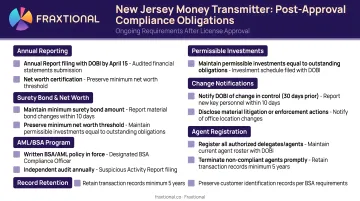
These obligations don't pause once the license is issued — they require consistent, ongoing attention. For fintech companies scaling fast, keeping up with these requirements without a dedicated compliance hire adds real overhead. Fractional compliance leadership, like the BSA Officer and CCO services Fraxtional provides, gives companies director-level expertise without the cost or commitment of a full-time executive.
Common Application Mistakes and How to Avoid Them
Most NJ money transmitter applications that stall do so for one of three reasons: missing documents, misunderstood financials, or overlooked delegate requirements. Here's what to watch for.
Submitting an Incomplete Application
The most common failure point: NJDOBI returns the entire package if anything is missing. You lose time but not the $700 fee (it is non-refundable once submitted). Use a pre-submission checklist covering:
- Every document listed in the requirements section
- Every signature on every form
- All Personal Certification Forms properly completed
- Audited financials clearly demonstrating required net worth
Misunderstanding Net Worth Calculation
Applicants sometimes confuse gross revenue or total assets with net worth (assets minus liabilities). If audited financials don't clearly demonstrate the required net worth threshold, the application will fail. The audited statements must be prepared by a CPA in good standing—unaudited or internally prepared financials are not accepted.
Overlooking Authorized Delegate Requirements
Many fintech applicants miss the need to include a complete list of all proposed NJ authorized delegates in Excel format, plus a sample delegate agreement. If your business model includes third-party agents, this documentation must be ready at initial application.
These gaps are exactly where applications get stuck for months. Fraxtional's money transmitter licensing specialists work with fintech and crypto firms to audit applications before submission, so NJDOBI receives a complete package the first time.
Frequently Asked Questions
Who needs a money transfer license?
Any person or business entity that receives money for transmission, sells or issues payment instruments, or receives money to pay consumer bills—all for a fee or commission—in New Jersey must obtain a money transmitter license from NJDOBI. This includes fintechs, remittance services, bill pay platforms, and digital wallet providers operating in the state.
Is a payment processor a money transmitter?
Not automatically. The key question is whether the processor takes custody of customer funds. Processors that merely facilitate fund movement without holding money likely fall outside licensing requirements—but those that receive, hold, or transmit funds for a fee typically do not. This is a fact-specific determination, and legal review is strongly recommended.
How long does it take to get a New Jersey money transmitter license?
NJDOBI does not publish official processing timelines, but review typically takes several weeks to several months depending on application completeness and volume. Submitting a complete package the first time is the most effective way to reduce delays.
What is the net worth requirement for a New Jersey money transmitter license?
Standard money transmitters must demonstrate minimum net worth of $100,000 plus $25,000 per authorized agent (up to $1,000,000). Foreign money transmitters must show $50,000 plus $10,000 per agent/location (up to $400,000), verified by audited financial statements from a CPA.
Does New Jersey use NMLS for money transmitter licensing?
No. New Jersey does not use the Nationwide Multistate Licensing System (NMLS) for money transmitter licenses. Applications are submitted by mail directly to NJDOBI's Licensing Services Bureau in Trenton—a notable difference from many states that process these licenses through NMLS.
What happens if I operate as a money transmitter in New Jersey without a license?
Operating without a license violates the New Jersey Money Transmitters Act and can result in cease-and-desist orders, civil penalties, criminal liability, and damage to your banking relationships. NJDOBI enforcement actions can move quickly once a violation is identified.