
Introduction
Hiring the wrong compliance officer — or skipping the role entirely — is one of the fastest ways a fintech or financial services company ends up in a regulatory examination it isn't prepared for. The compliance function isn't a back-office checkbox anymore. It's what keeps licenses active, regulators satisfied, and investors confident.
According to the Bureau of Labor Statistics, the compliance officer occupation is projected to grow 3% from 2024 to 2034, with approximately 33,300 openings per year. That steady demand reflects how embedded this function has become across regulated industries.
This article breaks down what compliance officers actually do, what qualifications and skills matter, and how those requirements translate specifically for financial services and fintech companies operating across the US, UK, EU, and Canada.
Key Takeaways
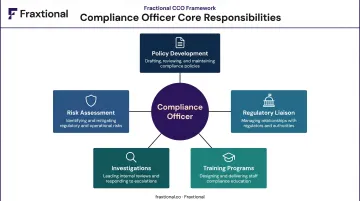
- Compliance officers manage regulatory risk, develop internal policies, investigate violations, and serve as the primary liaison to external regulators.
- A bachelor's degree is the standard minimum; senior and CCO-level roles frequently require a JD, MBA, or 7–10+ years of experience.
- Financial services mandates specific regulatory frameworks: BSA/AML (US), SEC Rule 206(4)-7 (US), MiFID II Article 22 (EU), and FCA SM&CR SMF16 (UK).
- The BLS reports a median annual wage of $78,420 (May 2024), with the top 10% earning over $130,000.
- Fintechs and crypto firms carry the same compliance obligations as banks, typically with smaller teams and tighter budgets to cover them.
What Is a Compliance Officer?
A compliance officer is a professional responsible for ensuring an organization meets the legal, regulatory, and ethical obligations governing its industry — covering internal policy enforcement, risk identification, and regulatory liaison with external bodies.
The role exists across healthcare, manufacturing, environmental sectors, and government — but it's most prominent, and often legally required, in financial services. Banks, investment advisers, fintechs, money transmitters, and crypto firms all operate under specific regulatory frameworks that mandate a designated compliance function. That mandate also draws a meaningful line between two distinct roles.
Compliance Officer vs. Chief Compliance Officer (CCO)
The distinction matters, especially for regulated entities:
- Compliance officer — operates at a functional level, executing compliance program tasks, conducting monitoring, and managing day-to-day obligations
- Chief Compliance Officer (CCO) — a C-suite executive who sets the overall compliance strategy, typically reporting directly to the CEO or Chief Legal Officer
The SEC's Rule 206(4)-7 (17 CFR 275.206(4)-7(c)) requires registered investment advisers to designate a specific CCO responsible for administering the firm's compliance policies and procedures. This is a named, accountable role — not a generic function that can be distributed informally.
Core Duties and Responsibilities of a Compliance Officer
Developing and Implementing Compliance Policies
Compliance officers translate laws and regulations into actionable internal policies. That includes compliance manuals, transaction monitoring protocols, employee codes of conduct, and written supervisory procedures.
Regulations change and products evolve. Keeping pace means coordinating with legal counsel and senior leadership to roll out policy updates across the organization without disrupting operations.
Conducting Risk Assessments and Managing Compliance Risk
Risk assessment is one of the most substantive parts of the role. Compliance officers systematically identify exposures — AML risk, data privacy violations, sanctions breaches, consumer protection failures — and design controls to reduce likelihood and impact.
The FFIEC's BSA/AML Manual describes the BSA compliance officer's responsibility as managing "all aspects of the BSA/AML program" and reporting compliance status continuously to the board and senior management — a standard that makes clear this is a continuous obligation, not a periodic checkbox.
Communicating with Regulatory Authorities
Compliance officers serve as the primary liaison between the organization and external regulators — FinCEN, SEC, FCA, FINTRAC, EBA, and others. Responsibilities include:
- Responding to regulatory information requests and examinations
- Submitting required periodic filings
- Managing audit or inspection processes
- Maintaining the organization's licensing standing
How a regulated entity communicates with its regulator directly affects its reputation, its licensing status, and its ability to operate. Regulators notice both responsiveness and gaps — and they remember both.
Designing and Overseeing Compliance Training Programs
Compliance obligations only hold if staff actually understand them. Compliance officers build and deliver training programs covering AML awareness, data handling, sanctions screening, consumer protection, and conflicts of interest.
They also manage onboarding compliance elements for new hires and track training completion — because regulators view documented training as evidence that a compliance program is functional, not theoretical.
Investigating Violations and Documenting Findings
When a monitoring alert fires, a whistleblower report comes in, or an internal audit surfaces an issue, the compliance officer leads the investigation. That means:
- Gathering and preserving evidence
- Analyzing root causes
- Documenting findings and conclusions
- Recommending corrective actions
Regulators reviewing a compliance program will scrutinize investigation records closely. The quality of those records signals whether the program has real operational depth — or just exists on paper.
Essential Skills for Compliance Officers
Hard Skills
Effective compliance officers combine regulatory knowledge with analytical capability and strong written communication:
- Regulatory and legal fluency — deep understanding of the specific frameworks governing the organization's industry and geography
- Data analysis and audit skills — ability to evaluate transaction patterns, compliance metrics, and program effectiveness
- Technical writing — producing policies, regulatory correspondence, and investigation reports that are clear, defensible, and precise
- Transaction monitoring — for financial services roles, understanding how monitoring systems work and when alerts require escalation
For broker-dealer roles specifically, FINRA's Series 14 Compliance Official content outline maps the expected technical competency areas: regulatory agency structure, broker-dealer operations, capital requirements, supervision systems, and surveillance procedure development — a useful benchmark for what hard-skill depth looks like in practice.
Soft Skills
Technical knowledge only takes a compliance officer so far. What determines day-to-day effectiveness is how they communicate, reason, and hold their ground:
- Interprets ambiguous regulatory guidance and maps it to specific business scenarios
- Translates complex requirements for product, engineering, and business stakeholders who don't share a compliance background
- Raises uncomfortable findings with senior leadership clearly and directly — that's a core part of the role, not a bonus trait
Organizational and Project Management
Compliance officers run multiple concurrent workstreams at any given time: active audits, training cycles, regulatory deadlines, and policy reviews. Strong organizational skills and meticulous recordkeeping aren't optional extras — they're what keeps the program functional under pressure.
Compliance Officer Qualifications: Education, Certifications, and Experience
Educational Requirements
A bachelor's degree is the standard minimum for entry-level compliance roles. Common fields include:
- Business administration or finance
- Accounting
- Law or public policy
- Economics
For senior or CCO-level positions at regulated financial institutions, a JD or MBA is increasingly expected. Some firms explicitly prefer candidates with advanced degrees when filling director-level compliance functions.
In specialized areas — environmental compliance, for example — a science or engineering background may matter more than business training.
Education establishes the foundation, but certifications are what signal credentialed expertise — particularly to regulators and hiring managers evaluating senior candidates.
Professional Certifications
Certifications aren't required across the board, but they strengthen hiring prospects, show regulators you know the field, and are typically expected at director and CCO levels.
| Certification | Full Name | Awarding Body | Key Eligibility |
|---|---|---|---|
| CAMS | Certified Anti-Money Laundering Specialist | ACAMS | 40 eligibility credits (education + experience + training) |
| CCEP | Certified Compliance & Ethics Professional | CCB (administered via SCCE) | 1 year full-time compliance work + 20 CCB-approved CEUs |
| CRCM | Certified Regulatory Compliance Manager | American Bankers Association | 3 years US compliance experience (or 6 years within last 10) |
| CHC | Certified in Healthcare Compliance | CCB (administered via HCCA) | 1 year full-time compliance + 20 CCB-approved CEUs |
For financial services specifically, CAMS is the most widely recognized credential for AML-focused roles. CRCM is the banking-sector standard. CCEP applies broadly across financial services compliance.
Experience and Career Pathways
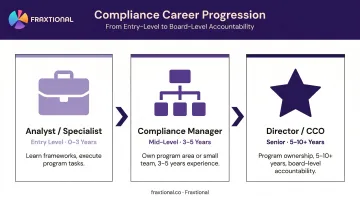
Most compliance officers follow a recognizable progression:
- Analyst or specialist — entry point for candidates coming from banking operations, auditing, paralegal work, or risk management; focus is on learning frameworks and executing program tasks
- Compliance manager — owns a specific program area (BSA, UDAAP, privacy) or manages a small team, typically after 3–5 years in the field
- Director or CCO — requires 5–10+ years of directly relevant experience; at this level, regulators and boards expect demonstrated program ownership, not just execution
Direct compliance titles aren't the only path in. Internal audit backgrounds, regulatory agency experience, legal or paralegal roles, and industry-specific operations work all translate — especially in earlier career stages — as long as they're paired with demonstrated knowledge of the relevant frameworks.
Compliance Officers in Financial Services and Fintech
Financial services is among the most compliance-intensive sectors in the world — and unique in that regulatory mandates don't just recommend a compliance function; they require one.
Regulatory Mandates by Jurisdiction
| Jurisdiction | Regulatory Requirement | Relevant Citation |
|---|---|---|
| US (Banks) | AML program must designate individual(s) responsible for coordinating day-to-day BSA/AML compliance | 31 CFR 1020.210 |
| US (Investment Advisers) | SEC-registered advisers must designate a CCO responsible for administering compliance policies and procedures | 17 CFR 275.206(4)-7(c) |
| EU (Investment Firms) | MiFID II requires a permanent, effective, independent compliance function with a designated compliance officer | EU Delegated Regulation 2017/565, Article 22 |
| UK (FCA-Regulated Firms) | SM&CR designates SMF16 (Compliance Oversight) as a Senior Management Function; SYSC 6.1 requires allocation to a director or senior manager | FCA SUP 10C.6; SYSC 6.1.4R |
| Canada (PCMLTFA) | Regulated entities must appoint a person responsible for implementing the compliance program | PCMLTFA s.9.6(1); SOR/2002-184 s.156(1)(a) |
Specialized Compliance Roles in Financial Services
Beyond the generic compliance officer title, financial services has developed jurisdiction-specific named roles with distinct legal accountability:
- BSA Officer (US) — designated individual accountable for BSA/AML program management, SAR filing, and board reporting under 31 CFR 1020.210 and FFIEC guidance
- MLRO (UK/EU) — Money Laundering Reporting Officer appointed under MLR 2017 regulation 21 and FCA SYSC 6.3; holds personal legal accountability for internal suspicious activity reporting and SAR submissions
- Compliance Officer / Responsible Person (Canada) — the PCMLTFA and FINTRAC regulations require a named individual responsible for implementing the compliance program, including written policies, risk assessment, training, and biennial effectiveness reviews
The Compliance Gap for Fintechs and Crypto Firms
Fintechs and crypto companies face the same regulatory obligations as established banks. The gap is capacity. A seed-stage startup operating under a money transmitter license or a BaaS arrangement still needs a designated BSA Officer, a defensible AML program, and the ability to respond to sponsor bank and regulatory inquiries.
According to Robert Half's 2026 US salary data, Chief Compliance Officer base compensation ranges from $171,750 to $233,000 — before benefits and equity. For a Series A fintech, that fixed cost is hard to justify when compliance needs shift with growth stage, product launches, and regulatory cycles.
Fractional compliance leadership addresses this directly. An experienced director-level professional engaged on a flexible basis can fill each of these roles without the full-time executive overhead:
- Named CCO, BSA Officer, CAMLO, or MLRO appearing in regulatory filings
- Active management of sponsor bank relationships
- AML program development and ongoing oversight
- Direct engagement with FinCEN, FCA, FINTRAC, and other regulators
Fraxtional operates this model across the US, UK, EU, and Canada. Their director-led team holds credentials including CAMS, CAMS-Audit, CRCM, and CERP. One Series B fintech CEO noted: "After looking at various options, including hiring a full-time BSA Officer, we were convinced that having a fractional resource provided the most flexibility and the most expertise at the best price." The model typically costs 50–70% less than a full-time equivalent hire — a meaningful difference at any growth stage.

Frequently Asked Questions
What is a compliance officer?
A compliance officer is a professional responsible for ensuring an organization meets applicable laws, regulations, and internal policies. The role covers risk management, policy development, regulatory liaison, and internal investigations — reducing legal exposure and reinforcing ethical conduct organization-wide.
What qualifications do you need to be a compliance officer?
The standard minimum is a bachelor's degree in a relevant field (finance, law, business, or public policy), combined with relevant industry experience. Certifications like CAMS or CCEP strengthen candidacy meaningfully. Senior and CCO-level roles typically expect advanced degrees or 7–10+ years of direct compliance experience.
What is the difference between a compliance officer and a Chief Compliance Officer (CCO)?
A CCO is a C-suite executive responsible for the organization's entire compliance strategy, reporting directly to the CEO or CLO. A compliance officer generally operates at a functional level within the compliance program, executing specific responsibilities under the CCO's direction.
How much does a compliance officer make?
The BLS reports a median annual wage of $78,420 as of May 2024, with the top 10% earning over $130,000. Salary varies by industry, seniority, and geography — CCO-level roles at regulated financial institutions command substantially higher compensation.
Do fintechs and startups need a compliance officer?
Yes — most regulated financial services activities legally require a designated compliance function. Fintechs under money transmission licenses, BaaS models, or crypto registrations must designate a named compliance officer — often a precondition for sponsor bank approval or regulatory licensing.
What certifications are most valuable for financial services compliance officers?
CAMS is the standard for AML-focused roles. CRCM is the primary banking compliance credential. CCEP covers broader financial services compliance. The right certification depends on the regulatory frameworks and jurisdictions the organization operates under.