Introduction
If your fintech startup has ever lost a deal because an enterprise client asked for your SOC 2 report — and you didn't have one — you already understand the pressure this standard creates. For fintech startups, crypto firms, embedded finance companies, and banking-adjacent service organizations, SOC 2 has become a non-negotiable credential in enterprise sales, sponsor bank onboarding, and investor due diligence.
Here's what many organizations get wrong from the start: SOC 2 is not a certification. There's no badge, no certifying body, and no official pass/fail outcome. It's an attestation — a formal opinion issued by a licensed CPA firm on whether your security controls meet the AICPA's Trust Services Criteria.
That distinction matters more than most founders realize. Misunderstanding what SOC 2 actually is leads to misrepresenting it to customers, underestimating what it takes to maintain, and making the wrong call between Type 1 and Type 2.
This article covers:
- What SOC 2 attestation actually is and why the terminology matters
- What the Trust Services Criteria require from your organization
- How the process works, from scoping to final report
- How to choose between Type 1 and Type 2
Common misconceptions are addressed throughout.
Key Takeaways
- SOC 2 is an attestation: a licensed CPA firm issues a professional opinion on your controls, with no pass/fail outcome
- Five Trust Services Criteria define the scope: Security (required), plus optional Availability, Processing Integrity, Confidentiality, and Privacy
- Type 1 assesses control design at a point in time; Type 2 tests operating effectiveness over 6–12 months and carries more weight with enterprise buyers
- Only AICPA-accredited CPA firms can issue a SOC 2 report — the AICPA sets the standards but does not grant certifications
- Voluntary in principle, SOC 2 is a practical requirement for FinTech and financial services firms seeking enterprise contracts
What SOC 2 Attestation Is — and Why It's Not a Certification
SOC 2 is a formal, third-party examination conducted by a licensed CPA firm. The auditor evaluates whether a service organization's controls are designed and operating effectively to meet the AICPA's Trust Services Criteria. The output is a report containing the auditor's professional opinion — not a certificate, not a badge, and not an official status granted by any regulatory body.
Attestation vs. Certification
The difference is meaningful, not semantic:
- Certification (like ISO 27001): an accredited body evaluates you against a fixed standard and issues a formal certificate if you pass
- Attestation: a licensed CPA firm delivers a professional opinion on whether your controls were suitably designed and operating — at a point in time or over a defined period
The AICPA develops the SOC 2 standards and provides guidance to CPA firms, but it does not certify organizations. There is no official SOC 2 certifying body. When someone says they "got certified," they're describing the process loosely — what they actually received is an auditor's attestation report.
What a Qualified Opinion Means
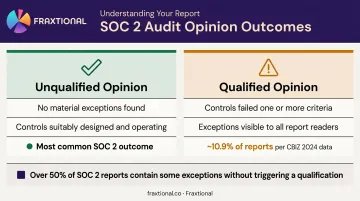
That professional opinion can go one of two ways. An unqualified opinion means no material exceptions were found — the outcome most organizations are working toward. A qualified opinion signals that controls were not suitably designed or didn't operate effectively against one or more criteria, and every reader of that report will see it.
Control exceptions and qualified opinions are not the same thing. According to CBIZ's 2024 SOC Benchmark Report, over half of reviewed SOC 2 reports contained some control exceptions, while only about 10.9% received qualified opinions — meaning auditors apply materiality judgment before qualifying a report.
Why SOC 2 Attestation Matters for Fintech and Financial Services
SOC 2 is technically voluntary. No US law requires it. But in financial services, "voluntary" often means "you won't win the contract without it."
Enterprise and Institutional Due Diligence
Enterprise clients in financial services routinely request SOC 2 reports during vendor security reviews. The list of who asks is consistent:
- Banks evaluating fintech partners — regulators expect documented evidence of how third parties handle customer data
- Payment networks assessing service providers — SOC 2 is a standard checkpoint in onboarding due diligence
- Institutional investors conducting pre-deal reviews — particularly at Series A and beyond
As Ncontracts describes it, SOC 2 reports help banks assess how critical vendors manage customer data stored in the cloud — precisely the kind of evidence regulators expect before a third-party relationship begins.
The Sponsor Bank and Investor Dimension
For fintechs pursuing sponsor bank relationships or raising capital, a SOC 2 report functions as a credibility marker. Sponsor banks face regulatory pressure to conduct thorough due diligence on their fintech partners. Investors at Series A and beyond increasingly treat SOC 2 as a baseline expectation during pre-deal reviews.
Getting there requires more than checking boxes. Fraxtional's fractional CCO and CRO engagements support fintechs through this process directly — mapping controls to Trust Service Criteria, building audit evidence packages, and aligning policy documentation to what sponsor banks and investors actually want to see.
Geographic Reach
SOC 2 originated in the US but is widely accepted in international markets. UK organizations dealing with US counterparties encounter SOC 2 regularly, though for broader international coverage, SOC 2 is often paired with an ISAE 3000 report — the international assurance standard recognized across Europe. SOC 2 does not replace GDPR or HIPAA; it complements them.
The Five SOC 2 Trust Services Criteria
The Trust Services Criteria (TSC), developed by the AICPA and last updated with revised points of focus in 2022, define what SOC 2 auditors actually examine. Organizations choose which criteria to include based on their business model, customer commitments, and risk profile.
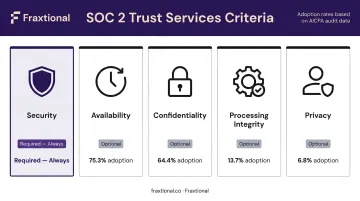
| Criterion | Required? | What It Covers |
|---|---|---|
| Security | Yes — always | Nine control families including risk assessment, logical access, change management |
| Availability | Optional | System uptime, redundancy, and recovery controls |
| Confidentiality | Optional | Protections for data designated confidential under client agreements |
| Processing Integrity | Optional | Accuracy and completeness of data processing and transactions |
| Privacy | Optional | Handling of personally identifiable information (PII) |
How Organizations Actually Choose Criteria
According to CBIZ's 2024 SOC Benchmark Report, Availability was included in 75.3% of reviewed SOC 2 reports, Confidentiality in 64.4%, Processing Integrity in 13.7%, and Privacy in just 6.8%. These figures come from a specific sample rather than a universal census, but they give a reliable read on what most service organizations actually prioritize.
Those adoption rates also reflect how the criteria map to different business types. Security is the non-negotiable foundation — its nine Common Criteria families (CC1 through CC9) cover the control environment, risk assessment, logical and physical access controls, system operations, and change management. Every SOC 2 audit includes all nine.
Processing Integrity applies primarily to organizations whose core service involves financial transaction processing or data transformation. Privacy is the most demanding optional criterion, and FinTech or crypto firms handling personal data at scale — particularly those operating under CCPA or with EU customers under GDPR — should expect it to require the most preparation.
How the SOC 2 Attestation Process Works
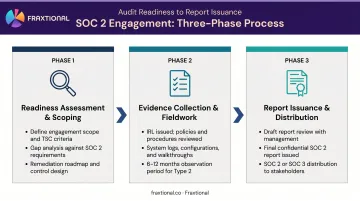
SOC 2 is a structured engagement between your organization and a licensed CPA firm. The total timeline varies — a first-time engagement typically runs 3 to 9 months from initial preparation to final report, depending on organizational readiness, the number of criteria in scope, and whether you're pursuing Type 1 or Type 2.
Only AICPA-accredited CPA firms can conduct and issue a SOC 2 report. Choosing an experienced audit partner early — and deciding whether to use compliance automation software — has a real impact on cost, timeline, and report quality.
Phase 1: Readiness Assessment and Scoping
This is the most important phase, and the one most organizations underinvest in. Before the formal audit begins:
- Define the audit scope — which systems, services, and TSC are in scope
- Conduct a gap analysis against TSC controls
- Remediate identified deficiencies before fieldwork starts
Organizations that arrive at Phase 2 with unresolved gaps face delays, additional auditor time, and potential exceptions in the final report.
Fractional compliance leadership is one practical solution here. A part-time CCO or compliance director — through a firm like Fraxtional — can own the readiness process and map controls to how the business actually operates, preparing audit-ready documentation without pulling engineering or operations teams off their core work.
Phase 2: Evidence Collection and Fieldwork
Once fieldwork begins, the auditor issues an Information Request List (IRL) — a structured list of evidence required to test each control. This typically includes:
- Security policies and procedures
- Access logs and user provisioning records
- System configuration documentation
- Process walkthroughs and interviews
For Type 2, this observation period runs for the full review window (typically 6–12 months). Automated evidence collection tools can reduce the manual effort involved in gathering and organizing this documentation.
Phase 3: Report Issuance and Distribution
After fieldwork, the auditor issues a draft SOC 2 report for organizational review before finalizing. The final report is confidential, shared only under NDA with customers, prospects, and institutional partners. Two distribution options exist:
- SOC 2 report: Full confidential report shared under NDA
- SOC 3 report: Covers the same subject matter in a format designed for public distribution and marketing use
SOC 2 Type 1 vs. Type 2: Choosing the Right Attestation
Type 1: Point-in-Time Design Assessment
Type 1 answers one question: are your controls suitably designed to meet the selected TSC as of a specific date? It confirms the presence and design of controls — not whether they've been operating consistently.
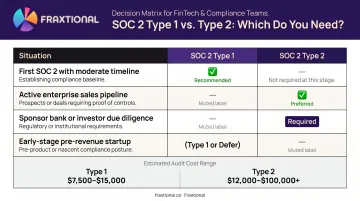
Type 1 is faster and less expensive. According to estimates from Drata, Type 1 costs typically range from $7,500 to $15,000 for small to midsize organizations. For organizations pursuing SOC 2 for the first time with a clear deadline pressure, Type 1 provides a legitimate initial trust signal.
Type 2: Operating Effectiveness Over Time
Type 2 is what most enterprise clients actually want. It assesses whether controls operated effectively over a defined review period — typically 6 to 12 months. The auditor must observe controls functioning consistently throughout that window, not just confirm they exist.
Type 2 costs more: Drata estimates $12,000 to $20,000 for small to midsize organizations, and $30,000 to $100,000+ for large ones. Vanta estimates the total cost of achieving SOC 2 — including preparation — at $10,000 to $80,000 or more, depending on organizational complexity and tooling choices.
Which to Choose
The right choice depends on who's asking and why:
| Situation | Recommended Approach |
|---|---|
| First SOC 2, moderate timeline pressure | Type 1 to establish baseline, then Type 2 at next cycle |
| Active enterprise sales pipeline | Type 2 expected; Type 1 may buy time but rarely closes sophisticated deals |
| Sponsor bank or investor due diligence | Type 2 — banks and investors rarely accept Type 1 as sufficient |
| Early-stage startup, pre-revenue | Type 1 or defer until controls are mature enough to support Type 2 |
Renewal and Bridge Letters
SOC 2 reports are generally accepted for approximately 12 months after issuance. Key renewal facts to keep in mind:
- Most organizations renew annually to maintain continuous coverage
- When a new audit is underway but the previous report has expired, a bridge letter fills the gap — an interim document from the auditor covering the transition period
- Bridge letters are not a substitute for a new report, but they are widely accepted in sales and partnership due diligence conversations while the audit is in progress
Common Misconceptions About SOC 2 Attestation
"We passed our SOC 2"
SOC 2 produces an auditor's opinion, not a pass/fail result. A clean report means no material exceptions were found and the auditor issued an unqualified opinion. Calling it a "pass" overstates what the report says — and sophisticated enterprise buyers or institutional partners who read the actual report will notice the mismatch.
"SOC 2 is a one-time exercise"
This is the most costly misconception. Many organizations complete SOC 2 for a specific deal and then let controls drift. For Type 2, controls must operate consistently throughout the review period. Gaps discovered between audit cycles will surface in the next report as exceptions — potentially triggering a qualified opinion and undermining the trust you built with the previous clean report.
"Our Security-only scope covers everything we need"
A Security-only scope is appropriate for some organizations, but enterprise buyers in regulated industries frequently ask whether additional Trust Service Criteria are covered. Buyers in the following sectors commonly request broader scope:
- Financial services: Availability and Confidentiality criteria for vendor due diligence
- Healthcare: Privacy criteria for HIPAA-adjacent data handling reviews
- Government/enterprise: Full criteria coverage to avoid supplemental questionnaires
A narrowly scoped report may trigger exactly the security questionnaires SOC 2 was meant to replace. Scope decisions should be driven by your target customer profile, not by what minimizes audit cost.
Frequently Asked Questions
What is a SOC 2 attestation?
SOC 2 attestation is a formal report issued by a licensed CPA firm evaluating whether a service organization's controls meet the AICPA's Trust Services Criteria. It is not a certification — no certifying body exists, no pass/fail outcome is issued, and no badge is awarded. The output is an auditor's professional opinion.
What is a SOC 2 Type 2 certification?
"SOC 2 Type 2 certification" is a common but technically incorrect phrase. The correct term is SOC 2 Type 2 attestation. It evaluates whether an organization's controls operated effectively over a defined period, typically 6 to 12 months.
Is SOC 2 recognized in the UK?
SOC 2 is a US-origin standard but is increasingly accepted by UK organizations, particularly those doing business with US companies. For broader international coverage, UK organizations often pair SOC 2 with an ISAE 3000 report — the international assurance framework recognized across Europe and aligned with global non-financial assurance standards.
What is the difference between SOC 2 Type 1 and Type 2 attestation?
Type 1 assesses whether controls are suitably designed at a specific point in time. Type 2 assesses whether those same controls operated effectively over a defined review period (typically 6–12 months). Type 2 carries significantly more commercial weight with enterprise clients and institutional partners.
How long does the SOC 2 attestation process take?
Type 1 fieldwork typically takes 2–4 weeks once controls are ready. Type 2 requires a 6–12 month observation period plus fieldwork time. First-engagement timelines — preparation through final report — generally run 3 to 9 months total.
Is SOC 2 attestation legally required?
SOC 2 is a voluntary standard. No law mandates it, but it functions as a practical prerequisite in many B2B contexts — particularly in financial services, where enterprise clients and institutional partners require a current SOC 2 report as a condition of vendor engagement.