Introduction
SOC 2 compliance has moved from a "nice to have" to a hard requirement across fintech and financial services. Enterprise customers ask for it before signing. Sponsor banks flag it during onboarding reviews. Investors request it during due diligence. Many organizations still enter the formal audit process without a clear picture of where their controls actually stand.
The cost of that unpreparedness is real. Discovering a material control gap after an auditor is already engaged delays attestation, stalls deal timelines, and raises questions with the exact stakeholders you need on your side.
According to IBM's 2024 analysis, financial organizations spend an average of $6.08 million dealing with data breaches — 22% above the global average. Unresolved gaps in your control environment carry direct financial consequences, not just compliance ones.
A SOC 2 gap analysis prevents these outcomes by surfacing weaknesses before they become audit findings. This guide covers what a gap analysis is, why it matters specifically for fintech and compliance-driven businesses, how to run one step by step, and what the most common deficiencies look like in practice.
Key Takeaways
- A SOC 2 gap analysis maps your existing controls against the AICPA's Trust Services Criteria to find what needs fixing before audit
- The output is a prioritized remediation roadmap, not an attestation
- The most common gaps are access control weaknesses, missing or outdated policies, poor vendor management, and insufficient monitoring
- For fintech companies, closing these gaps protects sponsor bank and investor relationships — not just audit outcomes
- Fractional compliance leadership covers this process at a fraction of the cost of a full-time hire
What Is a SOC 2 Gap Analysis?
A SOC 2 gap analysis is a structured pre-audit evaluation that measures the distance between your current security controls and the requirements defined in the AICPA's Trust Services Criteria (TSC). It is not a formal attestation — no opinion is issued, no report is certified. The objective is diagnostic: map what you have against what SOC 2 requires, and surface what's missing before an auditor does it for you.
The Five Trust Services Criteria
SOC 2 reports are built around five criteria:
| Criterion | Scope |
|---|---|
| Security | Logical and physical access controls, threat detection, incident response |
| Availability | System uptime and performance commitments |
| Processing Integrity | Complete, accurate, timely processing of data |
| Confidentiality | Protection of designated confidential information |
| Privacy | Collection, use, and disposal of personal information |
Security appeared in 100% of SOC 2 reports analyzed in CBIZ's 2024 SOC Benchmark Study. Availability was included in 75.3% of reports, and Confidentiality jumped from 34% to 64% year-over-year — driven by rising customer pressure around how companies handle sensitive data.
The criteria you include depend on what data you process and what commitments you've made to customers. A fintech handling payment data and PII will almost always need Security, Availability, and Confidentiality at minimum.
Gap Analysis vs. Gap Letter
These two terms are related but distinct. A gap analysis is the assessment process itself. A gap letter is the written deliverable — typically outlining identified deficiencies, their risk level, and a proposed remediation timeline.
Gap letters are commonly shared with auditors, board members, or investors to document the organization's compliance trajectory and show a clear remediation path.
Why SOC 2 Gap Analysis Matters for Fintech and Compliance-Driven Businesses
Audit Readiness
Organizations that complete a thorough gap analysis before engaging an auditor consistently see fewer findings, cleaner audit cycles, and faster time to attestation. The reason is straightforward: remediation happens proactively rather than under auditor scrutiny. Common delays — missing documentation, unclear policy ownership, weak audit trails — get resolved before they become formal exceptions.
ISACA recommends performing a readiness assessment to identify gaps between the TSC and your internal control environment specifically before beginning a SOC 2 audit. That guidance reflects what experienced practitioners see in practice: rushing into the formal audit without it leads to audit delays, rework, and avoidable auditor time charges.
Stakeholder Trust and Business Development
For fintech, crypto, and embedded finance companies, SOC 2 signals to enterprise customers and institutional partners that security and data handling meet recognized standards. The CBIZ benchmark found that the most common motivation for obtaining a SOC report is a request from a customer or vendor seeking assurance over the control structure.
A gap analysis ensures that signal is credible. Completing one — even before formal attestation — demonstrates compliance maturity to the sponsor banks and investors evaluating organizational readiness, not just checking for a certificate.
Risk Mitigation and Resource Efficiency
Stakeholder trust is one reason to run a gap analysis. Actual risk exposure is another. The 2025 Verizon Data Breach Investigations Report found that third-party involvement in breaches doubled from 15% to 30% year over year — a direct concern for payments and BaaS companies relying on cloud infrastructure, payment processors, and banking partners.
The resource case is just as practical. Knowing exactly where controls are missing lets leadership direct remediation effort precisely:
- Avoid over-investing in areas that are already well-controlled
- Focus time and budget on high-risk gaps that auditors — and attackers — will find first
How to Conduct a SOC 2 Gap Analysis: Step by Step
Most gap analysis failures aren't methodological — organizations don't fail because they skipped a step. They fail because they rushed scoping, underestimated the documentation burden, or didn't assign clear ownership to remediation tasks. Here's a process that avoids those pitfalls.
Step 1: Define Scope and Applicable Trust Services Criteria
Start by identifying which TSC apply to your organization based on:
- What data you collect and process (PII, financial data, credentials)
- What uptime or processing commitments you've made to clients
- What your auditor or enterprise customers will expect
Getting scope wrong here cascades into wasted remediation effort. Fintech companies handling personal financial information typically need Security, Availability, and Confidentiality. Adding criteria after the assessment has started means re-work.
Step 2: Inventory Data, Assets, and Data Flows
Map your environment across four dimensions:
- What: types of data in scope (PII, financial data, access credentials, payment records)
- Where: storage locations across cloud services, databases, and third-party platforms
- How: data movement through systems and integrations
- Who: roles and accounts with access to each asset
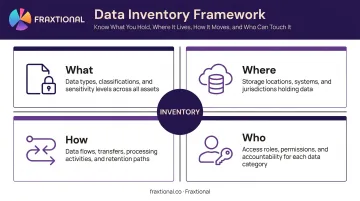
This inventory is the foundation every subsequent control evaluation is built on. If you don't know what data you have and where it lives, you can't accurately assess whether it's protected.
Step 3: Review and Map Existing Controls
Conduct a structured review of current policies, technical configurations, access controls, and documented procedures. Map each against the applicable TSC criteria.
Many organizations discover they already satisfy certain controls by default — particularly around infrastructure managed by compliant cloud providers. The goal is to document what genuinely exists and identify what's absent or insufficient. Assumed controls that aren't documented provide no audit defense.
Step 4: Identify Gaps and Assess Risk
Compare mapped controls against SOC 2 requirements to produce a prioritized gap list. Assess each finding across three dimensions:
- Impact: the potential damage if this gap is exploited (data exposure, downtime, audit failure)
- Likelihood: how probable a failure or incident is given current controls
- Remediation complexity: the time, cost, and technical effort required to close the gap
Not all gaps carry equal weight. A missing MFA requirement on a production system is a higher priority than an outdated version note in a secondary policy document. Without that prioritization, teams burn time on low-risk findings while critical exposures sit unaddressed.
Step 5: Build a Remediation Plan
Translate the prioritized gap list into a roadmap with specific actions, assigned owners, realistic timelines, and defined success criteria. Fraxtional structures these deliverables using a Risk Prioritization Matrix with effort vs. impact sorting, so the output is usable by both technical teams and leadership — not just a spreadsheet that gets filed away.
Stage matters here. Early-stage companies may rely on manual controls initially. More mature organizations should target automated, scalable controls that don't require human intervention to remain effective.
Step 6: Implement, Monitor, and Reassess
Execute remediation, collect evidence of implementation, and establish continuous monitoring to prevent compliance drift between audits. SOC 2 is a continuous exercise, not an annual checkbox. Annual reassessments and ongoing monitoring are required to maintain both attestation and a defensible security posture.
The Most Common SOC 2 Compliance Gaps
Every organization's control environment is different, but certain deficiencies appear with striking consistency. The CBIZ 2024 SOC Benchmark Study found that 54.9% of SOC 2 reports contained exceptions — up from 51% the prior year — with qualified opinions rising from 8% to 10.9%.
Here's where those exceptions tend to cluster.
Access Controls and User Access Reviews
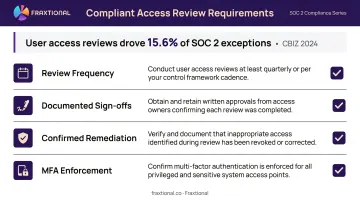
The top two exception reasons in the CBIZ benchmark were business approvals/reviews (16.5%) and user access reviews (15.6%). User access reviews also became the primary driver of qualified opinions — meaning they weren't just exceptions, they were report-level problems.
A compliant access review process requires:
- Defined review frequency (quarterly for privileged accounts, at minimum annually for standard users)
- Documented reviewer sign-offs on each review cycle
- Confirmed remediation of any flagged access — not just flagging
- MFA enforced on production systems and administrative accounts
Personnel Offboarding and Termination Processes
Terminations accounted for 12% of exceptions in the benchmark data. The pattern is consistent: HR notifies IT informally or with delay, access lingers across systems after departure, and no one can produce documentation that revocation was confirmed.
A formalized offboarding procedure needs to cover:
- Documented notification timelines from HR to IT
- Ticketing system tracking for each offboarding event
- Confirmed access revocation across all in-scope systems, including third-party tools
Incomplete or Outdated Policies and Procedures
Many organizations either lack formal security policies or have documentation that hasn't been touched in years. Policies need to be actively maintained — reviewed at least annually, accessible to relevant personnel, and tied to actual operational practices.
A policy audit should confirm:
- Annual review dates are documented with named reviewers
- Policies reflect current systems, tools, and workflows — not a prior architecture
- Relevant personnel can demonstrate awareness of applicable procedures
Third-Party and Vendor Risk Management
Companies frequently lack a structured vendor risk framework: no inventory, no risk tiering, no defined assessment cadence. For fintech and BaaS companies that depend on cloud infrastructure, payment processors, and banking partners, this is a significant gap. The AICPA's TSC CC9.2 directly requires documented controls for managing risks associated with vendors and business partners — not a checkbox item.
A mature vendor management program includes:
- A complete inventory of vendors with access to in-scope systems or data
- Risk tiering based on access level and criticality
- Security assessment cadence tied to risk tier
- Contractual security requirements for critical third parties
Insufficient Logging, Monitoring, and Incident Response
Missing or incomplete system logs, absent alerting mechanisms, and undocumented incident response procedures appear consistently in gap assessments. SOC 2's TSC CC7.1, CC7.2, and CC7.4 collectively require organizations to detect anomalous activity, monitor system components, and execute a defined incident response program.
General awareness that incidents can happen doesn't satisfy this requirement. A defensible program requires:
- Defined escalation paths with named roles and response timelines
- Documented investigation workflows tied to specific incident categories
- Evidence of testing — tabletop exercises, post-incident reviews, or simulation records
How Fraxtional Can Help You Identify and Close Compliance Gaps
Fraxtional is a fractional compliance leadership firm serving fintech, crypto, and banking companies across the US, Canada, UK, and EU. The firm's founder, Ryan Cimo, was recognized as one of the Top 100 Leaders in Finance for 2024 — an acknowledgment of Fraxtional's track record across the sectors where SOC 2 compliance intersects directly with regulatory and business risk.
For companies at seed through Series B, engaging a fractional compliance leader to lead or oversee a SOC 2 gap analysis delivers institutional-grade rigor without the overhead of a full-time hire.
What that engagement looks like in practice:
- Every client works directly with experienced compliance Directors — no handoffs to junior staff
- Controls are mapped to how your business actually operates, not a generic checklist
- Directors bring cross-regulatory familiarity with BSA/AML, UDAAP, Reg E, privacy, and cyber risk — gap findings reflect the full regulatory environment your company operates in, not the TSC alone
- Documentation is organized and audit-ready, structured for board reviews, bank evaluations, and auditor scrutiny
- Engineering and operations teams are kept light — the process doesn't pull your core team off their work

For a one-time SOC 2 gap analysis, Fraxtional's On Demand Advisory model is typically the right fit: a flat-fee engagement with access to multiple Directors, scoped to the specific deliverable.
For companies that need ongoing fractional compliance leadership to build and sustain their program beyond the initial gap analysis, Subscription or Fractional Advisory engagements scale accordingly.
Fraxtional's work is trusted by sponsor banks and investors in pre-deal reviews. That means a gap analysis led by their team carries weight in due diligence conversations — with the documentation and control mapping to back it up.
Frequently Asked Questions
What is a SOC 2 gap analysis?
A SOC 2 gap analysis is a structured pre-audit assessment that compares your current security controls against the AICPA's Trust Services Criteria. It identifies deficiencies that need to be addressed before a formal audit and produces a prioritized remediation roadmap — it is not itself a certification or attestation.
What is a SOC 2 gap letter?
A SOC 2 gap letter is a written document summarizing the findings of a gap analysis — typically outlining identified control deficiencies, their risk level, and a proposed remediation timeline. It is shared with auditors, board members, or investors to signal audit readiness and current compliance standing.
What are the 5 principles of SOC 2?
The five Trust Services Criteria are Security, Availability, Processing Integrity, Confidentiality, and Privacy. Security appeared in 100% of SOC 2 reports analyzed in the CBIZ 2024 benchmark. Organizations select additional criteria based on their service commitments and the nature of the data they handle.
What is SOC 1 vs SOC 2 vs SOC 3?
SOC 1 addresses internal controls relevant to financial reporting. SOC 2 addresses controls related to security, availability, processing integrity, confidentiality, and privacy of customer data. SOC 3 covers the same subject matter as SOC 2 but is a general-use, public-facing summary without the full technical detail.
How long does a SOC 2 gap analysis take?
Most gap analyses take between two and eight weeks depending on organizational size, complexity, and the current state of documentation. With clear scope and experienced compliance leadership, the process can move quickly and translate directly into an actionable remediation roadmap.
How often should you perform a SOC 2 gap analysis?
Perform a gap analysis at least annually, and always before each SOC 2 audit renewal. Any significant change to systems, personnel, or data processing activities should also trigger a fresh review.